SZTUKA
Piękno i dobre samopoczucie
RZEMIOSŁO
KULTURA I HISTORIA
ROZRYWKA
ŚRODOWISKO
JEDZENIE I NAPOJE
ZIELONA PRZYSZŁOŚĆ
INŻYNIERIA ODWROTNA
NAUKI
LEKKOATLETYKA
TECHNOLOGIA
URZĄDZENIA DO NOSZENIA
Building a Celestial Globe — Mapping the Stars on a Sphere
Astro

Autor

Astro

30. maj 2026IS
0
0
0
0
0

Building a Celestial Globe — Mapping the Stars on a Sphere

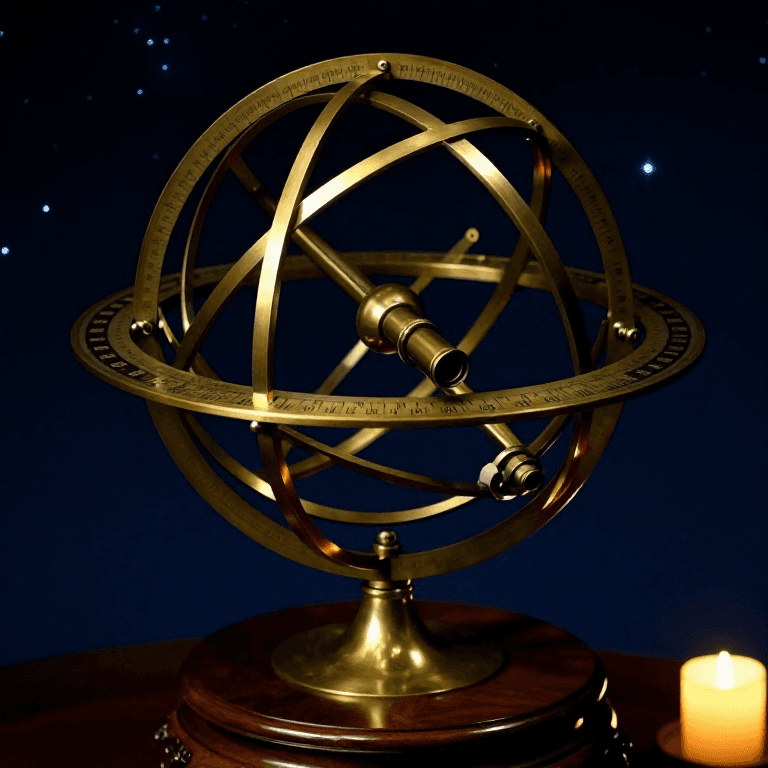
A celestial globe is a sphere with the stars, constellations, and celestial coordinate lines marked on its outer surface — a three-dimensional map of the night sky as seen from the outside looking in. Unlike a star chart, which distorts the shapes of constellations through projection, a globe preserves the true angular relationships between stars. Islamic astronomers of the 9th–13th centuries produced the finest celestial globes, casting them in bronze and engraving hundreds of star positions with remarkable accuracy. When mounted in a stand tilted to the observer's latitude and oriented to the current sidereal time, the globe shows exactly which stars are above the horizon at any moment, which are rising, and which are setting. This blueprint builds a functional celestial globe from a wooden or papier-mâché sphere, marked with the brightest stars and the major constellations, mounted in a tilting stand with horizon and meridian rings — accurate enough to plan an evening's stargazing or demonstrate the motions of the celestial sphere.

Zaawansowany
15-25 hours

Instrukcje

1

Prepare the sphere

Start with a smooth sphere about 20-30 cm in diameter. You can use a wooden ball turned on a lathe, a commercially available papier-mâché sphere, or build one up by layering papier-mâché over an inflated balloon. The surface must be smooth enough to draw and write on. Sand the sphere with fine sandpaper and apply a coat of white primer or gesso to create a clean drawing surface. Mark the north and south poles — these are where the axis of rotation will pass through the sphere.

Materiały do tego kroku:

Hardwood BlockHardwood Block1 sztuka

Tools needed:

Fine Sandpaper
2

Draw the celestial equator and poles

Insert a thin rod or pin through the north and south poles to serve as the polar axis. The celestial equator is the great circle exactly halfway between the two poles — mark it by holding a pencil at a fixed height while rotating the sphere on its axis. The equator divides the sphere into northern and southern hemispheres. Mark the equator clearly with a continuous line and divide it into 360 degrees (or 24 hours of right ascension, where each hour equals 15 degrees).

Tools needed:

DividersDividers
3

Draw the ecliptic

The ecliptic is the Sun's annual path through the zodiac — a great circle tilted 23.5 degrees from the celestial equator. It crosses the equator at two points: the vernal equinox (0 hours right ascension) and the autumnal equinox (12 hours). Mark these crossing points on the equator, then draw the ecliptic as a great circle passing through them, reaching 23.5 degrees north of the equator at the summer solstice point and 23.5 degrees south at the winter solstice. Divide the ecliptic into the twelve zodiac signs, each spanning 30 degrees.
4

Draw the declination circles

Draw circles of constant declination at useful intervals: the Tropic of Cancer (23.5°N), the Tropic of Capricorn (23.5°S), and circles at every 10 degrees of declination from the equator to the poles. These latitude-like lines help locate star positions. Draw them by holding a pencil at the correct angle while rotating the sphere. Also draw hour circles (lines of constant right ascension) at every hour or every 2 hours — these are great circles passing through both poles, like longitude lines.
5

Plot the brightest stars

Using a star catalogue, plot the positions of at least 30-50 of the brightest stars. For each star, find its right ascension (position along the equator) and declination (angular distance from the equator). Mark the position on the globe with a dot sized proportional to the star's brightness — larger dots for brighter stars. Label each star with its common name. Essential stars include: Sirius, Canopus, Arcturus, Vega, Capella, Rigel, Procyon, Betelgeuse, Altair, Aldebaran, Antares, Spica, Pollux, Fomalhaut, and Deneb.
6

Draw the constellation figures

Connect the stars of each constellation with lines showing the traditional stick-figure patterns. The 48 classical constellations catalogued by Ptolemy cover the sky visible from the Mediterranean. At minimum, draw the most recognizable: Ursa Major (Big Dipper), Ursa Minor (Little Dipper), Orion, Cassiopeia, Leo, Scorpius, Taurus, Gemini, Cygnus, Lyra, Aquila, Pegasus, and the zodiac constellations along the ecliptic. Remember that on a celestial globe the constellations appear mirror-reversed compared to how they look in the sky — this is correct, because the globe shows the sky as seen from the outside.
7

Add the Milky Way

Paint or shade the band of the Milky Way across the globe. It runs as an irregular band roughly 10-30 degrees wide, passing through Cassiopeia, Cygnus, Aquila, Sagittarius, Scorpius, Centaurus, Carina, and back around through Monoceros, Gemini, Auriga, and Perseus. The Milky Way band is densest toward the galactic centre in Sagittarius and splits into two branches in Cygnus (the Great Rift). Use a light grey wash or stippled dots to indicate the Milky Way without obscuring the constellation lines beneath.
8

Seal and finish the globe surface

Apply a thin coat of clear varnish or lacquer over the entire globe to protect the markings from handling. Use a matte or satin finish — gloss reflects light and makes the markings hard to read. Allow it to dry completely. The varnish also prevents the ink from smudging and protects the surface from humidity.
9

Build the meridian ring and stand

Bend a brass strip into a ring that fits around the globe with about 1 cm clearance — this is the meridian ring. Graduate it with degree markings from 0 at the equator to 90 at the poles. The globe sits inside this ring and pivots on the polar axis. Build a wooden base with a vertical support column and a semicircular cradle that holds the meridian ring tilted at an angle equal to 90 minus your latitude — so the polar axis points toward the celestial pole.

Materiały do tego kroku:

Brass StripBrass Strip2 metrów

Tools needed:

Diamond ScriberDiamond Scriber
10

Add the horizon ring

Cut a flat wooden or brass ring that sits horizontally in the stand at the equator level of the tilted globe — this represents the observer's horizon. When the globe is correctly oriented for your latitude, the horizon ring divides the globe into the visible sky (above) and the hidden sky (below the horizon). Stars on the eastern edge of the horizon ring are rising; stars on the western edge are setting. Graduate the horizon ring with compass bearings — north, south, east, west, and intermediate points.
11

Mount and orient the globe

Place the globe in its stand with the north pole tilted toward true north. Rotate the globe until the current sidereal time aligns with the meridian ring overhead. Now the globe shows the exact configuration of the night sky: stars above the horizon ring are visible, the star at the zenith is directly overhead, and the eastern horizon shows which constellations are about to rise. Rotating the globe forward simulates the passage of time — one full rotation equals 23 hours 56 minutes.
12

Use the globe to plan observations

To find when a specific star or constellation rises tonight: rotate the globe until that object crosses the eastern horizon ring, and read the time from the hour scale on the equator aligned with the meridian. To find the best time to observe a deep-sky object: rotate until it reaches its highest point (crossing the meridian ring at the top). The celestial globe makes the motions of the sky intuitive in a way that flat star charts cannot — you are holding the entire sky in your hands, just as Islamic astronomers did a thousand years ago.

Materiały

2

Wymagane narzędzia

3

Materiały z połączonych planów

CC0 Domena publiczna

Ten plan jest udostępniany na licencji CC0. Możesz go swobodnie kopiować, modyfikować, rozpowszechniać i wykorzystywać do dowolnych celów, bez konieczności uzyskiwania zgody.

Wesprzyj Makera kupując produkty przez jego plan, za co zarabia Prowizja Makera ustalony przez sprzedawców, lub stwórz nową iterację tego planu i dołącz go jako połączenie w swoim własnym planie, aby dzielić się przychodami.

Dyskusja

(0)

Zaloguj się aby dołączyć do dyskusji

Ładowanie komentarzy...