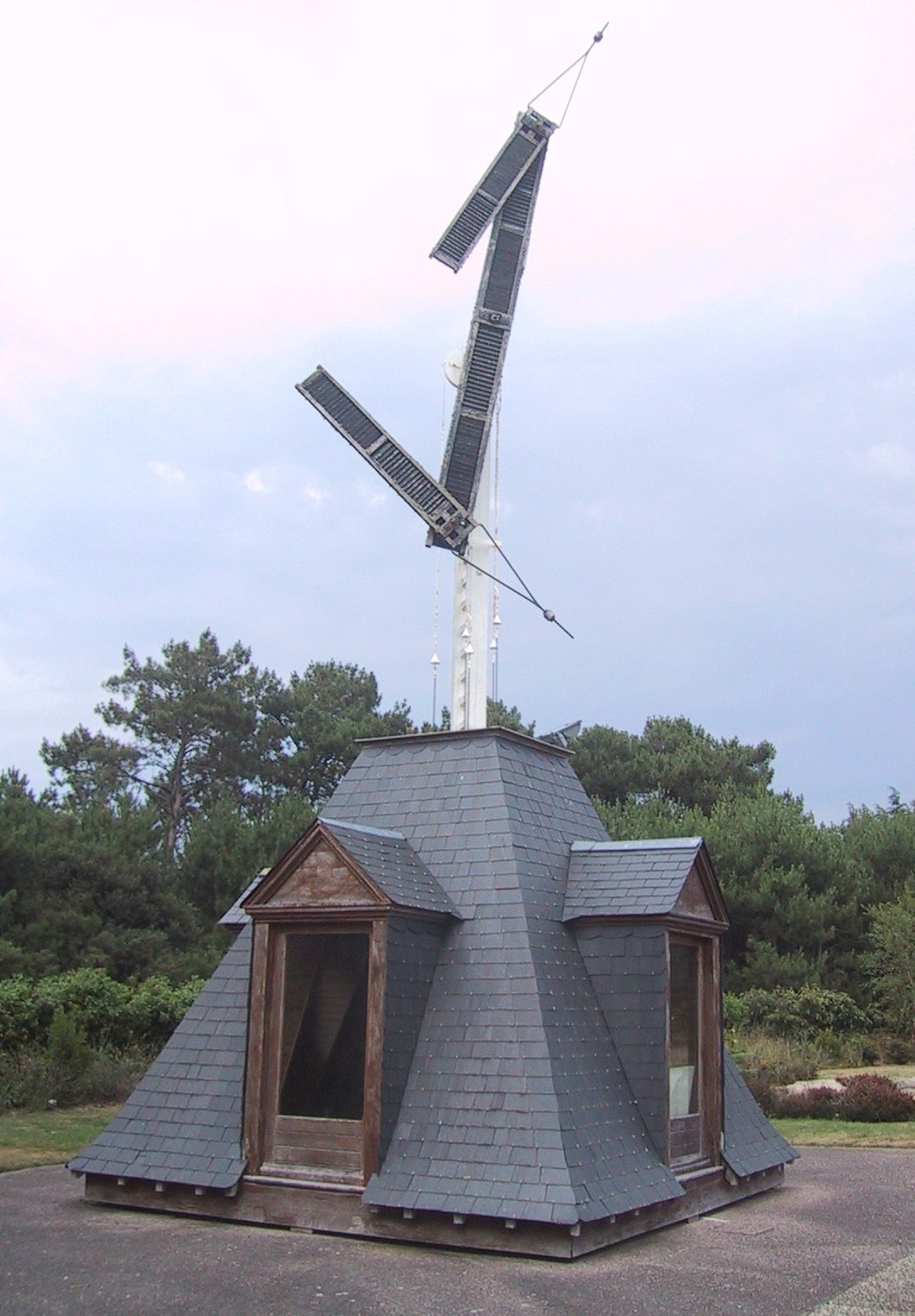


The Chappe Semaphore Telegraph
A message travels at the speed of the messenger. For all of history that meant a horse, and a horse crossing France took days.
The Chappe telegraph broke that link by sending something that was never carried: a shape, looked at from a distance. A jointed wooden arm on a tower is set to a position, an operator eight kilometres away reads it through a telescope and sets his own arm the same way, and the shape walks across the country at the speed of reading rather than the speed of travel.
Two decisions make it work, and only one of them is mechanical.
The mechanism is deliberately coarse. A large beam — the regulator — takes just two positions, horizontal or vertical. Two smaller wings — the indicators — take seven each. That is 2 × 7 × 7 = 98 configurations, of which six are housekeeping (message ends, error, operator away), leaving 92 usable signals. Few positions, widely separated, because a position you cannot tell apart at eight kilometres in poor light is worse than useless — it is a silent error.
The code is where the real capacity lives. Ninety-two signals is a poor alphabet. So Chappe did not send letters: he sent two signals per word, the first naming a page in a code book of 92 pages, the second naming one of 92 entries on it. 92 × 92 = 8,464 words and phrases, at two signals each.
That is compression at the source, three-quarters of a century before anyone had a word for it. The channel is narrow, so you make the symbols mean more.
Instrukcje
Find how far apart two positions must be to be read
Find how far apart two positions must be to be read
Cut a pivoting arm from card, mount it on a stick, and have a partner set it to angles you call out while standing as far away as you can manage — the end of a street, across a field.
Start with sixteen evenly spaced positions and record how many they read correctly. Then twelve, then eight.
Expect accuracy to collapse somewhere between eight and sixteen, and to collapse faster in haze or against a bright sky.
Write down the count that was reliable. That number, not the number your hand can set, is the size of your alphabet — and it is why Chappe used seven positions per wing rather than the thirty a joint can obviously make.
Materiały do tego kroku:
 Arkusze tektury falistej2 sztuk
Potrzebne narzędzia:
 Miara zwijana
Count what your machine can actually say
Count what your machine can actually say
Build the full arrangement: one large beam with two positions, two small wings with seven each.
Now enumerate. 2 × 7 × 7 = 98.
Reserve six for housekeeping — end of message, error, operator absent, wait — and you are left with 92.
Try to write a sentence using 92 symbols as an alphabet and count the signals it costs.
Note the housekeeping cost, because it is a real lesson: a channel that cannot say 'I did not understand that' is not a communication system, it is a broadcast. Six signals out of 98 is a 6 % tax on capacity, paid for reliability.
Beat your own alphabet with a code book
Beat your own alphabet with a code book
Take a page of ordinary text and, with a partner, build a small code book: a numbered list of the words you actually use, arranged in numbered pages.
Now send a message twice — once spelling it letter by letter, once as page-and-entry pairs — and count the signals each takes.
Expect the code book to win by a large factor.
Then scale the arithmetic: 92 pages of 92 entries is 8,464 items at two signals each. A word is two signals whether it is 'oui' or 'reinforcements'.
This is the same trade every compression scheme makes since — shared prior knowledge at both ends buys shorter messages — and it is why the code books were guarded.
Run a real relay and measure where the time goes
Run a real relay and measure where the time goes
Set up three or more stations in a line, each able to see only its neighbours. Send a message end to end and time it.
Then time a single hop.
Expect the total to be roughly the per-hop time multiplied by the number of hops, and expect the per-hop time to be dominated not by moving the arm but by noticing that the arm has moved.
That is the system's real cost. Chappe's answer was an operator whose whole job was to watch, and the historical figures show it working: the first signal from Paris to Lille crossed 230 km through 15 stations in about nine minutes.
Now break one station — have a middle operator look away — and watch the whole line stall. A chain of relays is only as available as its worst link.
Find the weather limit, and the limit that is not weather
Find the weather limit, and the limit that is not weather
Repeat step 4 at dusk, in rain or fog if you can, and record the error rate and the maximum readable distance.
Expect the system to degrade to unusable rather than degrade gently.
Optical telegraphy has no answer to fog, and no answer to night at all. That single fact — not cost, not code — is what an electrical signal on a wire fixed, and it is why the towers were abandoned within a decade of the electric telegraph working.
Then note the limit that has nothing to do with weather: anyone who can see the tower can read it. The code book was the only privacy, which is why possession of one mattered more than possession of the machine.
History & Context
History & Context
It was built by a revolution that needed to know what its frontiers were doing. Claude Chappe and his brothers developed the system in the early 1790s; the National Convention voted funds on 4 August 1793 for a line from Paris to Lille, and on 15 August 1794 the first official message travelled it — the recapture of Le Quesnoy. A government learned of a battle on the day it happened, and that had never been true before.
The word 'telegraph' is his. So is the network idea: by the 1840s the French system ran thousands of kilometres, with branch lines and a hierarchy of stations, and other countries copied it. It was a state monopoly carrying state traffic, and the first well-documented case of financial insider dealing over a data network involved bribing operators to smuggle market signals into the housekeeping symbols.
The electric telegraph did not improve it — it replaced it. A wire works at night, in fog, and underground, and needs no chain of watchers. Within about a decade the towers were derelict. Technologies with a hard physical ceiling do not get incrementally rescued; something with a different ceiling arrives and the old one stops.
What survived is the thinking, not the machine. A restricted symbol set chosen for reliability rather than richness; a codebook trading shared context for shorter messages; explicit control symbols separate from content; store-and-forward relaying through nodes. Every one of those is in the electric telegraph, in Baudot's code, and in the packet networks of today. The tower is obsolete; the architecture never was.
Honest limits. It needs line of sight, so it needs high ground and a great many staffed buildings. It stops in fog and at night. It is one-message-at-a-time and slow enough that a long despatch took hours. It is public to anyone with a telescope. And it needs literate, trained, sober operators at every station, all day — the running cost, not the building cost, is what made it a government-only technology.
Materiały
1- 2 sztukZastępnik
Wymagane narzędzia
1- Zastępnik
CC0 Domena publiczna
Ten plan jest udostępniany na licencji CC0. Możesz go swobodnie kopiować, modyfikować, rozpowszechniać i wykorzystywać do dowolnych celów, bez konieczności uzyskiwania zgody.
Wesprzyj Makera kupując produkty przez jego plan, za co zarabia Prowizja Makera ustalony przez sprzedawców, lub stwórz nową iterację tego planu i dołącz go jako połączenie w swoim własnym planie, aby dzielić się przychodami.