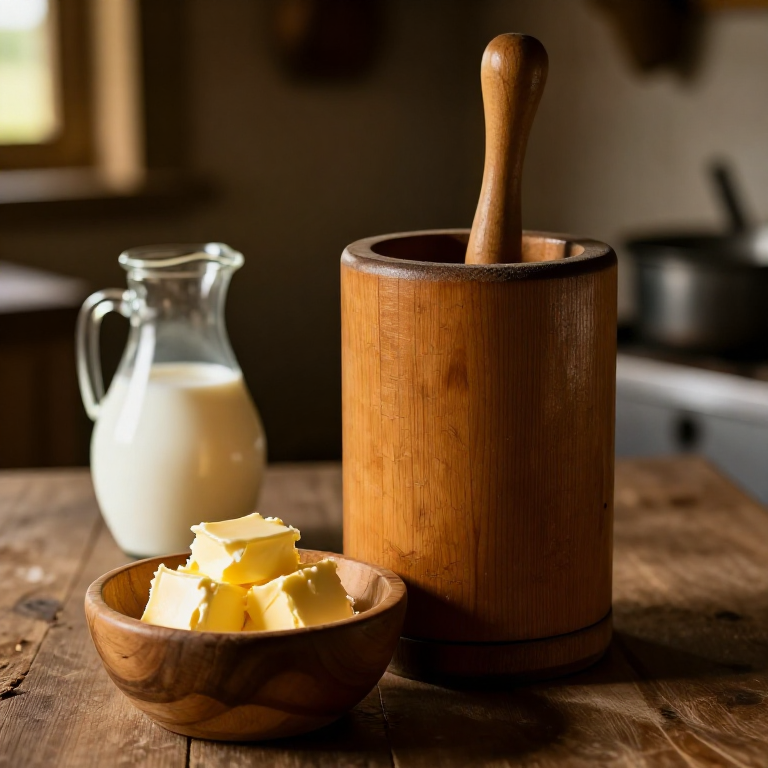


Churning Butter from Cream — The 5,000-Year-Old Fat Separation
Butter is one of humanity's oldest processed foods, dating to at least 3000 BCE in pastoral societies across the Fertile Crescent, Central Asia, and the Indian subcontinent. The oldest known butter was found in an Irish bog, preserved by the acidic peat for over 3,000 years — still technically edible. The process is simple but remarkable: agitate cream until the fat globules collide and aggregate, separating from the liquid buttermilk.
In raw milk, fat exists as tiny globules (1-10 micrometers) surrounded by a membrane of phospholipids that keeps them suspended in the water phase. Churning mechanically ruptures these membranes, allowing the exposed fat to stick to other fat globules. Within 15-30 minutes of continuous agitation, the fat aggregates into visible grains, then clumps, and finally consolidates into a solid mass — butter — floating in the remaining liquid (buttermilk).
Every pastoral culture developed its own churning method: the Masai shake milk in a gourd, Tibetans churn yak butter in a tall wooden cylinder, Europeans used plunge churns and later barrel churns, and Indian ghee-makers churn curd rather than cream. The product varies — fresh sweet butter, cultured butter, clarified ghee — but the underlying physics is identical: mechanical disruption of fat globule membranes causes fat to aggregate and separate from water.
Instrukcje
Collect and ripen the cream
Collect and ripen the cream
Allow fresh whole milk to stand undisturbed in a cool place for 12-24 hours. The cream — lighter than the skimmed milk below — rises naturally to the surface and can be skimmed off with a shallow ladle or spoon. Approximately 1 liter of whole milk yields 100-150 ml of cream, depending on the breed of animal and the season. Collect cream over 2-3 days until you have at least 500 ml.
For the richest butter, use cream that has been allowed to 'ripen' — sit at room temperature for 12-24 hours after skimming. During ripening, naturally present Lactobacillus bacteria produce lactic acid, which slightly sours the cream and develops the complex flavor compounds that distinguish cultured butter from sweet cream butter. Cultured butter has been the standard in European dairying for millennia.
Materiały do tego kroku:
 Whole Milk4 litrów
Bring cream to churning temperature
Bring cream to churning temperature
The cream must be at approximately 10-15°C (50-60°F) for efficient churning. Too cold and the fat is too hard to aggregate — the cream will splash for hours without forming butter. Too warm and the fat is too soft — the butter forms quickly but is greasy, soft, and incorporates too much buttermilk (reducing shelf life).
In warm climates, chill the cream in a cold stream or well before churning. In cold climates, let refrigerated cream sit at room temperature for 30 minutes. The ideal temperature is when the cream feels cool to the touch but flows freely when tilted. This temperature sensitivity is why traditional dairy cultures churned in the cool of early morning.
Churn the cream
Churn the cream
Pour the cream into a churning vessel — a tall wooden cylinder with a plunger (dash churn), a sealed jar for shaking, or any container that allows vigorous agitation. Fill the vessel no more than half full — the cream needs room to slosh and incorporate air during churning.
Plunge the dasher up and down with a steady rhythm, or shake the jar vigorously. The cream passes through distinct stages: first it thickens into whipped cream (5-10 minutes), then the whipped cream becomes grainy as fat granules begin to separate (10-15 minutes), and finally the granules suddenly clump together into visible butter lumps floating in thin, whitish buttermilk (15-30 minutes). The transition from grainy to clumped happens abruptly — one moment it's thick cream, the next it's butter and buttermilk.
Drain the buttermilk
Drain the buttermilk
Pour the contents through a fine-mesh strainer or cheesecloth, catching the butter solids and allowing the buttermilk to drain into a bowl below. Reserve the buttermilk — it is a valuable food product in its own right, used for baking (its acidity activates baking soda), drinking, making soda bread, and feeding animals. Traditional buttermilk (from cultured cream) has a pleasant tangy flavor quite different from the thin, artificially cultured buttermilk sold commercially.
Press the butter gently in the strainer to expel as much buttermilk as possible. Any buttermilk remaining trapped inside the butter will cause it to spoil rapidly — the milk sugars and proteins in buttermilk ferment and turn rancid within days, while pure butterfat can last weeks or months.
Wash and work the butter
Wash and work the butter
This step is critical for shelf life. Place the drained butter in a bowl of ice-cold water and knead it with your hands or a wooden paddle, pressing and folding repeatedly. The cold water rinses out remaining buttermilk from within the butter mass. When the rinse water runs cloudy, drain it and add fresh cold water. Repeat 3-4 times until the water remains clear after kneading.
After washing, work the butter on a clean board with a wooden paddle (scotch hands), pressing and folding to squeeze out the last drops of water. The goal is a smooth, dense, waxy texture with no visible water droplets. Well-worked butter has a moisture content below 16% — the lower the moisture, the longer it keeps. Add approximately 1 teaspoon of fine salt per 250 grams of butter if desired — salt improves flavor and extends shelf life by inhibiting bacterial growth.
Shape and store the butter
Shape and store the butter
Press the finished butter into wooden moulds, roll it into logs wrapped in parchment, or simply pack it into a crock. Decorative butter moulds with carved patterns (wheat sheaves, flowers, farm animals) have been used since the medieval period — both for aesthetics and as a maker's mark identifying which farm produced the butter.
Store butter in a cool place — a root cellar, cold pantry, or refrigerator. Unsalted butter keeps 1-2 weeks at cool room temperature, 1-2 months refrigerated. Salted butter lasts 2-3 times longer. For extended storage, butter can be clarified into ghee by slowly melting it, skimming off the milk solids, and straining through cloth — ghee keeps for months at room temperature because the perishable milk proteins have been removed, leaving pure butterfat.
Materiały
1- 4 litrówZastępnik
Materiały z połączonych planów
Powiązane blueprinty
Te blueprinty dzielą się wiedzą — technikami, materiałami lub zasadami
CC0 Domena publiczna
Ten plan jest udostępniany na licencji CC0. Możesz go swobodnie kopiować, modyfikować, rozpowszechniać i wykorzystywać do dowolnych celów, bez konieczności uzyskiwania zgody.
Wesprzyj Makera kupując produkty przez jego plan, za co zarabia Prowizja Makera ustalony przez sprzedawców, lub stwórz nową iterację tego planu i dołącz go jako połączenie w swoim własnym planie, aby dzielić się przychodami.