

Tube au Néon
Faire briller un gaz raréfié n'a rien de nouveau en 1910. On sait le faire depuis les tubes de Geissler et de Crookes. Le problème n'est pas d'allumer le tube, c'est de le garder allumé : au bout de quelques heures ou quelques jours, la lumière faiblit et meurt.
Deux choses tuent un tube à décharge. Le gaz n'est jamais parfaitement pur, et les impuretés faussent tout ; et les électrodes, bombardées en permanence, se vaporisent lentement et polluent ce qui reste.
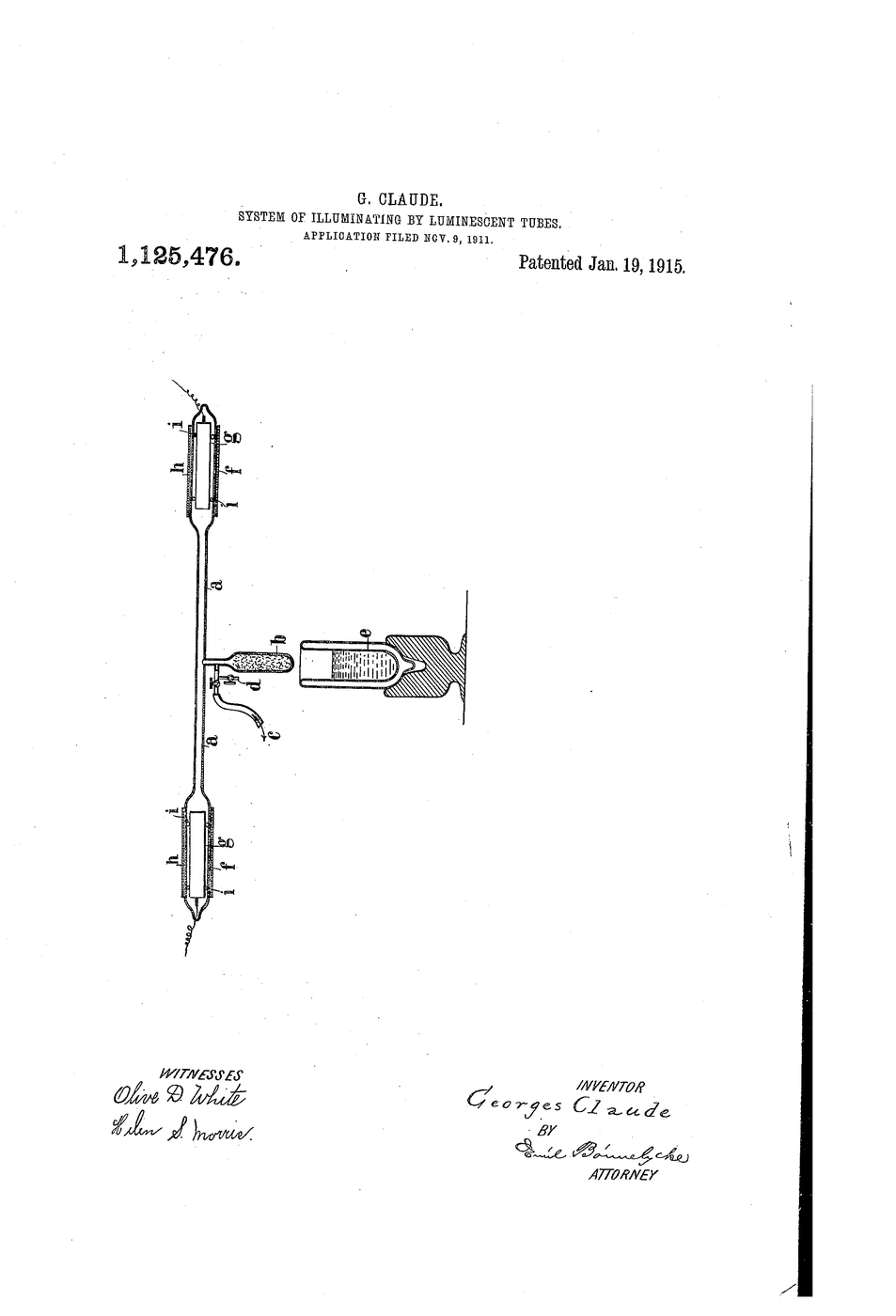
Claude s'attaque aux deux, et pas du tout à la lumière. Il purifie le gaz avec du charbon de bois ou de noix de coco refroidi à la température de l'air liquide — le charbon froid piège les impuretés et laisse le néon. Puis il donne aux électrodes une surface énorme, au moins 1,5 décimètre carré par ampère, pour que le courant s'y étale et cesse de les ronger.
Brevet US 1 125 476, « System of illuminating by luminescent tubes », déposé le 9 novembre 1911, délivré le 19 janvier 1915, à Georges Claude. Il revendique le seul cas connu d'un tube à décharge capable de fonctionner « pratiquement indéfiniment sans renouvellement du gaz ».
Instrukcje
Attention : une lampe au néon s'amorce vers 90 V
Attention : une lampe au néon s'amorce vers 90 V
Ce montage utilise une petite lampe témoin du commerce, jamais un tube d'enseigne. Limite toujours le courant par une résistance série d'au moins 100 kΩ, ne touche rien sous tension, et fais-toi accompagner par un adulte. Ne fabrique jamais un tube haute tension toi-même.
Lis le brevet et compte les deux problèmes
Lis le brevet et compte les deux problèmes
Claude ne parle presque pas de lumière. Il parle de pureté du gaz et de surface d'électrode. Le brevet est un brevet de durée de vie.
Monte la lampe avec sa résistance
Monte la lampe avec sa résistance
Câble une lampe au néon en série avec une résistance de 100 kΩ. Sans elle, la lampe s'emballe et se détruit en quelques secondes.
Materiały do tego kroku:
 Lampka neonowa sygnalizacyjna2 sztuk
Monte lentement la tension
Monte lentement la tension
Augmente la tension depuis zéro en surveillant le multimètre. Rien, rien, rien — puis la lampe s'allume d'un coup. Note cette valeur : c'est la tension d'amorçage.
Potrzebne narzędzia:
 Multimetr cyfrowy — autozakres, True RMS
Redescends et trouve la tension d'extinction
Redescends et trouve la tension d'extinction
Baisse doucement. La lampe reste allumée bien en dessous de sa tension d'amorçage. Un gaz ionisé conduit mieux qu'un gaz neutre — il faut plus pour l'allumer que pour l'entretenir.
Regarde où se trouve la lumière
Regarde où se trouve la lumière
Observe la lampe de près. La lueur orange colle à une seule électrode. Ce n'est pas un filament qui chauffe : c'est le gaz lui-même qui émet.
Compare avec une ampoule à filament
Compare avec une ampoule à filament
Allume une petite ampoule à incandescence à côté. L'une chauffe fort et rayonne large, l'autre reste tiède et donne une seule couleur. Deux mécanismes sans rapport.
Inverse la polarité
Inverse la polarité
Échange les fils. La lueur change d'électrode. Elle marque toujours la cathode — c'est pour cela qu'on utilisait ces lampes comme indicateurs de polarité.
Alimente-la en alternatif
Alimente-la en alternatif
En courant alternatif, les deux électrodes brillent : chacune est cathode à son tour. Une enseigne fonctionne ainsi, et c'est pourquoi ses deux extrémités s'usent également.
Calcule la surface exigée par Claude
Calcule la surface exigée par Claude
Pour 1 ampère, le brevet impose au moins 1,5 dm², soit 150 cm². Dessine ce carré : environ 12 × 12 cm d'électrode. Voilà pourquoi une enseigne a de gros culots aux extrémités.
Comprends pourquoi la surface protège
Comprends pourquoi la surface protège
Le même courant réparti sur une grande surface donne une densité faible, donc moins d'échauffement local et moins de métal vaporisé. On ne réduit pas le courant, on l'étale.
Montre l'adsorption sur charbon actif
Montre l'adsorption sur charbon actif
Enferme un chiffon parfumé et du charbon actif dans un bocal fermé. Une heure après, l'odeur a disparu : le charbon a piégé les molécules. Claude fait exactement cela, mais très froid.
Materiały do tego kroku:
 Słoiki szklane z pokrywkami1 sztuka
Refais l'essai avec du charbon refroidi
Refais l'essai avec du charbon refroidi
Recommence avec du charbon sorti du congélateur. L'odeur part plus vite. Le froid augmente l'adsorption — et à la température de l'air liquide, le charbon retient presque tout sauf le néon.
Histoire et contexte — un brevet sur la durée de vie
Histoire et contexte — un brevet sur la durée de vie
Le brevet. US 1 125 476, « System of illuminating by luminescent tubes », déposé le 9 novembre 1911 et délivré le 19 janvier 1915 à Georges Claude, ingénieur et industriel français.
Ce brevet ne porte pas sur le néon, ni sur la lumière. C'est important, parce qu'on le résume presque toujours par « Claude a inventé le néon », ce qui est faux deux fois : le néon avait été isolé en 1898 par Ramsay et Travers, et les tubes à décharge existaient depuis des décennies. Ce que Claude apporte, ce sont deux solutions d'ingénierie — la purification par charbon froid et la grande surface d'électrode — qui font passer un tube de quelques jours à des années. La phrase du brevet est explicite : c'est « le seul cas connu » d'un tube fonctionnant indéfiniment sans renouveler le gaz.
Le néon lui venait de son autre métier. Claude produisait de l'air liquide à l'échelle industrielle, principalement pour l'oxygène. Le néon est un sous-produit de cette distillation : présent dans l'air à environ 18 parties par million, il n'existait auparavant qu'en quantités de laboratoire. Claude avait donc à la fois la matière première et le froid nécessaire à la purification. C'est un cas net où l'invention naît d'un déchet industriel disponible en abondance chez celui qui cherchait un usage.
Pourquoi le néon et pas un autre gaz. Le brevet le dit : le néon est très peu absorbé par les électrodes. Un tube rempli d'azote ou d'oxygène perd son gaz, absorbé par le métal, et s'éteint ; les gaz nobles ne réagissent avec rien, donc une seule charge suffit. La couleur orange-rouge n'est pas un choix esthétique, c'est simplement ce que le néon émet — les autres couleurs des enseignes viennent d'autres gaz, l'argon, le mercure, ou de poudres fluorescentes déposées sur le verre.
Sur l'homme, honnêtement. Georges Claude fut un ingénieur de premier plan — air liquide, néon, essais d'énergie thermique des mers. Il fut aussi, pendant l'Occupation, un collaborateur déclaré : condamné après la Libération, emprisonné, et exclu de l'Académie des sciences. Les deux faits sont vrais et n'annulent rien l'un de l'autre. Le brevet reste un bon brevet ; il n'y a pas de raison de taire le reste.
Materiały
2- Zastępnik
- 1 sztukaZastępnik
Wymagane narzędzia
1Powiązane blueprinty
Te blueprinty dzielą się wiedzą — technikami, materiałami lub zasadami

CC0 Domena publiczna
Ten plan jest udostępniany na licencji CC0. Możesz go swobodnie kopiować, modyfikować, rozpowszechniać i wykorzystywać do dowolnych celów, bez konieczności uzyskiwania zgody.
Wesprzyj Makera kupując produkty przez jego plan, za co zarabia Prowizja Makera ustalony przez sprzedawców, lub stwórz nową iterację tego planu i dołącz go jako połączenie w swoim własnym planie, aby dzielić się przychodami.