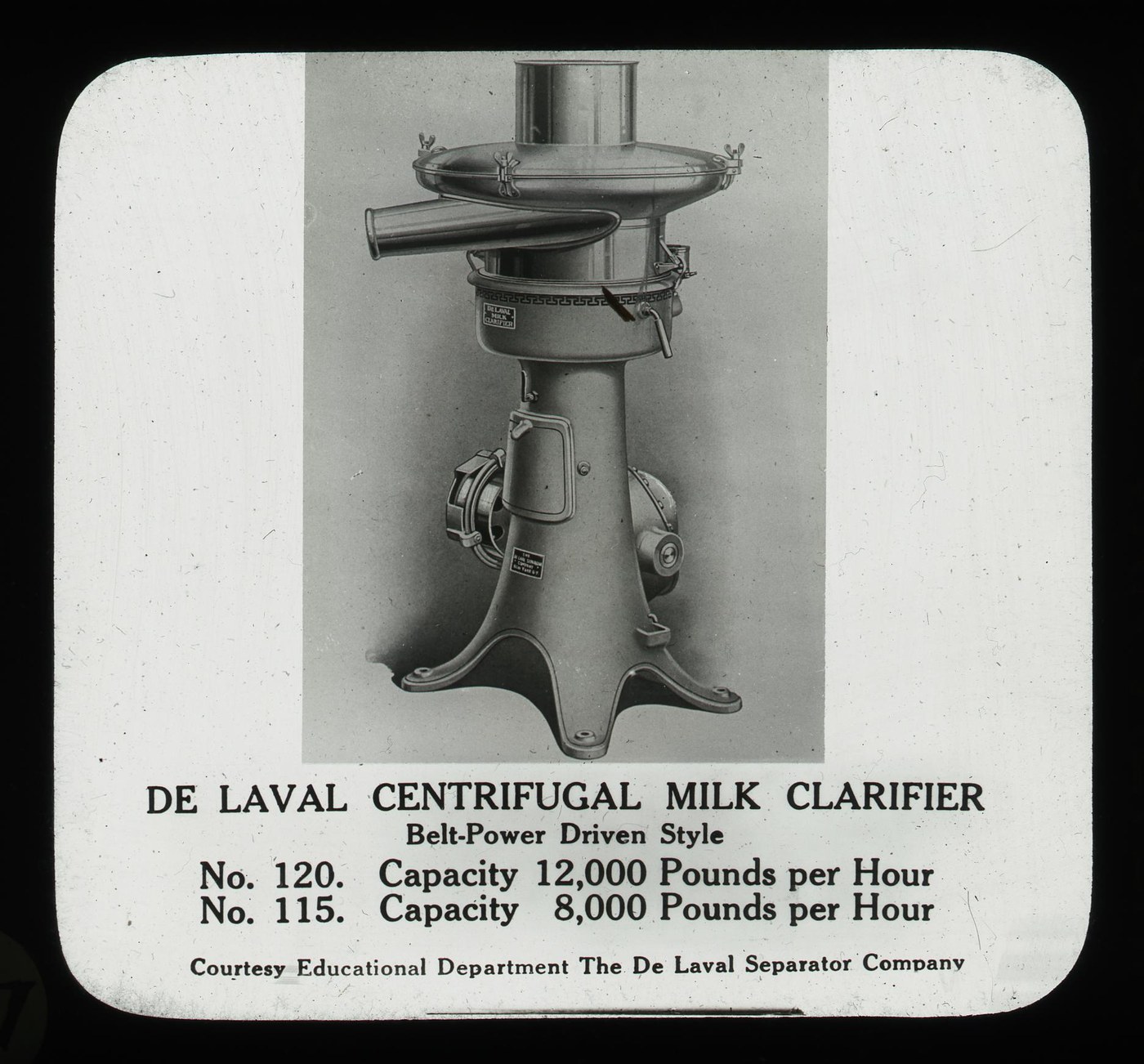


De Laval Cream Separator
Cream rises because fat globules are less dense than the water around them, and gravity pulls the heavier phase down. It works, and it takes twelve to twenty-four hours in a cool pan — by which time the milk is souring and you have a dairy full of pans.
Spinning replaces waiting. Inside a bowl at seven thousand revolutions a minute the effective field is thousands of times gravity, so a separation that took a day happens in seconds. The heavy skim milk is flung to the wall, the light cream collects at the centre, and both are drawn off continuously while the machine keeps running.
That last word is the commercial one: continuous, not batch. US Patent 368,328, "Apparatus for working centrifugal machines", granted to Gustaf de Laval of Stockholm on 16 August 1887 — a hand-cranked machine skimming sixty litres an hour.
Instrukcje
A bowl at 7000 rpm is a serious hazard
A bowl at 7000 rpm is a serious hazard
Build and test only inside a substantial enclosure. Balance obsessively, run up slowly, and never open the housing while anything is turning.
Read US 368,328 and note the numbers
Read US 368,328 and note the numbers
De Laval specifies gearing to reach six or seven thousand revolutions a minute from a hand crank, skimming sixty litres per hour. Both figures are in the specification.
Set milk in a pan and time gravity separation
Set milk in a pan and time gravity separation
Leave whole milk in a shallow pan somewhere cool and record how long a cream line takes to form. That number — many hours — is the thing being replaced.
Calculate the effective field you need
Calculate the effective field you need
Centripetal acceleration is ω²r. At 7000 rpm on a 50 mm radius that is several thousand g — which is why seconds replace hours.
Potrzebne narzędzia:
 Linijka
Turn a bowl and balance it before anything else
Turn a bowl and balance it before anything else
Machine a bowl that runs true. At these speeds a gram of imbalance is a large cyclic force — balance is a safety requirement, not a refinement.
Materiały do tego kroku:
 Blacha ze stali nierdzewnej 3161 arkusz
Potrzebne narzędzia:
 Pilnik do metalu
Mount it on a slender flexible spindle
Mount it on a slender flexible spindle
Support the bowl on a thin shaft rather than a rigid one. De Laval's insight was that a flexible shaft lets the bowl spin about its own centre of MASS above the critical speed, instead of fighting the imbalance.
Materiały do tego kroku:
 Pręt ze stali niskowęglowej1 sztuka
Pass THROUGH the critical speed, do not sit on it
Pass THROUGH the critical speed, do not sit on it
Run up briskly past the resonance and note the vibration peak then fall away. Lingering at the critical speed is what destroys the machine.
Gear the crank up, hard
Gear the crank up, hard
Build a gear train taking a comfortable 60 rpm hand speed to several thousand at the bowl. Ratios above a hundred to one are what make it hand-powered at all.
Feed milk in at the CENTRE
Feed milk in at the CENTRE
Introduce milk down the axis. It must enter where the field is weakest and travel outward, or it simply mixes what has already separated.
Take skim from the rim and cream from the axis
Take skim from the rim and cream from the axis
Fit two outlets at different radii. Dense skim milk collects at the wall; light cream is displaced inward — the LIGHT phase goes to the middle, which surprises people.
Add a stack of conical discs
Add a stack of conical discs
Insert nested cones so the milk is split into thin layers. A globule then has millimetres to travel instead of centimetres, and separation time collapses.
Run it and measure the fat in both streams
Run it and measure the fat in both streams
Collect both outputs and compare. Good separation leaves skim milk at a fraction of a per cent fat, continuously, with no waiting at all.
Vary the feed rate and watch quality change
Vary the feed rate and watch quality change
Feed faster and separation worsens: residence time in the bowl has dropped below what the globules need to travel. Throughput and purity trade directly.
Open the bowl and look at what collected
Open the bowl and look at what collected
Find the sludge at the wall — dirt, cells and debris denser than milk. The separator is also a clarifier, and that hygiene benefit mattered as much as the cream.
Compendium — spinning instead of waiting
Compendium — spinning instead of waiting
The patent. US 368,328, "Apparatus for working centrifugal machines", granted 16 August 1887 to Gustaf de Laval of Stockholm, covering the support and hand operation of vertically-mounted centrifugal cream separators. De Laval had built his first continuously operating separator in 1878; the significance of "continuously" is that milk flows in and two streams flow out without the machine stopping, where every earlier method was a batch that had to be set, waited on and skimmed.
The physics is Stokes' law with gravity replaced. A fat globule rises through milk at a rate set by the density difference, the globule's size squared, the fluid viscosity and the acceleration field. Gravity gives 1 g and a cream line in half a day. Spinning at 7000 rpm on a 50 mm radius gives several thousand g, and the same separation happens in seconds. Nothing about the milk changes — only the size of the field driving the separation.
The disc stack is the second idea. Separation time also depends on how FAR a globule must travel, and that distance scales with the depth of the liquid layer. Nesting a stack of conical discs divides the bowl into many thin layers, so each globule has a very short path to the nearest surface, from which it slides inward. This is the same reasoning as a plate settler in water treatment, and it is why a modern separator bowl is full of pressed cones.
De Laval's other contribution is the shaft. A rigid spindle must be balanced almost perfectly or it tears itself apart; a slender flexible one behaves differently. Above its critical speed a flexible shaft lets the rotor spin about its own centre of mass, so residual imbalance is accommodated rather than resisted — a machine that shakes violently at one particular speed and then runs smoothly beyond it. This is now standard rotordynamics, and the same man went on to apply high-speed rotation to the de Laval steam turbine and gave his name to the converging-diverging nozzle used in rocket engines.
Materiały
2- 1 arkuszZastępnik
- 1 sztukaZastępnik
Powiązane blueprinty
Te blueprinty dzielą się wiedzą — technikami, materiałami lub zasadami


CC0 Domena publiczna
Ten plan jest udostępniany na licencji CC0. Możesz go swobodnie kopiować, modyfikować, rozpowszechniać i wykorzystywać do dowolnych celów, bez konieczności uzyskiwania zgody.
Wesprzyj Makera kupując produkty przez jego plan, za co zarabia Prowizja Makera ustalony przez sprzedawców, lub stwórz nową iterację tego planu i dołącz go jako połączenie w swoim własnym planie, aby dzielić się przychodami.