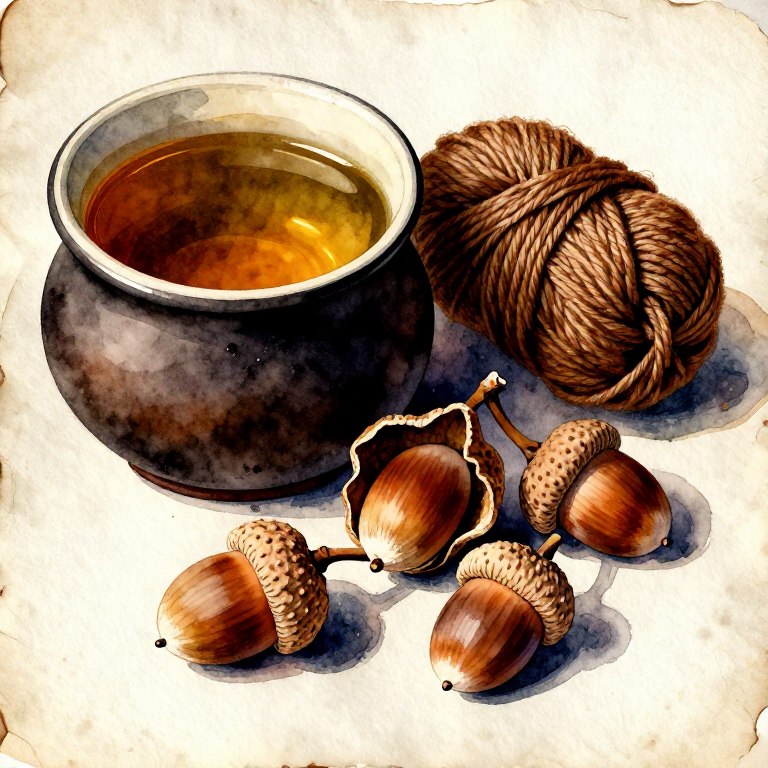


Dyeing Brown with Acorns — The Universal Tannin Dye of the Ancient World
Acorns — the fruit of oak trees (Quercus species) — have been used as a dye source since the earliest periods of human textile work. Every culture that lived among oak forests discovered that acorn caps, hulls, and whole crushed acorns produce warm brown shades on wool and leather. The dye comes from the same tannins that make raw acorns bitter and astringent — gallotannins and ellagitannins in concentrations of 5-10% by dry weight. These tannins bond directly to protein fibres without a mordant, making acorn one of the simplest and most accessible natural dyes.
Acorn caps (cupules) are the richest dye source — they contain higher tannin concentrations than the nut meat. In Turkish and Greek folk dyeing traditions, acorn caps were the preferred material, producing warm golden-brown to grey-brown depending on the oak species. Red oak acorns (Quercus rubra and relatives) tend toward warmer, redder browns, while white oak acorns (Q. alba and relatives) produce cooler, grey-toned browns.
As a substantive dye, acorn tannin requires no mordant for permanent colour on wool. The tannin-fibre bond forms naturally during the dyeing process. However, iron modification (iron saddening) dramatically darkens acorn dye to deep grey-brown or near-black — this was a standard technique in traditional European dyeing for producing dark work clothes from readily available materials. Acorn dye also serves as an excellent tannin pre-mordant for cotton and linen, allowing cellulose fibres to take up plant dyes that would otherwise not bond.
Instrukcje
Gather and weigh the acorn caps
Gather and weigh the acorn caps
Use 100-200% WOF of dried acorn caps (cupules). For 100 g of wool, gather 100-200 g of dried caps. Collect in autumn when acorns have fallen — the caps separate easily from ripe acorns. Focus on the caps rather than the nut meat — the caps have the highest tannin concentration. If using whole acorns, crush them coarsely with a hammer. Dry the caps in shade for 1-2 weeks before storing. Any oak species works — experiment with local species for different brown tones.
Materiały do tego kroku:
 Miseczki żołędzi (suszone)150 g
Potrzebne narzędzia:
 Cyfrowa waga kuchenna
Soak the caps in warm water for 2-3 hours
Soak the caps in warm water for 2-3 hours
Place the acorn caps in a dye pot with 4 litres of warm water and soak for 2-3 hours. The water will turn golden-brown within the first hour as tannins dissolve. Acorn caps release dye faster than bark sources because of their thin structure and high surface area. An overnight soak produces slightly darker results but is not essential.
Potrzebne narzędzia:
 Garnek wysoki
Simmer at 80°C for 30 minutes
Simmer at 80°C for 30 minutes
Bring the pot to a gentle simmer (80°C) and hold for 30 minutes. Stir occasionally. The liquid will deepen to a warm, rich brown. Acorn caps extract fully within 30 minutes at this temperature. The caps will darken and soften. A second extraction in fresh water yields a lighter, more golden bath useful for layered colour effects.
Potrzebne narzędzia:
 Termometr kuchenny
 Drewniana łyżka do mieszania
Strain out the caps
Strain out the caps
Strain the dye liquor through a fine mesh strainer into a clean pot. Press the caps to extract all remaining liquid. Cap fragments can catch in wool fibres — strain thoroughly. The strained liquor should be a warm, clear golden-brown.
Potrzebne narzędzia:
 Sitko o drobnych oczkach
Dye wool at 80°C for 45 minutes
Dye wool at 80°C for 45 minutes
Pre-wet wool in lukewarm water for 15 minutes, squeeze gently, and lower into the acorn dye bath at room temperature. Slowly raise to 80°C and hold for 45 minutes. Turn gently every 10 minutes. No mordant is required — acorn tannins bond directly to wool. The colour will be a warm golden-brown to medium brown depending on the concentration and oak species. For darker shades, dip briefly in iron water after the acorn bath — tannins react with iron to produce deep grey-brown to near-black.
Materiały do tego kroku:
 Motek wełny100 g
Cool, rinse, and dry
Cool, rinse, and dry
Turn off the heat and let the wool cool in the dye bath overnight. Remove, squeeze gently, and rinse in lukewarm water until the runoff is mostly clear. The final colour is a warm golden-brown — the colour of autumn oak forests where the acorns were gathered. Washfastness is excellent due to the strong tannin-fibre bond. Lightfastness is good. Acorn-dyed wool has a slightly stiffened hand from the tannin — this was considered a feature, not a defect, in traditional workwear. Dry in shade.
Materiały
2- Zastępnik
- 100 gZastępnik
Wymagane narzędzia
5- Zastępnik
- Zastępnik
- Zastępnik
- Zastępnik
- Zastępnik
Materiały z połączonych planów
Według tego planu powstaje

Powiązane blueprinty
Te blueprinty dzielą się wiedzą — technikami, materiałami lub zasadami
CC0 Domena publiczna
Ten plan jest udostępniany na licencji CC0. Możesz go swobodnie kopiować, modyfikować, rozpowszechniać i wykorzystywać do dowolnych celów, bez konieczności uzyskiwania zgody.
Wesprzyj Makera kupując produkty przez jego plan, za co zarabia Prowizja Makera ustalony przez sprzedawców, lub stwórz nową iterację tego planu i dołącz go jako połączenie w swoim własnym planie, aby dzielić się przychodami.