SZTUKA
Piękno i dobre samopoczucie
RZEMIOSŁO
KULTURA I HISTORIA
ROZRYWKA
ŚRODOWISKO
JEDZENIE I NAPOJE
ZIELONA PRZYSZŁOŚĆ
INŻYNIERIA ODWROTNA
NAUKI
LEKKOATLETYKA
TECHNOLOGIA
URZĄDZENIA DO NOSZENIA
Extracting Nickel from Pentlandite — The Devil's Copper That Wouldn't Behave
Peter

Autor

Peter

1. maj 2026SE
17
0
0
0
0

Extracting Nickel from Pentlandite — The Devil's Copper That Wouldn't Behave

Nickel (Ni, element 28) gets its name from the German Kupfernickel — 'Old Nick's copper' or 'the Devil's copper.' Saxonian miners in the Erzgebirge encountered a reddish-brown ore (now called nickeline, NiAs) that resembled copper ore but yielded no copper when smelted. They blamed the mischievous sprite Nickel (a diminutive of Nicholas, used as a name for a troublesome goblin) for bewitching the copper. Swedish mineralogist Axel Fredrik Cronstedt isolated metallic nickel in 1751 by heating nickeline with charcoal, proving it was a distinct metal.

Pentlandite ((Fe,Ni)₉S₈) is the world's primary nickel ore mineral, typically containing 22–42% nickel. It occurs almost exclusively in magmatic sulfide deposits — massive concentrations of metal sulfides that crystallized from sulfide-rich magma deep in the Earth's crust. The two largest deposits on Earth, Sudbury (Ontario, Canada) and Norilsk (Siberia, Russia), together supply a large fraction of the world's nickel.

The extraction of nickel from pentlandite follows a roast-reduce sequence: roasting converts the sulfide to nickel oxide (NiO), and carbon reduction at high temperature produces metallic nickel. The process is complicated by the iron content — pentlandite contains both iron and nickel, and separating them requires careful control of roasting conditions or a matte-smelting step.

HAZARD: Nickel compounds are classified as Group 1 carcinogens (confirmed human carcinogens) by IARC. Nickel dust and nickel oxide dust cause lung and nasal cancer with chronic exposure. Nickel is also one of the most common contact allergens — approximately 10–20% of women and 1–3% of men are sensitized. All work must use respiratory protection and gloves. Roasting produces sulfur dioxide (SO₂), a toxic, choking gas — work outdoors only.

Zaawansowany
6-8 hours

Instrukcje

1

Understand nickel chemistry and its discovery

Nickel (Ni, element 28) is a hard, silvery-white transition metal with a density of 8.91 g/cm³, melting point of 1455 °C, and Mohs hardness of 4. Like iron and cobalt, nickel is ferromagnetic at room temperature — it is attracted to magnets, though less strongly than iron. Nickel's Curie temperature is 354 °C, meaning it loses its magnetism above this temperature (much lower than cobalt's 1115 °C or iron's 770 °C).

Nickel is remarkably resistant to corrosion and oxidation, which is why its largest modern use is in stainless steel alloys (typically 8–12% nickel) and in nickel plating. Pure nickel develops a thin, tenacious oxide layer that protects the underlying metal — unlike iron, which rusts progressively. This corrosion resistance also made nickel valuable for coinage: the United States five-cent coin (the 'nickel') has been 75% copper and 25% nickel since 1866.

Cronstedt's 1751 isolation was initially disputed. Many chemists believed his 'new metal' was simply an alloy of known metals (cobalt, copper, arsenic, iron). It took decades of independent confirmation before nickel was universally accepted as a distinct element. The confusion was partly caused by the difficulty of obtaining pure nickel — the metal readily alloys with iron, cobalt, and copper, and separating these similar metals from each other was extremely challenging with 18th-century techniques.

2

Identify pentlandite and other nickel minerals

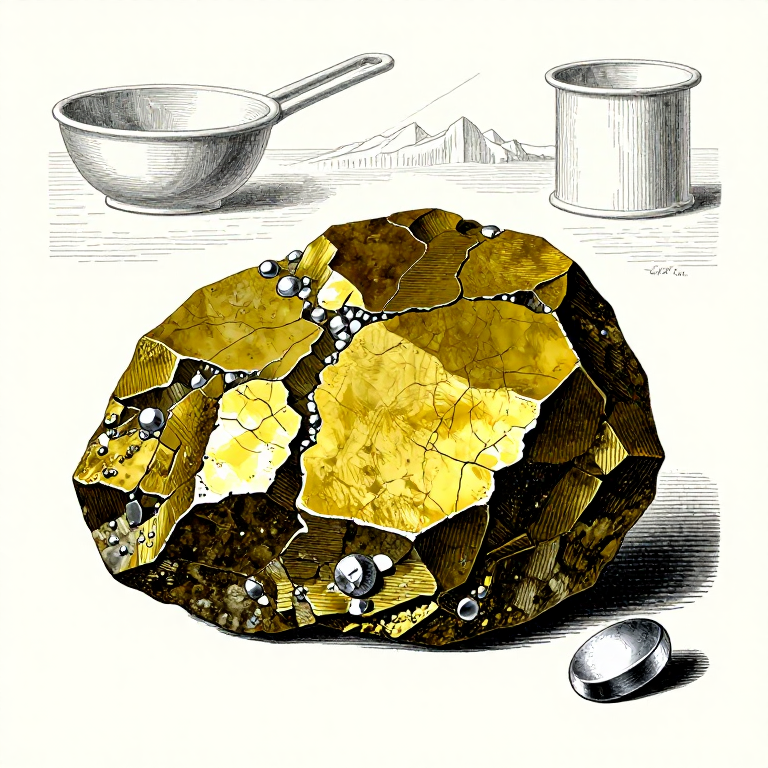
Pentlandite ((Fe,Ni)₉S₈) is a bronze-yellow metallic mineral that closely resembles pyrrhotite (Fe₁₋ₓS) and chalcopyrite (CuFeS₂) in appearance. Key identification features: Mohs hardness 3.5–4, specific gravity 4.6–5.0, and a bronze-brown streak. Unlike pyrrhotite, pentlandite is not magnetic (or only very weakly so). Unlike chalcopyrite, pentlandite lacks the greenish tinge and does not tarnish to iridescent colors.

Pentlandite almost always occurs intergrown with pyrrhotite in a fine-grained mixture called 'massive sulfide ore.' Separating the two by hand is often impossible — the minerals are intimately mixed at a microscopic scale. For small-scale extraction, the entire massive sulfide ore can be processed, accepting that both iron and nickel will be present in the product.

Other nickel minerals include garnierite ((Ni,Mg)₃Si₂O₅(OH)₄, a green nickel silicate found in tropical laterite soils), nickeline (NiAs, the original 'Kupfernickel' — pale copper-red with metallic luster), and millerite (NiS, brass-yellow acicular crystals). Garnierite is the principal nickel ore in tropical countries (New Caledonia, Indonesia, Philippines) and is processed by different methods than sulfide ores.

Tools needed:

Geological HammerGeological Hammer
Hand Lens (10x)Hand Lens (10x)
Streak Plate (unglazed porcelain)Streak Plate (unglazed porcelain)
Small MagnetSmall Magnet
3

Crush and prepare the pentlandite ore

Crush pentlandite-bearing massive sulfide ore into fragments under 5 mm using a geological hammer on a steel anvil. The ore is moderately hard (Mohs 3.5–4) and brittle, crushing readily. Wear a dust mask and gloves — nickel sulfide dust is carcinogenic with chronic inhalation exposure.

If possible, use a magnet to separate strongly magnetic pyrrhotite from the less magnetic pentlandite. Pyrrhotite (Fe₇S₈) is noticeably magnetic, while pentlandite is not. Pass a strong magnet over a thin layer of crushed ore spread on paper — the pyrrhotite grains cling to the magnet, leaving pentlandite-enriched material behind. This magnetic separation is imperfect but significantly increases the nickel-to-iron ratio in the concentrate.

Weigh 300–500 grams of prepared ore. Pure pentlandite contains approximately 34% nickel, but raw massive sulfide ore typically contains 1–5% nickel mixed with pyrrhotite and gangue. After magnetic separation, the concentrate may contain 10–20% nickel. The higher the nickel content, the better the final metal yield.

Materiały do tego kroku:

Pentlandite Ore (nickel iron sulfide)Pentlandite Ore (nickel iron sulfide)500 grams

Tools needed:

Geological HammerGeological Hammer
Steel Anvil (small)
Dust Mask (P2)Dust Mask (P2)
Nitrile Rubber Gloves (Thick)Nitrile Rubber Gloves (Thick)
Small MagnetSmall Magnet
4

Roast the ore to convert sulfides to oxides

OUTDOORS ONLY — produces toxic sulfur dioxide (SO₂) gas. Roasting converts nickel and iron sulfides to their oxides: 2(Fe,Ni)₉S₈ + 45O₂ → 18(Fe,Ni)O + 16SO₂↑. The sulfur dioxide is a choking, acrid gas that causes respiratory damage at concentrations above 5 ppm. Stand well upwind at all times.

Spread the crushed ore in a thin layer (under 2 cm) in a refractory dish. Place this in a well-ventilated charcoal fire and heat to 700–800 °C for 1–2 hours, stirring occasionally with a long steel rod. The ore changes from bronze-yellow to a dark grey-black as the sulfides convert to oxides. The sulfurous smell of SO₂ indicates the reaction is proceeding.

Multiple roastings may be needed to fully remove sulfur. After the first roast, re-crush the calcine, spread thinly, and roast again. Well-roasted calcine should show no sulfurous smell when re-heated. The final product is a mixture of nickel oxide (NiO, a green-grey powder) and iron oxide (Fe₂O₃/Fe₃O₄, black to reddish-brown). Both will be reduced in the next step, producing an iron-nickel alloy rather than pure nickel.

Materiały do tego kroku:

Charcoal (hardwood lump)Charcoal (hardwood lump)5 kg

Tools needed:

Refractory Dish (shallow ceramic)Refractory Dish (shallow ceramic)
Steel Stirring RodSteel Stirring Rod
P100 RespiratorP100 Respirator
Leather Gauntlet GlovesLeather Gauntlet Gloves
5

Reduce the oxide with carbon to produce nickel-iron alloy

Mix the roasted calcine with crushed charcoal at approximately 1:1 by weight. The reduction reactions are: NiO + C → Ni + CO and Fe₂O₃ + 3C → 2Fe + 3CO. Both nickel oxide and iron oxide are reduced by carbon, so the product is an iron-nickel alloy, not pure nickel. This is historically accurate — early nickel production always yielded iron-nickel alloys that required further refining.

Pack the mixture into a deep clay or graphite crucible. Place the crucible in a forced-air charcoal furnace and heat to the maximum achievable temperature — ideally above 1400 °C. Nickel has a melting point of 1455 °C, so extreme temperature is needed to produce a coherent metal button. Below the melting point, nickel forms as a spongy mass of metallic prills that can still be consolidated by remelting.

Maintain maximum temperature for 1–2 hours. The metal, being dense (8.91 g/cm³ for pure nickel, approximately 8.0–8.5 for iron-nickel alloy), sinks to the bottom of the crucible. Slag (silicate and oxide residue) floats above. Allow the crucible to cool naturally — do not quench.

Materiały do tego kroku:

Charcoal (crushed, fine)300 grams
Charcoal (hardwood lump)Charcoal (hardwood lump)5 kg

Tools needed:

Clay Crucible (deep)Clay Crucible (deep)
Charcoal Furnace (small)Charcoal Furnace (small)
Bellows (hand-operated)Bellows (hand-operated)
6

Extract the metal and test for nickel

Break open the cooled crucible. At the bottom, look for a metallic button or scattered metallic prills. The iron-nickel alloy is silvery-white, hard, and strongly magnetic — test with a magnet. The metal should be noticeably harder than pure iron (nickel alloys are harder than either pure metal), and the color should be a clean silver-white without the yellowish cast of brass or the bluish tinge of zinc.

The product at this stage is an iron-nickel alloy, similar in composition to the natural alloy found in iron meteorites (kamacite and taenite). Meteoritic iron typically contains 5–35% nickel, and the alloy from pentlandite smelting has a similar range depending on the ore's iron-to-nickel ratio. This alloy is historically significant — many scholars believe that the earliest worked iron in human history came from meteorites, not terrestrial smelting.

To confirm nickel content, the dimethylglyoxime (DMG) test is definitive: dissolve a small filing of the metal in hot dilute nitric acid, then add a few drops of 1% dimethylglyoxime solution in ethanol. A bright strawberry-red precipitate of nickel dimethylglyoximate confirms nickel. This test is specific to nickel — no other common metal gives this color with DMG. If DMG reagent is unavailable, the green color of nickel chloride solution (formed by dissolving the metal in hydrochloric acid) is a strong indicator — nickel salts in solution are characteristically green, distinct from the blue of copper, pink of cobalt, or yellow of iron(III).

Tools needed:

Hand Lens (10x)Hand Lens (10x)
Small MagnetSmall Magnet
Glass Sample Vial (50ml)Glass Sample Vial (50ml)
7

Understand historical nickel refining (the Mond process)

Separating nickel from iron in the alloy requires techniques beyond simple smelting. Historically, this was one of the great challenges of metallurgy. The breakthrough came in 1890 when Ludwig Mond discovered the Mond process (carbonyl refining): when carbon monoxide gas is passed over impure nickel at 50–60 °C, it reacts with nickel (but not iron, cobalt, or copper) to form nickel tetracarbonyl (Ni(CO)₄), a volatile liquid. This gas is then heated to 220–250 °C, causing it to decompose and deposit pure nickel on a heated surface.

The Mond process cannot be safely performed at small scale — nickel tetracarbonyl is one of the most toxic substances known (LC₅₀ approximately 3 ppm for 30-minute exposure, comparable to nerve agents). It is described here for historical understanding only. Industrial nickel refining today uses either the Mond process (with extreme containment) or electrorefining (dissolving impure nickel anodes in sulfate solution and plating pure nickel on cathodes).

For small-scale work, the iron-nickel alloy produced from pentlandite smelting is itself a useful material. Iron-nickel alloys have been used for precision instruments, magnetic cores, and specialized steel for centuries. The alloy's composition can be estimated by measuring its density (pure iron: 7.87 g/cm³, pure nickel: 8.91 g/cm³) and interpolating.

8

Clean up and document results

Nickel oxide dust from the roasting step is carcinogenic — wipe all surfaces near the roasting area with wet cloths and dispose of them appropriately. Do not sweep dry nickel-bearing dust. The roasting area should be hosed down with water to settle any remaining dust.

Used crucibles and tools from the smelting phase can be cleaned with water and reused. The iron sulfide slag from any magnetic separation step is not hazardous and can be discarded with mineral waste.

Document the complete experiment: ore weight, magnetic separation effectiveness (estimate percentage of pyrrhotite removed), roasting conditions, reduction temperature and time, alloy yield weight, magnetic properties, and results of the nickel confirmation test (DMG or green solution). From 500 grams of raw massive sulfide ore at 3% nickel, theoretical nickel yield is only 15 grams — mixed with iron in an alloy. From 500 grams of enriched pentlandite concentrate at 20% nickel, theoretical yield is 100 grams of nickel (in alloy form). Practical recovery will be lower. The experiment demonstrates why nickel was so difficult to isolate historically — the metal is always mixed with iron, and separating the two was the central challenge that delayed nickel's recognition as a distinct element until 1751.

Materiały

3

Wymagane narzędzia

17

CC0 Domena publiczna

Ten plan jest udostępniany na licencji CC0. Możesz go swobodnie kopiować, modyfikować, rozpowszechniać i wykorzystywać do dowolnych celów, bez konieczności uzyskiwania zgody.

Wesprzyj Makera kupując produkty przez jego plan, za co zarabia Prowizja Makera ustalony przez sprzedawców, lub stwórz nową iterację tego planu i dołącz go jako połączenie w swoim własnym planie, aby dzielić się przychodami.

Dyskusja

(0)

Zaloguj się aby dołączyć do dyskusji

Ładowanie komentarzy...