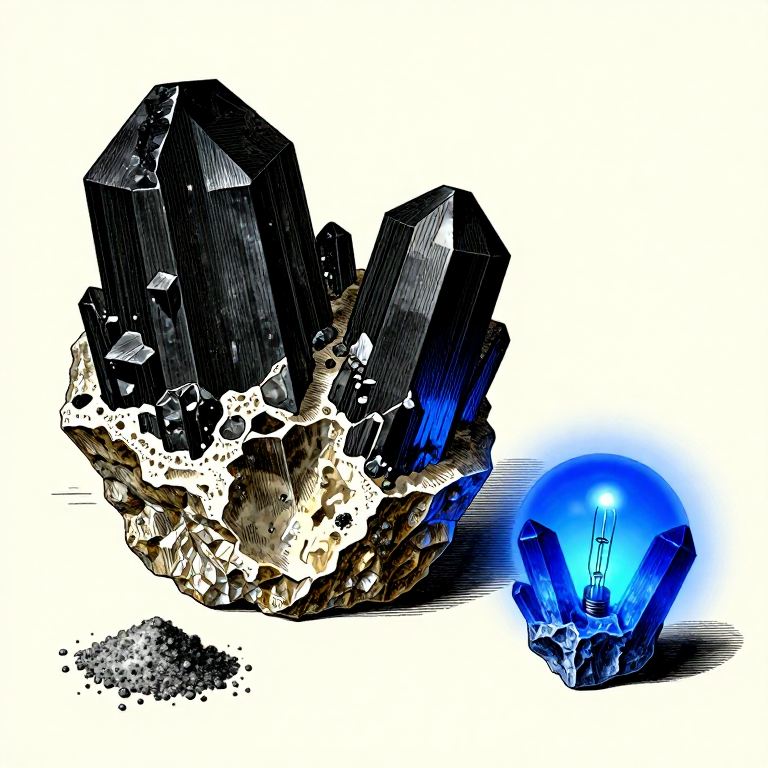


Extracting Tungsten from Wolframite — The Heaviest Practical Metal
Tungsten (W, element 74) has the highest melting point of any metal — 3422 °C, over a thousand degrees higher than platinum and nearly twice that of iron. Its name in most languages, wolfram, comes from the German Wolframit, which in turn derives from Wolf Rahm ('wolf's froth' or 'wolf's cream'). Medieval tin miners in the Erzgebirge found that the presence of wolframite in tin ore caused the tin to form a slag ('froth') during smelting, reducing the yield — as if a wolf had eaten the tin. The English name 'tungsten' comes from Swedish tung sten ('heavy stone'), originally referring to the mineral scheelite (CaWO₄).
Spanish chemists Juan José and Fausto Elhuyar first isolated metallic tungsten in 1783 by reducing tungstic acid (H₂WO₄) — obtained from wolframite — with charcoal. Carl Wilhelm Scheele had independently identified tungstic acid in scheelite two years earlier, but did not complete the reduction to metal.
Wolframite ((Fe,Mn)WO₄) is a series between ferberite (FeWO₄, iron tungstate) and hübnerite (MnWO₄, manganese tungstate). It contains approximately 60–61% WO₃ (47–48% tungsten metal). Wolframite and scheelite are the only commercially important tungsten minerals. Reducing tungsten oxide with carbon requires extremely high temperatures — among the highest in all of metallurgy.
HAZARD: Tungsten metal and tungsten carbide dust are respiratory irritants with potential for pulmonary fibrosis (hard metal disease) with chronic exposure. Use respiratory protection when handling powdered tungsten or tungsten ores. The reduction process produces carbon monoxide — work outdoors only.
Treści niebezpieczne
Ten blueprint zawiera niebezpieczne procedury. Zaloguj się i włącz niebezpieczne treści w ustawieniach konta, aby zobaczyć instrukcje krok po kroku.
CC0 Domena publiczna
Ten plan jest udostępniany na licencji CC0. Możesz go swobodnie kopiować, modyfikować, rozpowszechniać i wykorzystywać do dowolnych celów, bez konieczności uzyskiwania zgody.
Wesprzyj Makera kupując produkty przez jego plan, za co zarabia Prowizja Makera ustalony przez sprzedawców, lub stwórz nową iterację tego planu i dołącz go jako połączenie w swoim własnym planie, aby dzielić się przychodami.