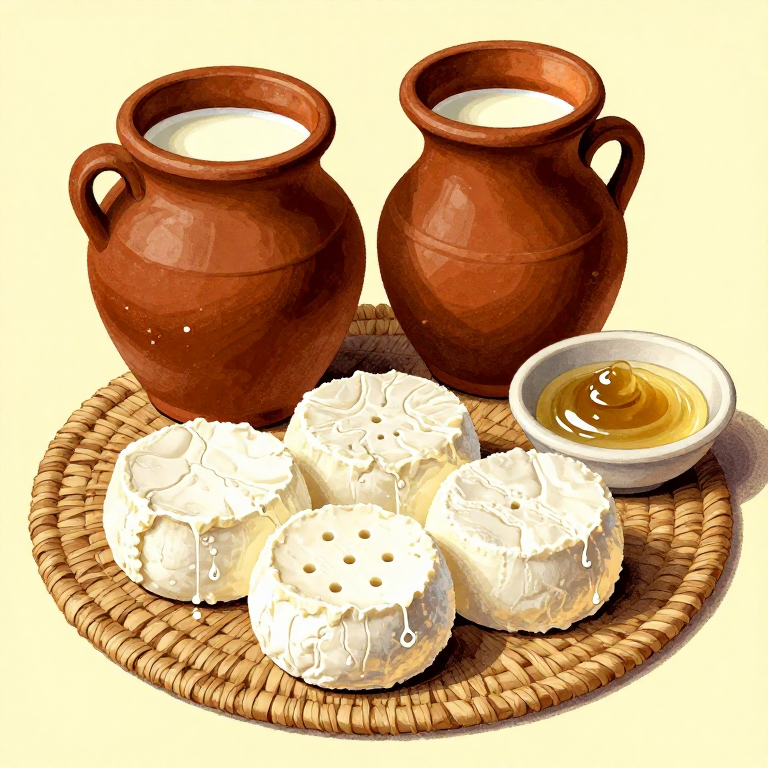


Greek Cheese Making — Making Fresh Goat Cheese (Tyros)
Instrukcje
Heat the Milk Gently
Heat the Milk Gently
Pour fresh goat milk into a large clean pot and heat it slowly over moderate flame to approximately 32-35 degrees Celsius (just warm to the touch — body temperature). Stir gently to heat evenly. Do not boil the milk, as high temperatures denature the casein proteins and prevent proper curd formation. Goat milk was far more common than cow milk in ancient Greece, as goats thrived on the rocky, arid terrain where cattle struggled. The Greek mainland and islands supported large flocks of goats and sheep, and fresh milk was consumed directly only near the source — cheese was the practical method of preserving the nutritional value of milk for storage and transport.
Materiały do tego kroku:
 Milk (Skimmed)2-4 liters sztuka
 Rennetsmall amount as per type sztuka
 Salt1-2 teaspoons sztuka
 Vinegar or lemon juice (alternative to rennet)30-50 ml ml
Potrzebne narzędzia:
Milk (Skimmed) Oven Thermometer
 Cheesecloth or fine linen for draining
 Cheese Mold
 Long knife or spatula for cutting curd
Add Rennet or Acid to Curdle the Milk
Add Rennet or Acid to Curdle the Milk
Remove the pot from heat and add the curdling agent. For rennet curdling (the traditional method), add a small amount of animal rennet (from the stomach lining of a young goat or lamb) or vegetable rennet (fig sap or thistle extract — both used in ancient Greece). Stir gently for 30 seconds, then leave undisturbed for 30-45 minutes until a firm curd sets. For acid curdling, add vinegar or lemon juice and stir — curds form almost immediately. Fig sap (the white latex from cut fig branches) was a well-known ancient coagulant; Aristotle describes it in his Historia Animalium. The rennet's chymosin enzyme cleaves kappa-casein proteins, causing the milk to coagulate into a firm gel.
Cut and Drain the Curds
Cut and Drain the Curds
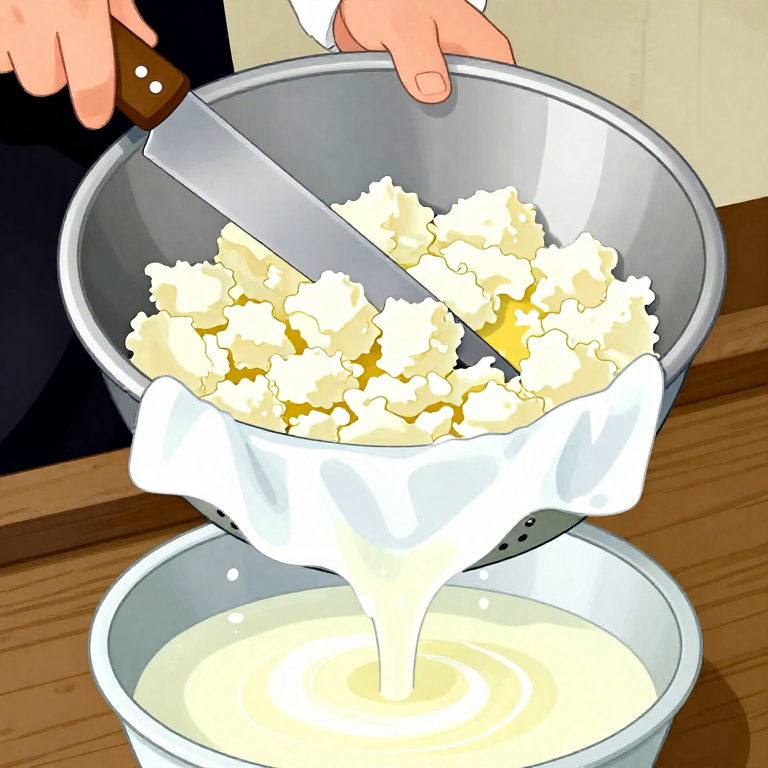
Once the milk has set into a firm, custard-like curd (it should break cleanly when cut with a knife), cut the curd mass into 2 cm cubes using a long knife or spatula, making parallel cuts in two perpendicular directions. Let the cut curds rest for 5-10 minutes — liquid whey will begin to separate and pool between the curd pieces. Gently stir the curds to release more whey, then pour the curds and whey through a cheesecloth-lined colander or into a woven basket with drainage holes. The whey drains away while the curds are retained. Save the whey for other uses — the Greeks used whey as a drink, animal feed, and for making secondary cheese (similar to ricotta).
Salt and Mold the Cheese
Salt and Mold the Cheese
Sprinkle salt over the drained curds and mix gently. Salt serves multiple functions: it flavors the cheese, draws out additional moisture, inhibits unwanted bacterial growth, and firms the curd texture. Pack the salted curds into a cheese mold (traditionally a woven rush or ceramic basket with drainage holes called a formos — the origin of the word fromage/formaggio). Press the curds firmly into the mold to eliminate air pockets. Place a small weight on top and let the cheese drain for several more hours at room temperature. The pressed cheese will take the shape of the mold — ancient Greek cheese molds were round, square, or heart-shaped.
Unmold and Serve or Age the Cheese
Unmold and Serve or Age the Cheese
After draining for 4-8 hours, turn the cheese out of the mold. The fresh cheese is ready to eat immediately — it will be soft, moist, mildly tangy, and slightly crumbly, similar to modern fresh chevre. For a firmer, more flavorful cheese, rub the exterior with additional salt and age in a cool, airy location for days to weeks, turning daily. The Greeks also preserved cheese by immersing it in brine (salt water), olive oil, or wine — Homer describes Polyphemus storing his cheeses in wicker baskets with whey draining underneath. Fresh goat cheese was eaten with bread, honey, figs, and olives, and was a standard offering at religious sanctuaries. The island of Delos, Naxos, and Crete were particularly noted for their cheese production in ancient sources.
Materiały
5- 2-4 liters sztukaZastępnik
- small amount as per type sztukaZastępnik
- 30-50 ml mlZastępnik
- 1-2 teaspoons sztukaZastępnik
- 30-50 ml sztukaZastępnik
Wymagane narzędzia
8- Zastępnik
- Zastępnik
- Zastępnik
- Zastępnik
- Zastępnik
- Zastępnik
- Zastępnik
- Zastępnik
CC0 Domena publiczna
Ten plan jest udostępniany na licencji CC0. Możesz go swobodnie kopiować, modyfikować, rozpowszechniać i wykorzystywać do dowolnych celów, bez konieczności uzyskiwania zgody.
Wesprzyj Makera kupując produkty przez jego plan, za co zarabia Prowizja Makera ustalony przez sprzedawców, lub stwórz nową iterację tego planu i dołącz go jako połączenie w swoim własnym planie, aby dzielić się przychodami.