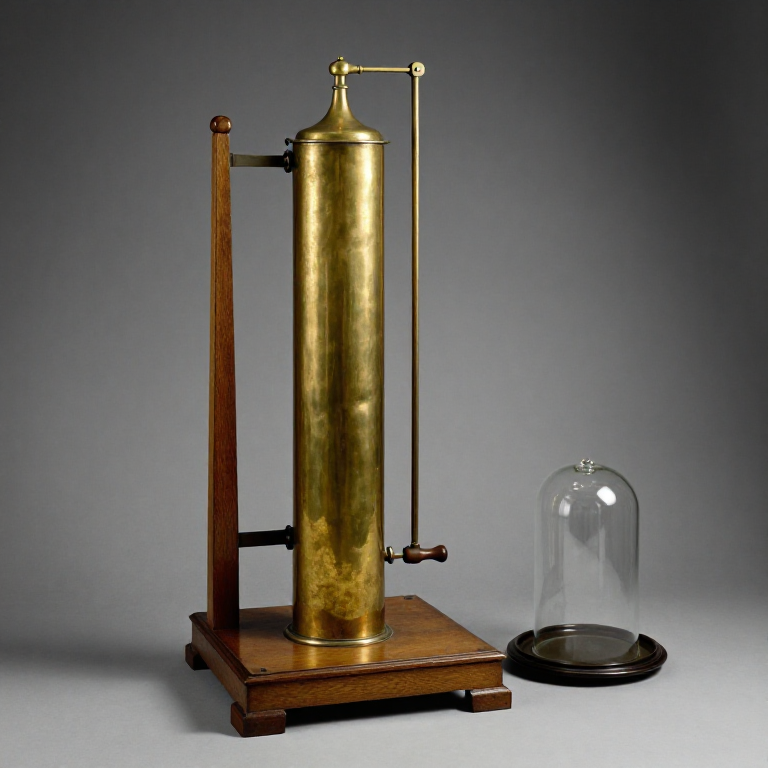


Guericke Air Pump
Instrukcje
Build the barrel and piston with a leather seal
Build the barrel and piston with a leather seal
A vacuum pump is a pump run backwards, and the seal is everything.
- Bore a barrel 50 mm diameter and 200 mm long from acrylic tube or aluminium.
- Turn a piston to fit with about 1 mm clearance all round.
- Cut a leather cup washer and fix it to the piston face so its lip flares OUTWARD against the barrel wall.
- Oil the leather thoroughly and work it until it is supple.
- Fit a rod through a guide at the barrel's end.
The lip must face the vacuum side. A cup seal is a one-way device: pressure on the concave side presses the lip harder against the wall, so it seals better the harder it is asked to work. Fit it backwards and it leaks precisely when you need it not to — the same asymmetry as the lip seal in batch 71, three centuries earlier.
Guericke's pumps were worked with the barrel submerged in water, so that any leak past the piston drew water rather than air. That is a crude but effective answer to a seal that cannot be made perfect.Materiały do tego kroku:
 Pręt akrylowy1 sztuka
 Pręt okrągły aluminiowy1 sztuka
 Zestaw pierścieni uszczelniających1 zestaw
Potrzebne narzędzia:
 Wiertarko-wkrętarka akumulatorowa
 Zestaw wierteł
 Zestaw pilników
 Imadło warsztatowe
 Suwmiarka cyfrowa 6 cali
 Ramka do piły do metalu z brzeszczotami
Fit two flap valves in opposition
Fit two flap valves in opposition
Two one-way valves are what turn a syringe into a pump.
- Cut two thin leather or rubber flaps.
- Fit the INLET valve at the barrel end connected to the vessel, opening toward the barrel.
- Fit the OUTLET valve in the piston or the barrel's far end, opening to atmosphere.
- Test each by blowing through it in both directions.
This is the same two-valve arrangement as Ctesibius' force pump and the grease gun in batch 71. One valve admits from the source on the intake stroke, the other discharges on the return, and neither lets flow reverse. Any reciprocating pump in history is these two valves plus a piston, and the only thing that changes is what is being moved.
The flaps must be light and must seat fully. At low pressure the force available to close a valve is tiny, which is why vacuum pump valves are made far lighter than pressure pump valves.Materiały do tego kroku:
 Wąż gumowy1 sztuka
 Muślin bawełniany1 metre
Potrzebne narzędzia:
Zestaw pilnikówSuwmiarka cyfrowa 6 caliWiertarko-wkrętarka akumulatorowaPump down and watch the returns diminish
Pump down and watch the returns diminish
Each stroke removes a FRACTION, never a fixed amount — and that changes everything.
- Connect the pump to a rigid vessel with a gauge or a manometer.
- Record the pressure after every stroke for the first twenty strokes.
- Plot pressure against stroke number.
- Keep pumping and note where the curve flattens.
Materiały do tego kroku:
 Zestaw rurek szklanych1 zestaw
 Papier milimetrowy1 pad
Potrzebne narzędzia:
 StoperSuwmiarka cyfrowa 6 cali
Find your leaks, because you have them
Find your leaks, because you have them
The pump's ultimate pressure is set by leakage, not by the pump.
- Pump down to the flattening point and close the valve to the vessel.
- Watch the pressure over ten minutes and record the rise.
- Paint suspect joints with soapy water and watch for bubbles being drawn IN.
- Tighten or re-grease each joint and repeat the rise test.
Potrzebne narzędzia:
StoperSuwmiarka cyfrowa 6 cali Zestaw kluczy imbusowych
Proving nothing exists, and history
Proving nothing exists, and history
Otto von Guericke, mayor of Magdeburg, built his air pumps from around 1650 and used them for a series of public demonstrations that changed what educated people believed. The hemispheres are the famous one, but he also showed that a bell in a vacuum makes no sound, that a candle goes out, and that animals cannot survive — establishing that air is a substance with properties rather than simply the absence of things.
The philosophical stakes were the point. Aristotelian physics held that a vacuum was logically impossible; Torricelli's barometer of 1643 had already produced a small one above the mercury, and Guericke's pump made large ones on demand. A machine settling a two-thousand-year-old argument is a rare event, and it is why this pump belongs at the head of the chain.
What it could not do. Guericke's pump reached perhaps a few per cent of atmospheric pressure — impressive, and nowhere near enough for the technologies later in this batch. An incandescent lamp needs pressures thousands of times lower, because a filament in a few per cent of an atmosphere still burns out in seconds. Every step in this chain is someone finding a way past the previous pump's ultimate limit.
Its honest limits: piston pumps are defeated by their own seals and by the volume left in the barrel at the end of a stroke, which re-expands into the vessel. That dead space sets a floor no amount of pumping beats. Later designs attack exactly that — the mercury pump next in this chain has no seals and no dead space at all.
Materiały
7- 1 sztukaZastępnik
- 1 sztukaZastępnik
- Zastępnik
- 1 sztukaZastępnik
- 1 metreZastępnik
- 1 zestawZastępnik
- 1 padZastępnik
Powiązane blueprinty
Te blueprinty dzielą się wiedzą — technikami, materiałami lub zasadami

CC0 Domena publiczna
Ten plan jest udostępniany na licencji CC0. Możesz go swobodnie kopiować, modyfikować, rozpowszechniać i wykorzystywać do dowolnych celów, bez konieczności uzyskiwania zgody.
Wesprzyj Makera kupując produkty przez jego plan, za co zarabia Prowizja Makera ustalony przez sprzedawców, lub stwórz nową iterację tego planu i dołącz go jako połączenie w swoim własnym planie, aby dzielić się przychodami.