Współpraca
SZTUKA
Piękno i dobre samopoczucie
RZEMIOSŁO
KULTURA I HISTORIA
ROZRYWKA
ŚRODOWISKO
JEDZENIE I NAPOJE
INŻYNIERIA ODWROTNA
NAUKI
LEKKOATLETYKA
TECHNOLOGIA
URZĄDZENIA DO NOSZENIA
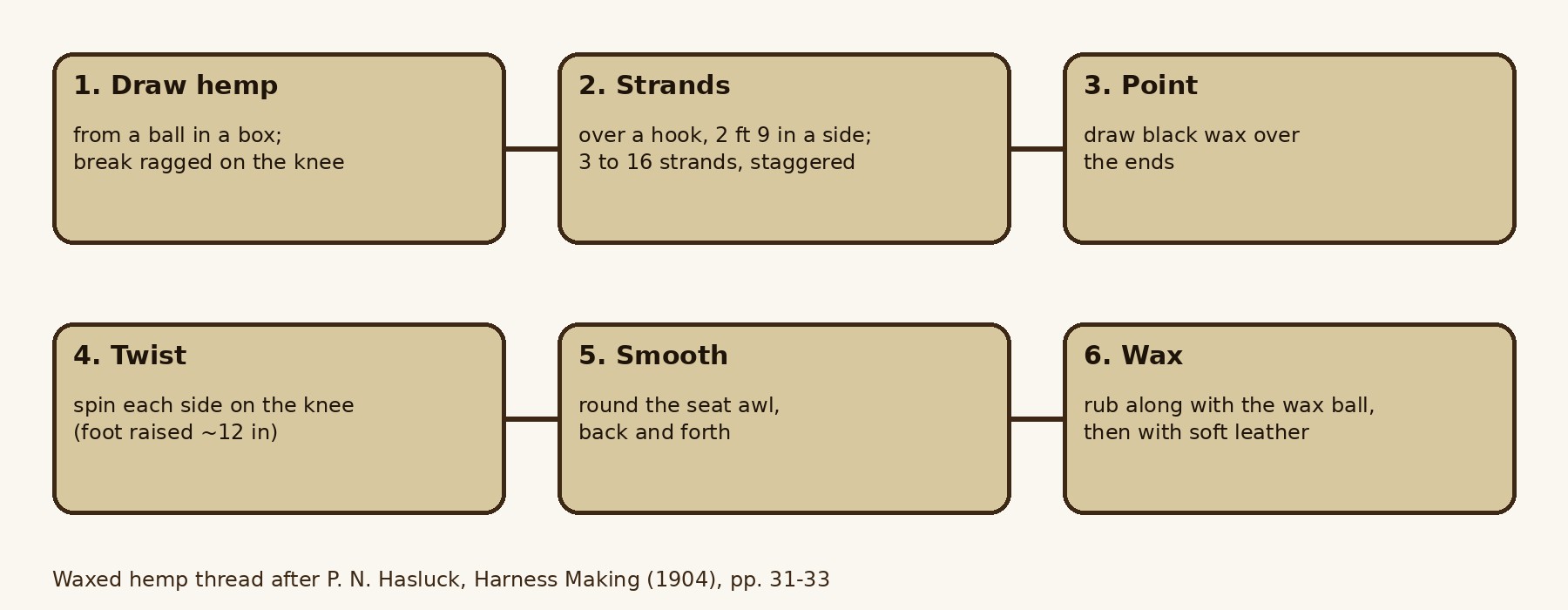


Saddler's Waxed Hemp Thread: Ragged-Pointed Strands Spun on the Knee and Rubbed With Black Wax (Hasluck, 1904)
How a harness maker makes his own waxed thread, from P. N. Hasluck's Harness Making (1904): strands of hemp broken to ragged points over a bench hook, 3 to 16 of them laid with staggered ends, each side twisted by rolling on the knee, smoothed round the seat-awl, and rubbed with black cobbler's wax (beeswax for light work).
Początkujący
About 15 minutes per thread
Instrukcje
1
1
Length and strands
Length and strands
Wczytywanie notatnika Jupyter…
2
2
Read Harness Making
Read Harness Making
"The threads used in the trade are many, but the principal is waxed thread, made by the saddler himself." White hemp is the best and toughest; fine No. 15 and coarse No. 3 meet most needs.
3
3
Cut the strands
Cut the strands
Keep the ball of hemp in a box with a small hole in the lid. Draw out the end, twist it once round the fingers, and break it by rolling on the knee and giving a sharp pull, so it breaks ragged (the more ragged, the better the point). Throw it over a nail or hook in the bench and pull until each side is about 2 ft 9 in, untwist by rolling on the knee and break again. Add strands the same way, 3 to 16 by the strength wanted, leaving the ends of unequal length for a fine point.
Materiały do tego kroku:
 Przędza konopna1 sztuka
Potrzebne narzędzia:
 Skrzynka drewniana
4
4
Point and twist
Point and twist
Draw the ball of wax over the points two or three times to hold them together. Raise the knee about 12 in by resting the foot on a support, and spin each side by rolling it on the knee with the palm until twisted enough (too much and it knots in stitching). For best work, twist both sides once round the seat-awl and draw it sharply back and forth to smooth out lumps.
Materiały do tego kroku:
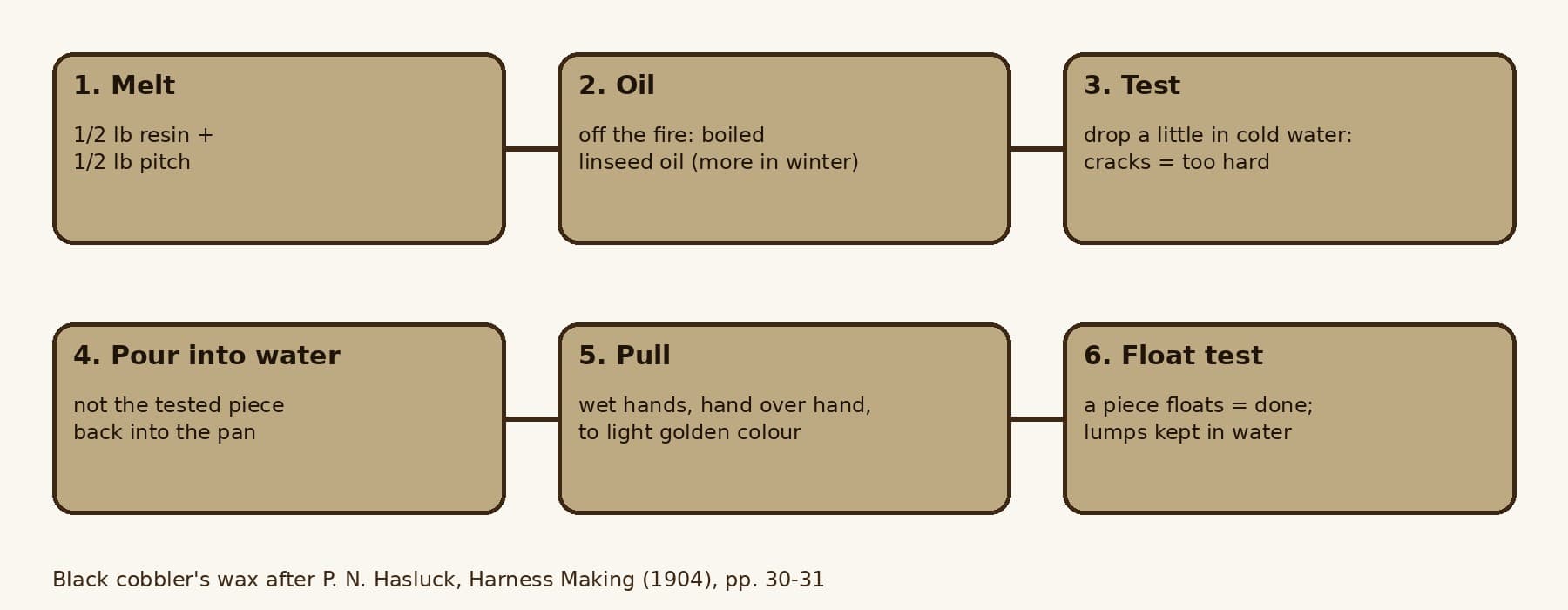
 Wosk szewski1 sztuka
Potrzebne narzędzia:
 Szydło rymarskie do wypełnień
5
5
Wax
Wax
Rub the thread with tallow so the wax runs smooth. Holding both ends in the left hand, rub the ball of wax along the whole thread, pulling the part round the hook out to wax it too, then rub the thread sharply end to end with soft leather or the bare hand to even the wax. For yellow or white thread on light work use beeswax, but always point the ends with black wax: only black wax keeps the thread fast to the needles.
Materiały do tego kroku:
Wosk szewski1 sztuka Łój1 sztuka
 Wosk pszczeli1 sztuka
Potrzebne narzędzia:
Szydło rymarskie do wypełnień6
6
Troubleshooting
Troubleshooting
Thread troubleshooting.
Flow
Loading...
7
7
History and honest limits
History and honest limits
From Paul N. Hasluck, **Harness Making** (1904), "Harness-makers' Materials" (checked on the archive.org scan harnessmaking00hasl, pp. 29-33). The strand-use notes, metric figures and the diagram are ours.
Materiały
4- 1 sztukaZastępnik
- 1 sztukaZastępnik
- 1 sztukaZastępnik
- 1 sztukaZastępnik
Wymagane narzędzia
2- Zastępnik
- Zastępnik
Według tego planu powstaje
Powiązane blueprinty
Te blueprinty dzielą się wiedzą — technikami, materiałami lub zasadami

CC0 Domena publiczna
Ten plan jest udostępniany na licencji CC0. Możesz go swobodnie kopiować, modyfikować, rozpowszechniać i wykorzystywać do dowolnych celów, bez konieczności uzyskiwania zgody.
Wesprzyj Makera kupując produkty przez jego plan, za co zarabia Prowizja Makera ustalony przez sprzedawców, lub stwórz nową iterację tego planu i dołącz go jako połączenie w swoim własnym planie, aby dzielić się przychodami.