SZTUKA
Piękno i dobre samopoczucie
RZEMIOSŁO
KULTURA I HISTORIA
ROZRYWKA
ŚRODOWISKO
JEDZENIE I NAPOJE
INŻYNIERIA ODWROTNA
NAUKI
LEKKOATLETYKA
TECHNOLOGIA
URZĄDZENIA DO NOSZENIA
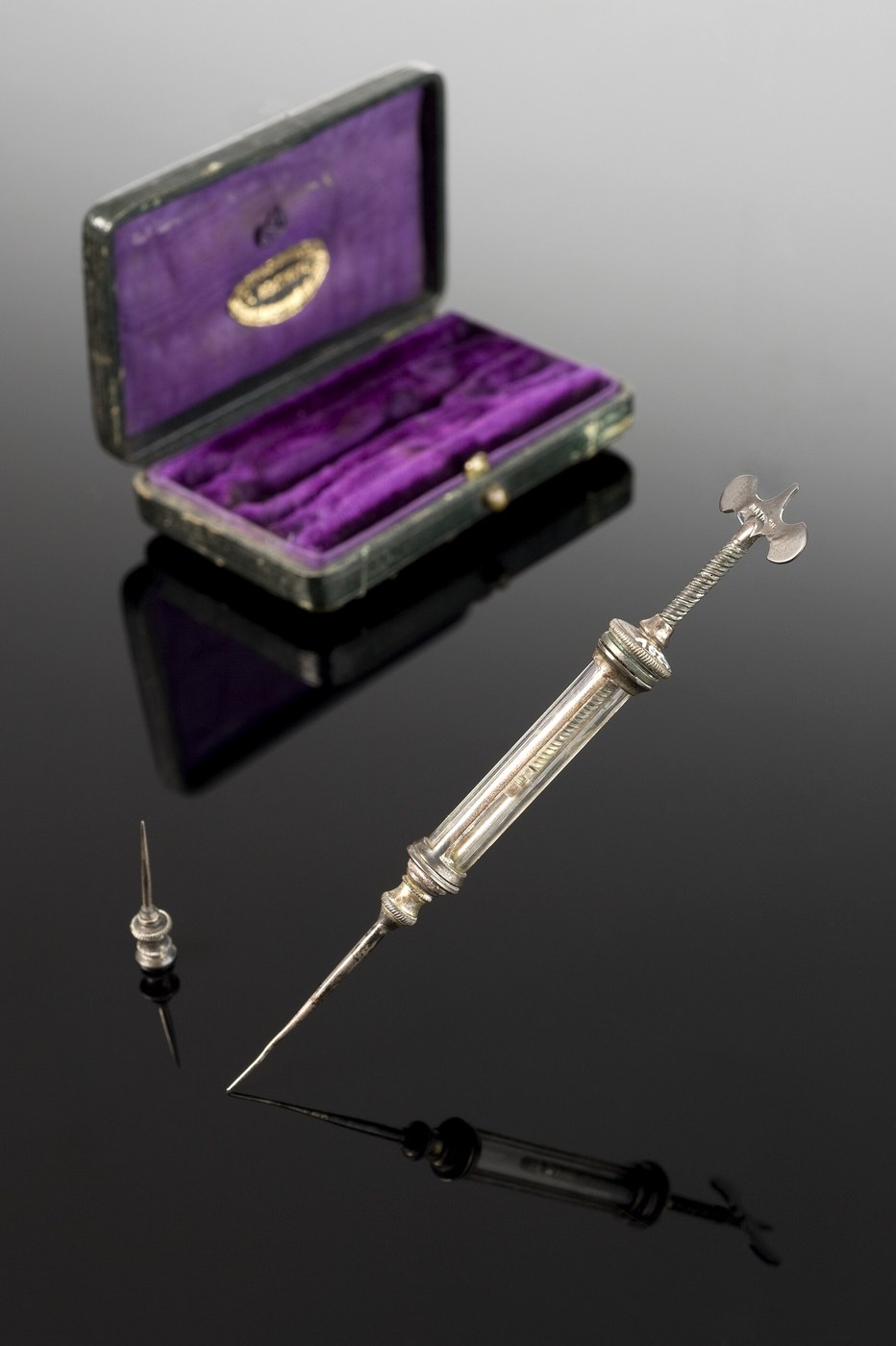


The Hypodermic Syringe
A syringe is a piston pump with a hole so small that the hole, not the pump, decides everything.
When Alexander Wood and Charles Pravaz independently arrived at the hollow-needle syringe in 1853, the hard part was never the barrel. Piston pumps were centuries old. The hard part was two fits: a plunger that seals against a glass bore without lubricant contaminating the dose, and a needle that stays attached under pressure without a thread that traps fluid.
Both were solved by taper. The plunger was ground to its own individual barrel — syringe and plunger were a matched pair, numbered together, useless if swapped. The needle was solved later and better, by the 6 percent Luer taper: a cone that grips by friction alone, has no crevice to harbour organisms, and works in one motion with one hand.
This blueprint builds the fluid mechanics rather than the disposable. You will model the taper, compute why needle gauge dominates the force in your thumb, and make a matched-pair ground fit — the same skill as grinding a lens, applied to a cylinder. What you will not do is inject anything into anything living: this is a bench pump, and every fluid in it is water or glycerol.
Średniozaawansowany
5 hours
Instrukcje
1
1
Why the needle wins the argument
Why the needle wins the argument
Take the two resistances in series and compare them honestly.
Flow through a smooth tube at low Reynolds number follows the Hagen-Poiseuille relation: the volumetric flow is proportional to the pressure drop times the fourth power of the radius, divided by viscosity and length. The fourth power is the entire story. A 21-gauge needle has an outside diameter of 0.819 millimetres and a bore near 0.51; a 25-gauge is 0.515 outside with a bore near 0.26. Halving the bore does not double the resistance, it multiplies it by sixteen.
Now the barrel. A 10 millilitre barrel is roughly 15 millimetres across and 60 long. Its radius is thirty times the needle's, so its contribution to resistance is thirty to the fourth — about 810,000 times smaller for equal length. The barrel is, hydraulically, not there.
This is why the force you feel in your thumb is set almost entirely by the needle you chose, and why the same syringe feels effortless with a wide needle and immovable with a fine one. It is also why you cannot fix a slow injection by pushing harder for long: the pressure needed rises as the fourth power falls, and glass barrels have a burst limit.
Write down the two bore radii you intend to test before proceeding.
2
2
Plunger force against needle gauge and viscosity
Plunger force against needle gauge and viscosity
Wczytywanie notatnika Jupyter…
Potrzebne narzędzia:
 Komputer stacjonarny
3
3
Grind a matched pair
Grind a matched pair
This is lens grinding applied to a cylinder, and the technique transfers directly.
Take a length of thick-wall borosilicate tube for the barrel and a solid rod for the plunger, sized so the rod enters the bore with visible slop. Charge the gap with a fine abrasive slurry — 400 grit to start — and work the plunger in and out with a slow rotation, reversing direction often. The two surfaces abrade each other, and because they abrade each other they converge on the same cylinder. That is the trick: you are not grinding to a dimension, you are grinding two parts into agreement.
Step down through 600 and 1000 grit, washing thoroughly between grades. One particle of coarse grit surviving into the fine stage will score the bore for its whole length and you will start again.
Test by feel and by air. A finished pair, dry and clean, should slide smoothly and then stop against trapped air with no audible hiss, and should return under its own trapped pressure when released. That air seal without any elastomer is the whole achievement, and it is why nineteenth-century syringes were numbered in pairs and ruined by being mixed up.
Mark both parts with the same number now, before they can be separated on the bench.
Materiały do tego kroku:
 Pręt ze szkła borokrzemowego1 sztuka
 Rurka borokrzemowa grubościenna1 sztuka
 Zestaw ziaren ściernych z węglika krzemu1 zestaw
Potrzebne narzędzia:
 Palnik stołowy do dmuchania szkła
 Tokarka szklarska
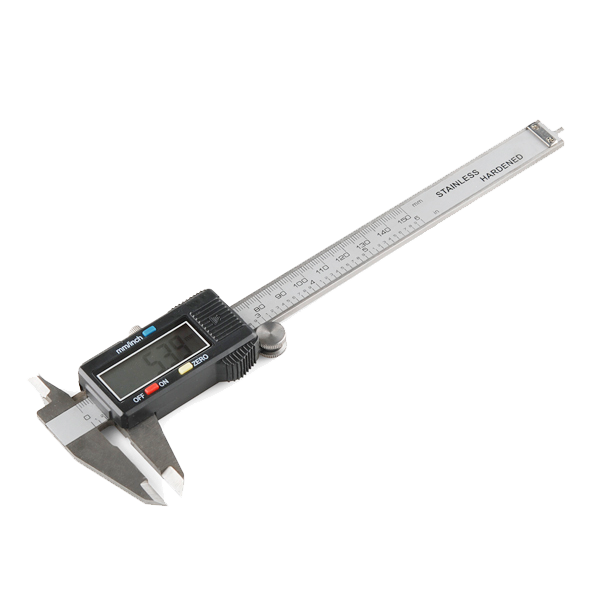 Digital Calipers - 152.4 mm
 Mikroskop cyfrowy
4
4
Measure your own curve, then read the limit
Measure your own curve, then read the limit
Mount the finished syringe vertically, hang known masses from the plunger, and time the delivery of a measured volume through each needle in turn. You now have flow against force, which is flow against pressure once you divide by the barrel area.
Plot your points on the notebook's prediction. Expect them to sit below the ideal line, and expect the discrepancy to grow at the fine gauges. Two effects account for it, and both are real: the entrance to the needle costs pressure that Poiseuille does not model, and the ground plunger has friction that does not scale with flow. Subtract a constant friction term and the residual should collapse onto the theory — do that fit, because it is how you separate a fluid effect from a mechanical one in any pump.
The limits are worth stating plainly. This is a bench pump for water and glycerol. A real hypodermic is a sterile single-use device, and its whole safety case rests on things this build does not have: certified needle sharpness and grind geometry, guaranteed particulate-free fluid path, sterility at point of use, and a disposal route that stops the sharp from reaching anybody else. None of those are grinding problems, which is precisely why the disposable plastic syringe replaced the beautiful matched glass pair everywhere by the 1970s. The ground fit was not beaten on performance. It was beaten on sterility.
Materiały do tego kroku:
 Zestaw odważników wzorcowych1 zestaw
Potrzebne narzędzia:
Digital Calipers - 152.4 mm Statyw laboratoryjny
 Precyzyjna waga cyfrowa
Materiały
4- 1 sztukaZastępnik
- 1 sztukaZastępnik
- Zastępnik
- 1 zestawZastępnik
Wymagane narzędzia
7- Zastępnik
- Zastępnik
- Zastępnik
- Digital Calipers - 152.4 mm10% prowizji$14.03
- Zastępnik
- Zastępnik
- Zastępnik
Powiązane blueprinty
Te blueprinty dzielą się wiedzą — technikami, materiałami lub zasadami


CC0 Domena publiczna
Ten plan jest udostępniany na licencji CC0. Możesz go swobodnie kopiować, modyfikować, rozpowszechniać i wykorzystywać do dowolnych celów, bez konieczności uzyskiwania zgody.
Wesprzyj Makera kupując produkty przez jego plan, za co zarabia Prowizja Makera ustalony przez sprzedawców, lub stwórz nową iterację tego planu i dołącz go jako połączenie w swoim własnym planie, aby dzielić się przychodami.