Współpraca
SZTUKA
Piękno i dobre samopoczucie
RZEMIOSŁO
KULTURA I HISTORIA
ROZRYWKA
ŚRODOWISKO
JEDZENIE I NAPOJE
INŻYNIERIA ODWROTNA
NAUKI
LEKKOATLETYKA
TECHNOLOGIA
URZĄDZENIA DO NOSZENIA
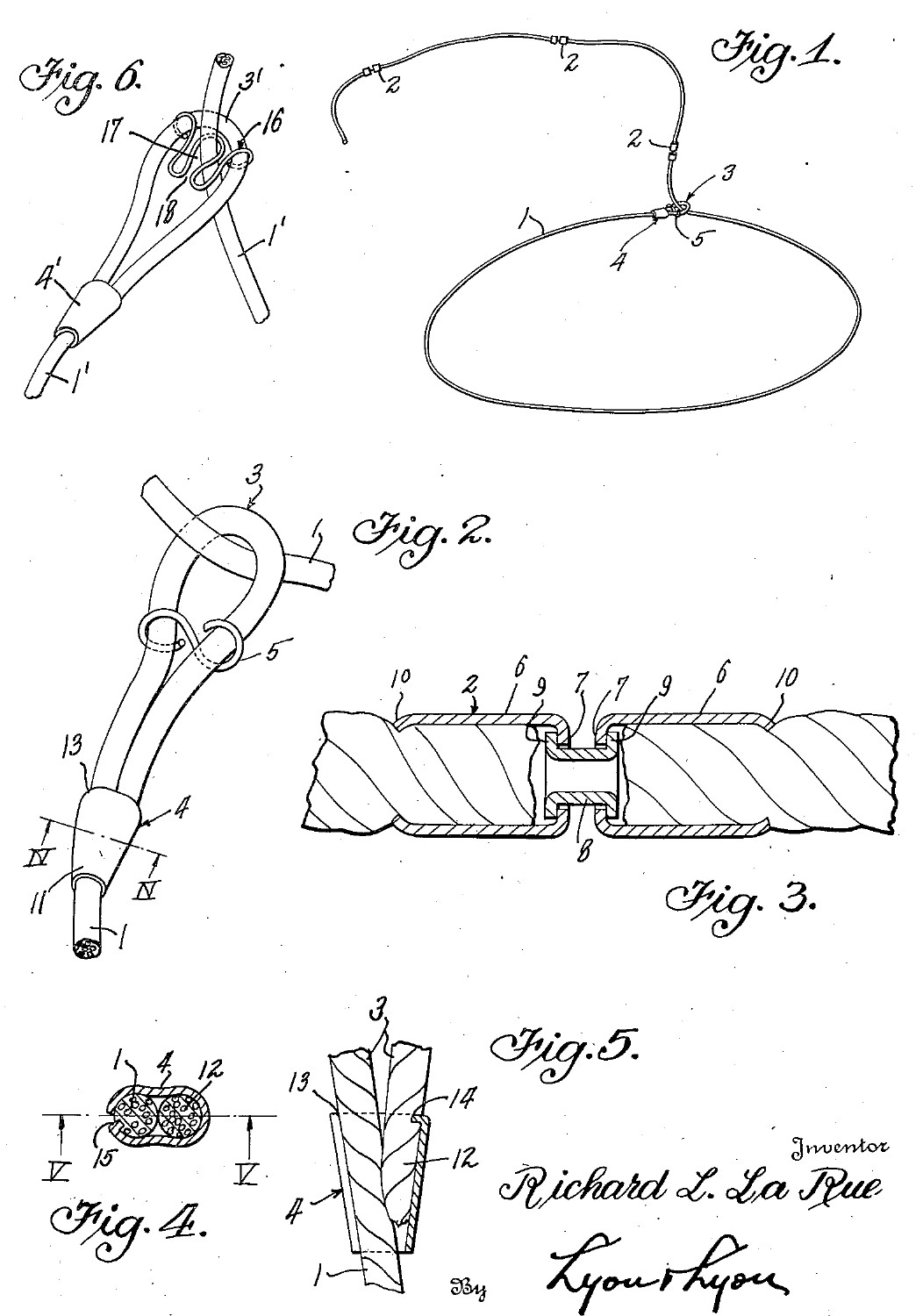


Trick Lariat That Will Not Twist: Brass Swivels in the Rope and a Choker on the Hondoo (La Rue, 1935)
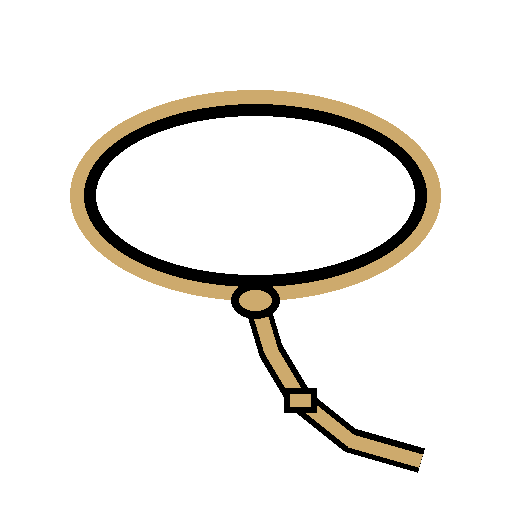
Richard L. La Rue of Los Angeles received US 1,993,010, dated 5 March 1935, for a lariat that beginners can spin. A spinning loop twists the rope; an expert lets it roll in the hand, a beginner cannot. La Rue cuts the rope into sections joined by small brass swivels, so the twist runs out. The hondoo, the eye the rope runs through, is clamped in a brass ferrule, and a wire choker can lock the loop at one size.
We make it from cotton rope and brass tube. All sizes are ours.
Średniozaawansowany
About 4 hours
Instrukcje
1
1
Where the swivels go
Where the swivels go
Wczytywanie notatnika Jupyter…
2
2
Read US 1,993,010
Read US 1,993,010
"In accordance with the present invention, twisting of the rope is prevented by inserting several swivels at intervals along the rope, so that no matter how the operator holds it there is always at least one swivel between his hand and the loop. The swivels are made substantially the same outside diameter as the rope so that they pass readily through the hondoo."
3
3
Cut the rope
Cut the rope
Cut 6 m of 10 mm braided cotton rope (ours) into the sections the notebook gives. Wrap tape round each place before cutting so the ends do not fray.
Materiały do tego kroku:
 Lina bawełniana1 sztuka
Potrzebne narzędzia:
 Miara zwijana
 Nóż introligatorski
4
4
Make the ferrules
Make the ferrules
For three swivels cut six 25 mm pieces of 3/8 in brass tube (ours), his ferrules 6, and file the ends square. Soften the brass by heating each piece to a dull red with the torch and dropping it in water. On the anvil, tap one end of each inward all round with the hammer, turning it as you go, until the opening is about 4.5 mm: his end wall 7. Flare the other end out a little so the rope will go in.
Materiały do tego kroku:
 Rurka mosiężna o średnicy zewnętrznej 9,5 mm1 sztuka
Potrzebne narzędzia:
 Piła do metalu
 Zestaw pilników
 Palnik propanowy
 Kadź hartownicza
 Woda
 Kowadło
 Młotek ślusarski z kulistym rąbem
 Okulary ochronne
5
5
Join the ferrules into swivels
Join the ferrules into swivels
Cut three 10 mm pieces of 4 mm brass tube (ours), his member 8. Put two ferrules end wall to end wall, push the small tube through both openings, and flare its ends with a centre punch from inside each ferrule until they cannot pull back through: his flanges 9. The two halves must turn freely on each other.
Materiały do tego kroku:
 Rura mosiężna1 sztuka
Potrzebne narzędzia:
Piła do metalu PunktakMłotek ślusarski z kulistym rąbem
 Imadło warsztatowe
6
6
Fit the rope into the swivels
Fit the rope into the swivels
Push a rope end into each open ferrule as far as it goes. Squeeze the flared end back in, with the hammer on the anvil or in the vice, until it digs into the rope all round. Pull hard on each joint to test it.
Potrzebne narzędzia:
Młotek ślusarski z kulistym rąbemKowadłoImadło warsztatowe7
7
Make the hondoo
Make the hondoo
Cut 40 mm of brass tube big enough to take the rope doubled (ours) and saw it open along its length. Squeeze one end round the single rope; flatten the other end into an oval. Pass the loop end of the rope through, from the small end, then double its butt end back and push it into the oval end as far as it will go, leaving a small eye: his hondoo 3. Dent the oval end to hold the butt (his 14) and turn one cut edge in against the rope (his 15).
Materiały do tego kroku:
Rura mosiężna1 sztukaPotrzebne narzędzia:
Piła do metaluImadło warsztatowe Szczypce płaskiePunktakMłotek ślusarski z kulistym rąbem
8
8
Bend the choker
Bend the choker
Bend 2.5 mm steel wire (ours) into a figure 8 round the two rope parts of the hondoo, one eye on each, so it slides when pushed but stays put by friction. Pass the free end of the rope through the hondoo to make the loop.
Materiały do tego kroku:
 Drut stalowy1 sztuka
Potrzebne narzędzia:
 Obcinaki boczne
 Szczypce okrągłeSzczypce płaskie
9
9
Use it
Use it
With the choker pushed up to the ferrule, the rope runs freely through the hondoo like any lariat. To spin a loop of one size, slide the choker away from the ferrule until the hondoo grips the running rope: the loop then stays the same size while it spins.
10
10
Troubleshooting
Troubleshooting
Swivel trick lariat troubleshooting.
Flow
Loading...
11
11
History and honest limits
History and honest limits
**Richard L. La Rue** of Los Angeles, US 1,993,010, dated 5 March 1935, filed 16 November 1932, for "a lariat for use by amateurs in performing tricks". He claimed the choker, "a figure 8 clamp of heavy wire", and a clamp "movable back and forth over the doubled rope constituting the hondoo for varying the size of the eye". He also shows a second choker of bent wire (Fig. 6), not built here. He names no rope and gives no sizes: the cotton rope, its length, the tubes, the annealing, the wire and all sizes are ours.
Materiały
4- 1 sztukaZastępnik
- Zastępnik
- 1 sztukaZastępnik
- 1 sztukaZastępnik
Wymagane narzędzia
15- 1 vendor sell this, none ship to you yetZastępnik
- Zastępnik
- Zastępnik
- Zastępnik
- Zastępnik
- Zastępnik
- Zastępnik
- Zastępnik
- Zastępnik
- Zastępnik
- Zastępnik
- Zastępnik
- Zastępnik
- Zastępnik
- Zastępnik
Według tego planu powstaje
Powiązane blueprinty
Te blueprinty dzielą się wiedzą — technikami, materiałami lub zasadami


CC0 Domena publiczna
Ten plan jest udostępniany na licencji CC0. Możesz go swobodnie kopiować, modyfikować, rozpowszechniać i wykorzystywać do dowolnych celów, bez konieczności uzyskiwania zgody.
Wesprzyj Makera kupując produkty przez jego plan, za co zarabia Prowizja Makera ustalony przez sprzedawców, lub stwórz nową iterację tego planu i dołącz go jako połączenie w swoim własnym planie, aby dzielić się przychodami.