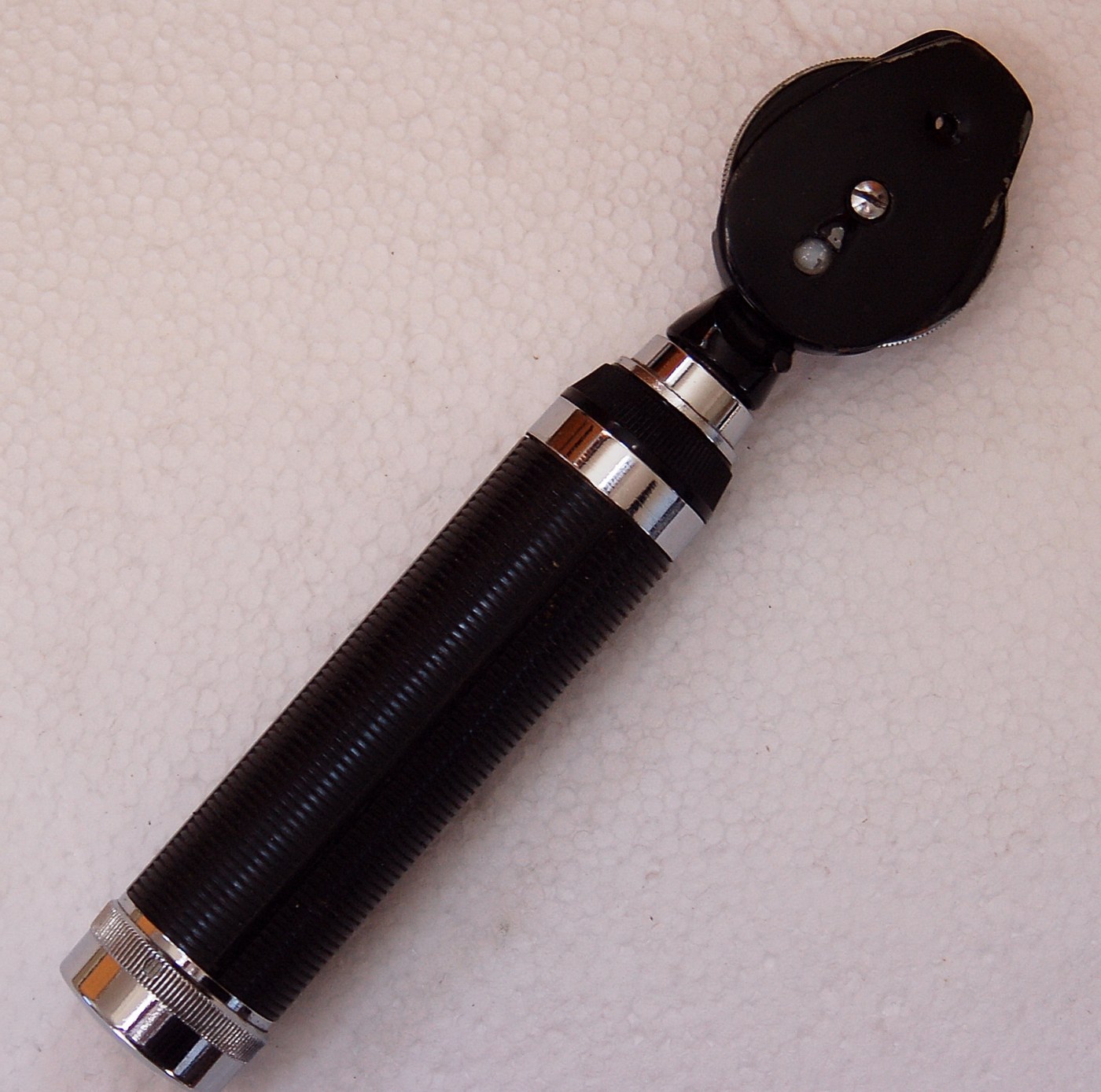


Ophthalmoscope
Instrukcje
Show why the pupil looks black
Show why the pupil looks black
Model the eye as a box with a lens and a small aperture.
- Make a light-tight box with a small hole and a lens behind it.
- Line the back with pale card to stand in for the retina.
- Shine a torch at the hole from beside your head and try to see the back wall.
Materiały do tego kroku:
 Soczewka wypukła1 sztuka
Put the observer in the beam
Put the observer in the beam
Helmholtz's insight: look along the illuminating axis, not beside it.
- Set a partly reflecting surface — a thin glass plate — at 45 degrees between your eye and the model.
- Shine the torch in from the side, so the plate reflects it into the aperture.
- Look THROUGH the plate along the same axis.
Materiały do tego kroku:
 Zwierciadło płaskie1 sztuka
 Płyta akrylowa1 arkusz
Add the focusing lenses
Add the focusing lenses
Patients are short-sighted, long-sighted or neither, and so are examiners.
- Add a holder that can swing different lenses into the viewing path.
- Change the model eye's internal length to simulate a refractive error.
- Select the lens that brings the back wall into focus.
Understand what the red reflex means
Understand what the red reflex means
Do NOT examine anyone's eyes with a homemade instrument — but know what clinicians look for.
- A healthy retina returns a uniform orange-red glow, the red reflex — this is the same effect as red-eye in flash photography.
- An absent or white reflex is a serious sign, and in a child can indicate retinoblastoma.
- Clinicians examine the optic disc, the vessels and the macula in turn.
History and context
History and context
Hermann von Helmholtz built his Augenspiegel in 1851, at 30, while teaching physiology at Königsberg — reportedly while preparing a lecture demonstration on why the pupil appears black. He was one of the most wide-ranging scientists of the century: the conservation of energy, the theory of hearing, colour vision, nerve conduction speed and the physiology of the eye all carry his work.
He was not quite first, and he said so. Charles Babbage — the computing pioneer — had built a similar instrument around 1847 and shown it to a physician who apparently did not grasp its value; it went nowhere. Priority in instruments often belongs to whoever puts the device into the hands of people with a use for it, and Helmholtz published into a medical community that immediately understood what it had.
It created a speciality. Before 1851, ophthalmology inferred internal disease from external signs and the patient's account. Afterwards it could observe pathology directly in a living person. That is a rare kind of instrument: not a better measurement of something already visible, but a first sight of something previously hidden.
Where it went: the fundus camera photographs what the ophthalmoscope shows, optical coherence tomography images the retina in cross-section micrometre by micrometre, and automated screening now examines retinal photographs for diabetic damage at population scale. All of them look through the pupil along the illumination axis — the geometry Helmholtz worked out.
Materiały
3- 1 sztukaZastępnik
- 1 sztukaZastępnik
- 1 arkuszZastępnik
Powiązane blueprinty
Te blueprinty dzielą się wiedzą — technikami, materiałami lub zasadami


CC0 Domena publiczna
Ten plan jest udostępniany na licencji CC0. Możesz go swobodnie kopiować, modyfikować, rozpowszechniać i wykorzystywać do dowolnych celów, bez konieczności uzyskiwania zgody.
Wesprzyj Makera kupując produkty przez jego plan, za co zarabia Prowizja Makera ustalony przez sprzedawców, lub stwórz nową iterację tego planu i dołącz go jako połączenie w swoim własnym planie, aby dzielić się przychodami.