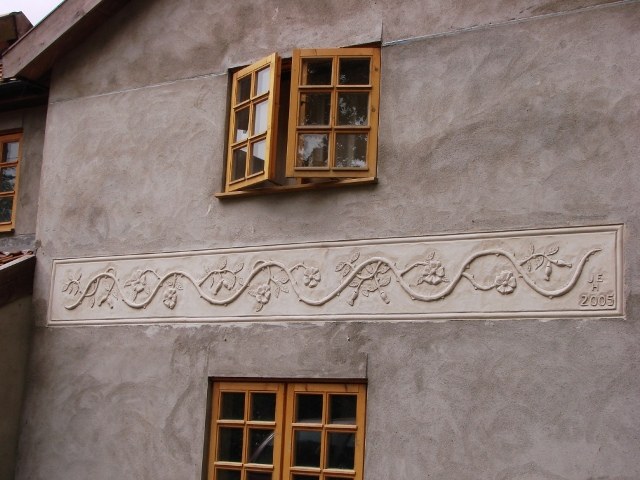


Pargeting
Instrukcje
Mix lime, sand and hair
Mix lime, sand and hair
Three components, each doing a different job. Lime is caustic — gloves and eye protection.
- Combine lime putty with well-graded sharp sand, roughly one part lime to three of sand.
- Beat in animal hair, teased apart so it distributes evenly.
- Knock the mix up thoroughly until it is plastic and cohesive.
Materiały do tego kroku:
 Wodorotlenek wapnia (wapno gaszone)2 kg
 Piasek formierski5 kg
Build up in coats, each weaker than the last
Build up in coats, each weaker than the last
Never one thick coat, and never a strong coat over a weak one.
- Apply a first coat and scratch it to key the next.
- Let it firm up before the second, thinner coat.
- Keep each successive coat no stronger than the one beneath.
Model the relief while it is workable
Model the relief while it is workable
Lime gives you hours, not minutes — use them.
- Build the relief up in successive additions rather than carving down from a thick mass.
- Model with wooden and metal tools, or press from a mould for repeated motifs.
- Undercut sparingly.
Materiały do tego kroku:
 Nóż snycerski sloyd1 sztuka
Cure it slowly and understand why
Cure it slowly and understand why
Lime does not dry — it reacts with the air, and it needs time and moisture to do it.
- Protect the work from sun, wind and frost.
- Mist it periodically over days to keep it damp.
- Understand the chemistry: Ca(OH)₂ + CO₂ → CaCO₃ + H₂O.
Materiały do tego kroku:
 Termometr błyskawiczny1 sztuka
History and context
History and context
Pargeting flourished in England in the sixteenth and seventeenth centuries and is concentrated in Suffolk and Essex — Saffron Walden has the best-known concentration, and the Ancient House at Ipswich carries an extraordinary display. Much surviving work is Victorian revival rather than original, and telling them apart is a genuine specialism.
Why lime and not cement, stated properly. A timber-framed building moves constantly with humidity and load. Lime plaster is soft enough to accommodate that movement and to self-heal fine cracks as free lime redeposits in them. Cement render is stronger, more brittle and — crucially — far less permeable, so moisture that gets behind it cannot evaporate out and instead rots the timber frame. Cement rendering applied to historic timber buildings in the twentieth century has destroyed a great deal of fabric, and that is a documented, expensive mistake rather than a matter of taste.
The hair is a real structural component. Ox or horse hair at a few kilograms per cubic metre gives the coat tensile capacity it otherwise entirely lacks. Modern conservation work still specifies animal hair for authenticity and performance, though polypropylene fibre is used where sourcing is difficult.
Its slow carbonation is now interesting for another reason: lime reabsorbs a substantial part of the CO₂ released when it was burned. That does not make lime carbon-neutral — burning it takes fuel — but it makes the comparison with Portland cement less lopsided than the kiln figures alone suggest.
Materiały
4- Zastępnik
- Zastępnik
- 1 sztukaZastępnik
- 1 sztukaZastępnik
Powiązane blueprinty
Te blueprinty dzielą się wiedzą — technikami, materiałami lub zasadami

CC0 Domena publiczna
Ten plan jest udostępniany na licencji CC0. Możesz go swobodnie kopiować, modyfikować, rozpowszechniać i wykorzystywać do dowolnych celów, bez konieczności uzyskiwania zgody.
Wesprzyj Makera kupując produkty przez jego plan, za co zarabia Prowizja Makera ustalony przez sprzedawców, lub stwórz nową iterację tego planu i dołącz go jako połączenie w swoim własnym planie, aby dzielić się przychodami.