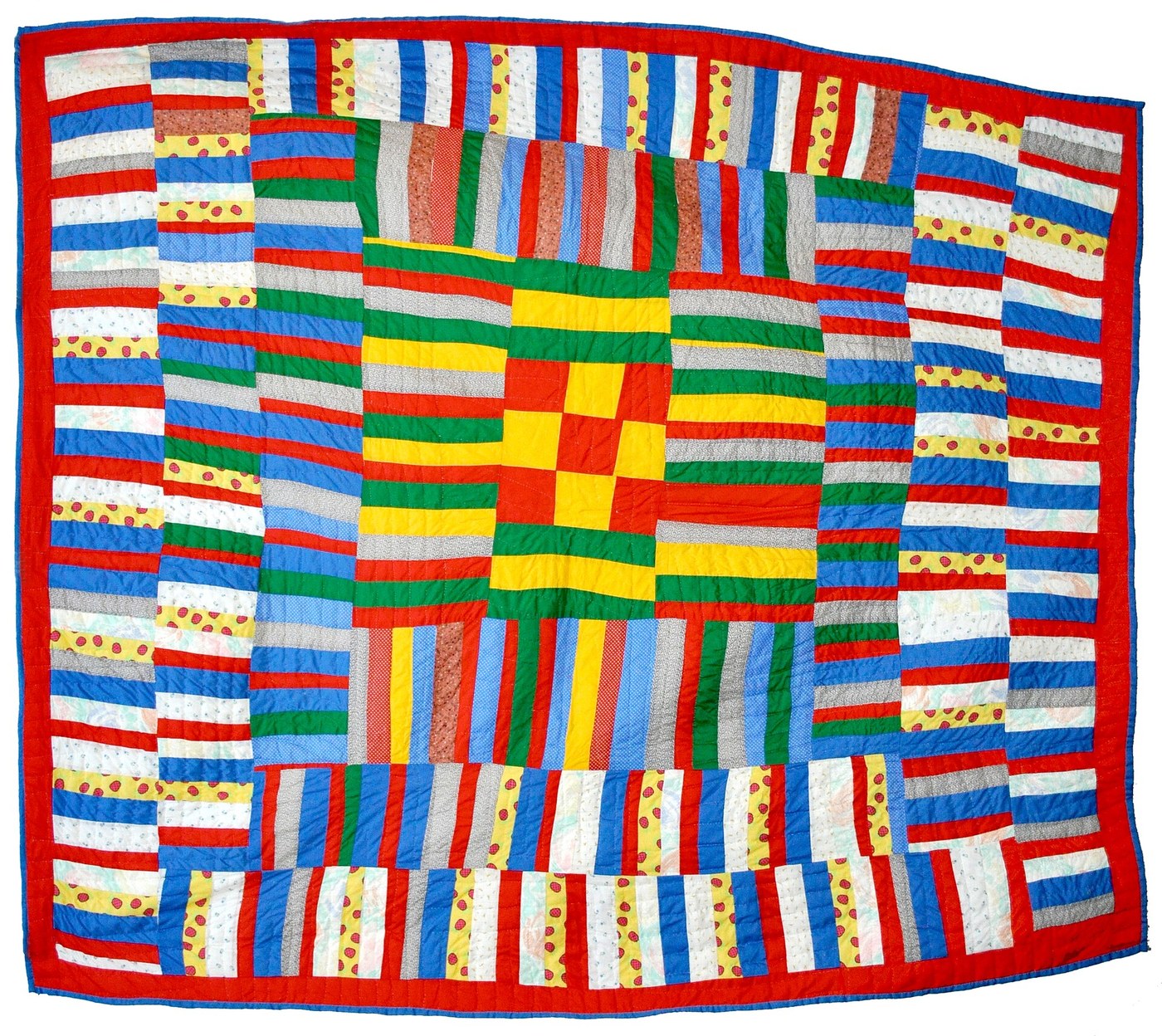


Patchwork Quilt Block
Patchwork solves a problem: cloth was expensive and worn garments still contained good fabric. Cutting the sound parts into simple geometric shapes and rejoining them turns scraps into yardage. The geometry is not decoration first — it is the most efficient way to make a large flat thing out of small irregular offcuts.
Everything depends on one number: the seam allowance. Traditional piecing uses a quarter inch, and it must be identical on every seam in the block. An error of a single millimetre, repeated across the dozens of seams in a finished quilt, compounds into corners that will not meet.
This builds a nine-patch — the simplest traditional block, and the one that teaches accuracy because its errors are immediately visible.
Instrukcje
Wash and press the fabric
Wash and press the fabric
Wash and press all fabric before cutting. Cottons shrink at different rates, and a block pieced from unwashed scraps will pucker the first time it is laundered.
Materiały do tego kroku:
 Tkanina z bawełny organicznej1 sztuka
Find the straight grain
Find the straight grain
Identify the lengthwise grain on each piece. Cut squares on the grain — a square cut on the bias stretches as you sew it and will never sit flat.
Cut nine squares
Cut nine squares
Cut nine 90 mm squares — five of one fabric and four of another. That is the finished size plus a 6 mm seam allowance on all four sides.
Potrzebne narzędzia:
 Nożyce krawieckie
 Linijka
Check every square against the first
Check every square against the first
Stack the squares and check the edges align. Any square more than a millimetre off will show as a bent seam line across the finished block.
Mark a consistent seam guide
Mark a consistent seam guide
Set a physical guide 6 mm from the needle — a strip of tape works. Consistency beats accuracy here. A slightly wrong allowance used identically everywhere still produces a square block; a correct allowance used inconsistently does not.
Sew three rows of three
Sew three rows of three
Join the squares into three rows of three, alternating the two fabrics so the centre row is the reverse of the outer two.
Materiały do tego kroku:
 Nić bawełniana1 sztuka
Potrzebne narzędzia:
 Zestaw igieł i nici kapeluszniczych
Press seams to alternate sides
Press seams to alternate sides
Press the seams of row one to the left, row two to the right, row three to the left. This is the step beginners skip and it is why their corners never match.
Nest the seams when joining rows
Nest the seams when joining rows
Put two rows right sides together and feel the seam allowances lock against each other. Because they were pressed opposite ways they nest, and the intersection lines up by touch rather than by eye.
Pin through the intersections
Pin through the intersections
Pin exactly through each seam junction. These crossings are where errors are visible; the space between them is forgiving.
Join the rows and press
Join the rows and press
Sew the three rows together with the same allowance and press the block flat. Press, do not iron — sliding a hot iron across pieced work stretches it out of square.
Measure the block and diagnose
Measure the block and diagnose
Measure both diagonals — equal means square. If it finished undersized, your seam allowance was too wide; oversized and it was too narrow. The finished measurement tells you exactly what to change.
History & Context
History & Context
Thrift, then design. Patchwork exists because cloth was costly and worn garments still held sound fabric. Geometric piecing is the efficient way to turn irregular salvage into usable yardage — straight seams, simple shapes, no waste. The decorative tradition grew on top of a practical solution, not the other way round.
Why the quarter inch. The traditional allowance is narrow enough not to waste fabric and to lie reasonably flat when pressed, and wide enough not to pull out under use. What matters far more than the exact figure is that it never varies — errors do not average out across a quilt, they accumulate, and a quilt has hundreds of seams.
Nesting is the whole craft. Pressing adjoining rows in opposite directions means their seam allowances butt against each other when the rows meet. That physical lock does the alignment for you. It is a small piece of mechanical cleverness that separates work that matches at the corners from work that does not.
Blocks as a distributed system. Building a quilt from standard blocks means the work is portable, can be done in short sittings, and can be shared — several people can make identical blocks separately and combine them at the end. That is why patchwork became a communal activity, and why block patterns spread with names attached and were traded like recipes.
Quilts as evidence. Dated and signed quilts are studied as historical documents: the fabrics date the piece, the patterns track how designs travelled, and signature quilts record real communities. Note also that some widely repeated stories about quilts — particularly claims that specific patterns encoded messages on the Underground Railroad — are disputed by historians and rest on thin evidence. The textiles are excellent evidence; some of the folklore around them is not.
Materiały
2- 1 sztukaZastępnik
- 1 sztukaZastępnik
Wymagane narzędzia
3- Zastępnik
- Zastępnik
- Zastępnik
CC0 Domena publiczna
Ten plan jest udostępniany na licencji CC0. Możesz go swobodnie kopiować, modyfikować, rozpowszechniać i wykorzystywać do dowolnych celów, bez konieczności uzyskiwania zgody.
Wesprzyj Makera kupując produkty przez jego plan, za co zarabia Prowizja Makera ustalony przez sprzedawców, lub stwórz nową iterację tego planu i dołącz go jako połączenie w swoim własnym planie, aby dzielić się przychodami.