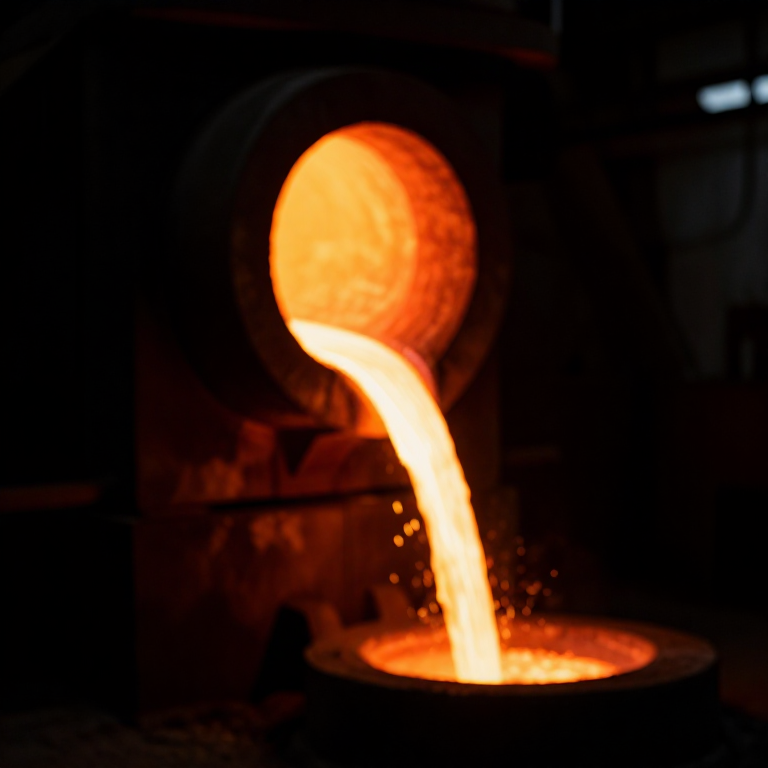


Smelting Pig Iron in a Coke Blast Furnace — Molten Iron at Industrial Scale
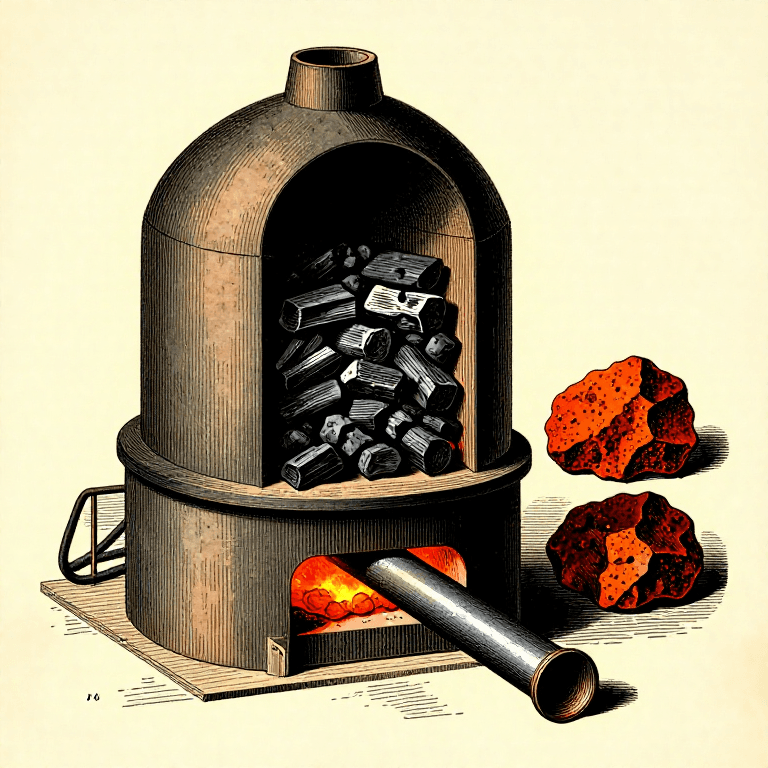
The bloomery gave the ancient world iron, but only in small spongy lumps, one slow batch at a time. The blast furnace changed everything: a tall shaft kept continuously charged and blown produces a steady river of molten iron. Where a bloomery never melts its metal, a blast furnace runs hot enough to liquefy iron entirely, letting it pool at the hearth and be tapped out by the tonne.
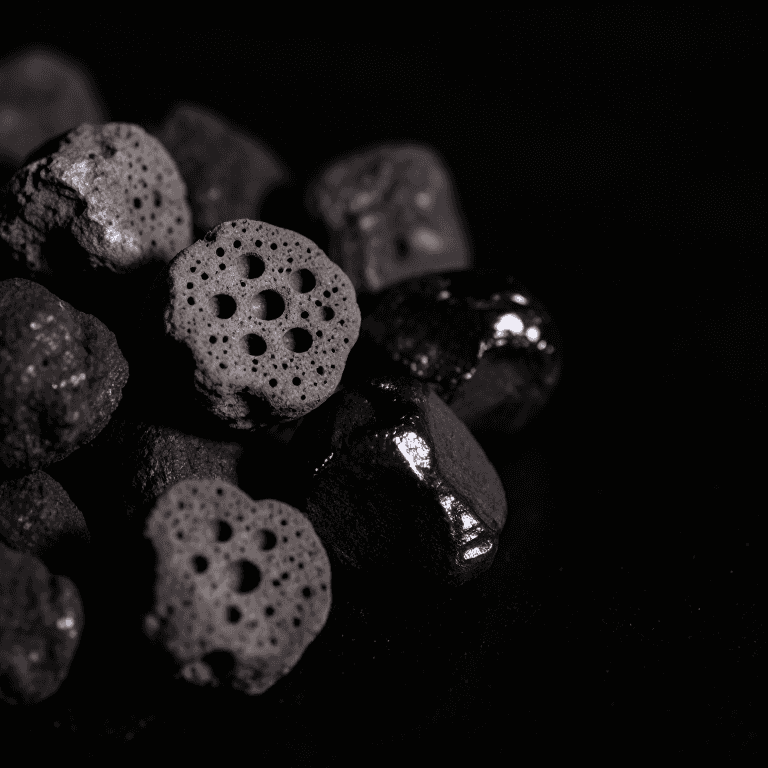
The key is heat and chemistry working together. A powerful air blast burns coke to carbon monoxide, which strips the oxygen from iron ore; meanwhile the descending iron soaks up carbon until it melts. Limestone added as flux carries off the stony impurities as a floating slag. What runs out of the tap hole is pig iron — iron saturated with about four percent carbon: hard, brittle, and perfect for casting or for refining into wrought iron and steel.
When coke replaced charcoal as the blast-furnace fuel in the early 1700s, iron could finally be made in unlimited quantity without consuming whole forests. Cheap pig iron became the raw material of the Industrial Revolution — the metal behind rails, bridges, engines, and machines.
Instrukcje
Understand pig iron
Understand pig iron
Build the shaft furnace
Build the shaft furnace
Materiały do tego kroku:
 Cegły szamotowe80 sztuk
Potrzebne narzędzia:
 Łopatka ogrodnicza
Crush the ore and flux
Crush the ore and flux
Materiały do tego kroku:
 Suszona ruda darniowa30 kg
 Płyta wapienna8 kg
Potrzebne narzędzia:
 Młotek
Set up the air blast
Set up the air blast
Potrzebne narzędzia:
 Miech
MiechLight the coke bed
Light the coke bed
Materiały do tego kroku:
 Koks hutniczy40 kg
Charge in layers
Charge in layers
Materiały do tego kroku:
Koks hutniczy40 kgReduce the ore
Reduce the ore
Melt and carburize
Melt and carburize
Form and tap the slag
Form and tap the slag
Potrzebne narzędzia:
 Drąg spustowy
Tap the molten iron
Tap the molten iron
Potrzebne narzędzia:
Drąg spustowyCast the pigs
Cast the pigs
Materiały do tego kroku:
 Piasek formierski50 kg
Cool, break, and identify
Cool, break, and identify
Potrzebne narzędzia:
MłotekMateriały
5- 80 sztukZastępnik
- Zastępnik
- 8 kgZastępnik
- 40 kgZastępnik
- 50 kgZastępnik
Materiały z połączonych planów

Powiązane blueprinty
Te blueprinty dzielą się wiedzą — technikami, materiałami lub zasadami


CC0 Domena publiczna
Ten plan jest udostępniany na licencji CC0. Możesz go swobodnie kopiować, modyfikować, rozpowszechniać i wykorzystywać do dowolnych celów, bez konieczności uzyskiwania zgody.
Wesprzyj Makera kupując produkty przez jego plan, za co zarabia Prowizja Makera ustalony przez sprzedawców, lub stwórz nową iterację tego planu i dołącz go jako połączenie w swoim własnym planie, aby dzielić się przychodami.