SZTUKA
Piękno i dobre samopoczucie
RZEMIOSŁO
KULTURA I HISTORIA
ROZRYWKA
ŚRODOWISKO
JEDZENIE I NAPOJE
INŻYNIERIA ODWROTNA
NAUKI
LEKKOATLETYKA
TECHNOLOGIA
URZĄDZENIA DO NOSZENIA
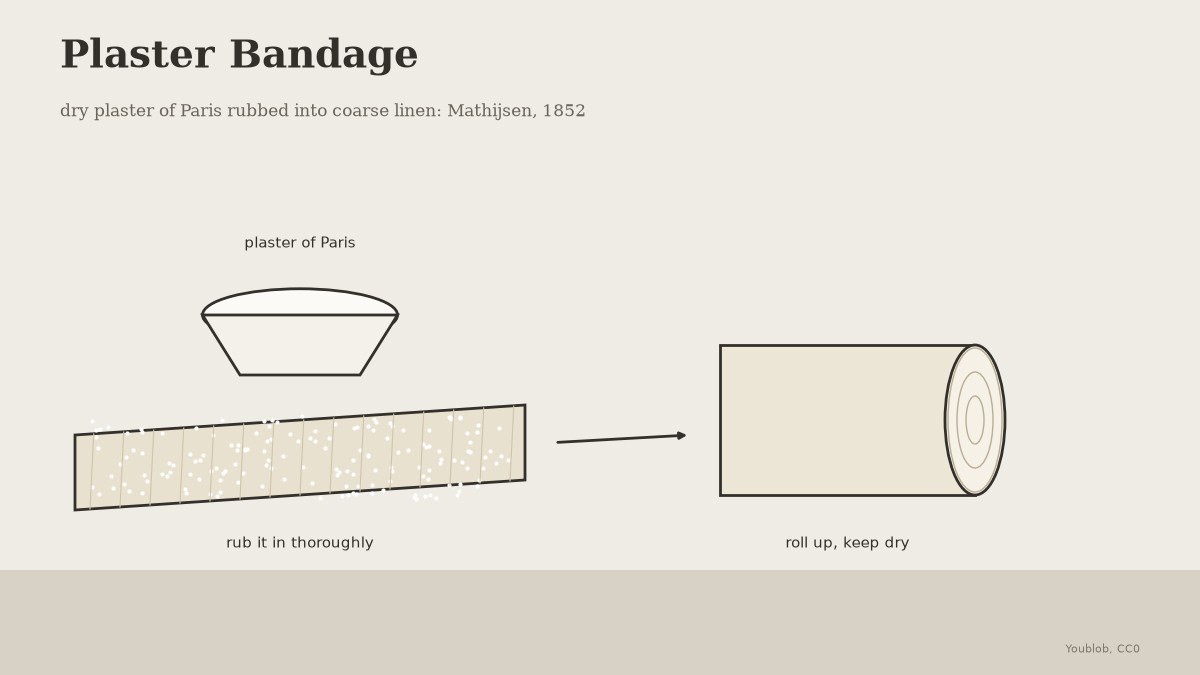


Plaster Bandage: Dry Plaster of Paris Rubbed into Coarse Linen, Mathijsen 1852
The plaster bandage of the Dutch army surgeon Antonius Mathijsen (1852): coarse linen with dry plaster of Paris rubbed well into it. Wetted as it goes on and rubbed by hand, it sets hard within minutes. Until 1931 hospitals made their own this way.
The picture: our own drawing.
Początkujący
1 hour
Instrukcje
1
1
Cut coarse linen strips
Cut coarse linen strips
Cut a coarsely woven linen into long strips, bandage width.
Materiały do tego kroku:
 Tkanina lniana1 sqm
Potrzebne narzędzia:
 Nożyce krawieckie
2
2
Rub the plaster in
Rub the plaster in
Lay a strip flat and rub dry plaster of Paris thoroughly into the weave, working along its length. Do it slowly so the dust stays down.
Materiały do tego kroku:
 Gips modelarski500 g
Potrzebne narzędzia:
 Miska
 Maska filtrująca N95
3
3
Roll and keep dry
Roll and keep dry
Roll each strip loosely and store it closed and dry: any damp sets the plaster. To use, wet it as it goes on and rub it smooth by hand.
Potrzebne narzędzia:
 Słoiki szklane z pokrywkami
Materiały
2- 1 sqmZastępnik
- 500 gZastępnik
Wymagane narzędzia
4- Zastępnik
- Zastępnik
- Zastępnik
- Zastępnik
Według tego planu powstaje

CC0 Domena publiczna
Ten plan jest udostępniany na licencji CC0. Możesz go swobodnie kopiować, modyfikować, rozpowszechniać i wykorzystywać do dowolnych celów, bez konieczności uzyskiwania zgody.
Wesprzyj Makera kupując produkty przez jego plan, za co zarabia Prowizja Makera ustalony przez sprzedawców, lub stwórz nową iterację tego planu i dołącz go jako połączenie w swoim własnym planie, aby dzielić się przychodami.