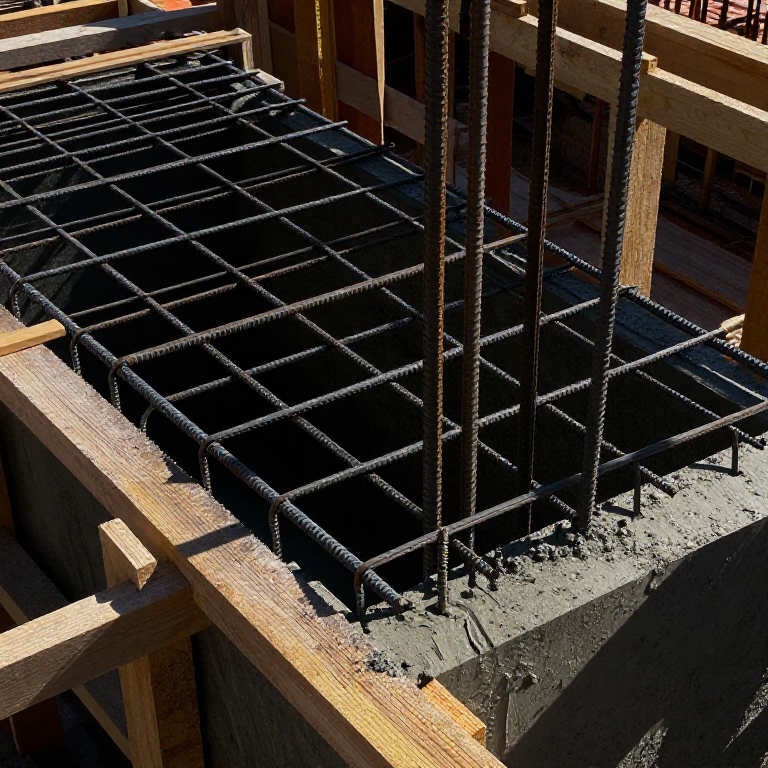


Casting Reinforced Concrete — Marrying Steel and Stone into the Modern Structure
Concrete is wonderful stuff in compression — squeeze it and it holds — but pull on it and it cracks like a biscuit. Steel is the opposite: superb in tension, useless if you try to build a wall of it. In the late 1800s builders like Joseph Monier and François Hennebique realised that embedding steel inside concrete combines the best of both, and reinforced concrete became the material that built the modern world.
The idea works because of three lucky properties. Concrete and steel expand and contract at almost exactly the same rate, so temperature changes do not tear them apart. Wet concrete is strongly alkaline, which coats the steel in a protective film that stops it rusting. And the two grip each other firmly, so a load shared between them is truly shared. Put steel where the structure is stretched and concrete where it is squeezed, and you get a member strong in every direction.
From this came bridges, dams, tunnels, and the skeletons of skyscrapers — shapes impossible in stone or iron alone. The skill is in knowing where the steel must go and in surrounding it completely with sound, well-cured concrete.
Instrukcje
Understand the partnership
Understand the partnership
Know where the steel goes
Know where the steel goes
Build the formwork
Build the formwork
Materiały do tego kroku:
 Deska tarta10 sztuk
Potrzebne narzędzia:
 Młotek
Cut and bend the rebar
Cut and bend the rebar
Materiały do tego kroku:
 Pręt zbrojeniowy ze stali niskowęglowej #415 metrów
Potrzebne narzędzia:
 Giętarka do prętów
Place and tie the cage
Place and tie the cage
Materiały do tego kroku:
 Drut wiązałkowy1 rolka
Mix the concrete
Mix the concrete
Materiały do tego kroku:
 Cement portlandzki50 kg
 Piasek drobny100 kg
 Żwir200 kg
Potrzebne narzędzia:
 Betoniarka
Pour around the steel
Pour around the steel
Materiały do tego kroku:
 Woda30 litrów
Compact out the air
Compact out the air
Potrzebne narzędzia:
 Pręt do zagęszczania
Cure it slowly
Cure it slowly
Strip the formwork
Strip the formwork
Potrzebne narzędzia:
 Łom płaski
Understand why it lasts
Understand why it lasts
See what it built
See what it built
Materiały
7- 10 sztukZastępnik
- Zastępnik
- 1 rolkaZastępnik
- 50 kgZastępnik
- 100 kgZastępnik
- 200 kgZastępnik
- 30 litrówZastępnik
Wymagane narzędzia
5- Zastępnik
- Zastępnik
- Zastępnik
- Zastępnik
- Zastępnik
Materiały z połączonych planów



Powiązane blueprinty
Te blueprinty dzielą się wiedzą — technikami, materiałami lub zasadami


CC0 Domena publiczna
Ten plan jest udostępniany na licencji CC0. Możesz go swobodnie kopiować, modyfikować, rozpowszechniać i wykorzystywać do dowolnych celów, bez konieczności uzyskiwania zgody.
Wesprzyj Makera kupując produkty przez jego plan, za co zarabia Prowizja Makera ustalony przez sprzedawców, lub stwórz nową iterację tego planu i dołącz go jako połączenie w swoim własnym planie, aby dzielić się przychodami.