SZTUKA
Piękno i dobre samopoczucie
RZEMIOSŁO
KULTURA I HISTORIA
ROZRYWKA
ŚRODOWISKO
JEDZENIE I NAPOJE
INŻYNIERIA ODWROTNA
NAUKI
LEKKOATLETYKA
TECHNOLOGIA
URZĄDZENIA DO NOSZENIA
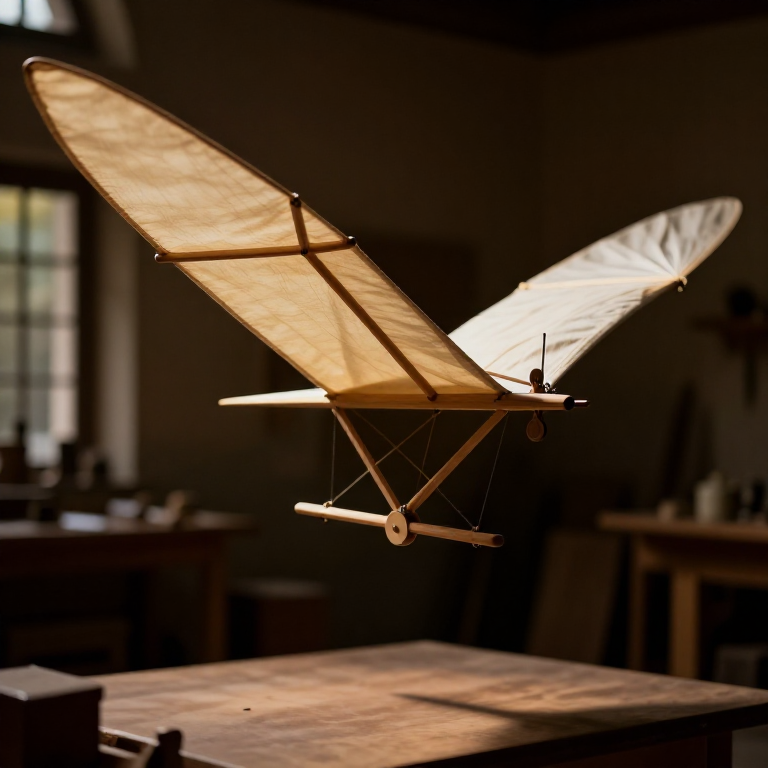


Building Leonardo da Vinci's Ornithopter — The Flapping-Wing Flying Machine
Leonardo da Vinci spent decades studying how birds fly, filling his 1505 Codex on the Flight of Birds with observations of wings, air and balance. From it came his ornithopter: a machine in which a person lies prone and drives great bird-like wings up and down with arms and legs. This blueprint reconstructs it — wing frames, linen membranes, and a pulley-and-pedal drive. It is also honest about the outcome: a human simply cannot produce the power to flap wings big enough to lift themselves. The dream failed, but Leonardo's insights into cambered wings and air as a fluid were right, and they fed the aircraft that finally flew.
Zaawansowany
30
Instrukcje
1
1
Study Leonardo's bird flight
Study Leonardo's bird flight
Leonardo watched birds for years, recording in his 1505 Codex on the Flight of Birds how a wing pushes against the air, how camber gives lift, and how a bird shifts its weight to balance. He set out to let a person fly the same way — by flapping wings.
2
2
Build the wing frames
Build the wing frames
Build two large wings on a light wooden frame, jointed so each can beat down and lift back up. Curve the leading edge into a camber like a bird's wing, the shape Leonardo saw gives lift.
Materiały do tego kroku:
 Tarcica bukowa4 sztuk
Potrzebne narzędzia:
 Piła ręczna
3
3
Cover the wings with linen
Cover the wings with linen
Stretch linen tightly over the wing frames so each wing presents a solid face that grips the air on the downstroke. Stitch and seal the membrane as Leonardo specified for his flying machines.
Materiały do tego kroku:
 Tkanina lniana25 square meter
Potrzebne narzędzia:
 Szydło
4
4
Build the pilot's cradle
Build the pilot's cradle
Build a frame where the pilot lies face-down (prone), the streamlined, balanced posture Leonardo drew, with straps to hold the body and free the arms and legs to work the wings.
Materiały do tego kroku:
Tarcica bukowa2 sztuk Skóra regenerowana2 sztuk
Potrzebne narzędzia:
 Nóż
Nóż5
5
Rig the flapping drive
Rig the flapping drive
Connect the wings to hand cranks and foot pedals through ropes and pulleys, so the pilot's arms and legs together haul the wings down hard and raise them for the next beat — pooling all four limbs' strength.
Materiały do tego kroku:
 Lina do wiązania25 metrów
Potrzebne narzędzia:
 Świder ręczny
6
6
Work the wings
Work the wings
The pilot pumps pedals and cranks; the wings beat down against the air. Feel how much force each downstroke needs — and how quickly a human tires trying to sustain it.
7
7
The honest verdict
The honest verdict
It cannot lift a person. Human muscles deliver only a fraction of the power needed to flap wings large enough to carry a body plus the machine; birds have far greater power-to-weight and dedicated flight muscles. Only in 2010, with featherlight modern materials, did a human-powered ornithopter (the Snowbird) briefly sustain flight — showing just how near-impossible Leonardo's goal was.
8
8
What Leonardo got right
What Leonardo got right
His grasp of cambered wings, of air pushing back like a fluid, and of shifting the centre of gravity to steer were all correct, and passed into the gliders and aircraft of later centuries. Flight came not from flapping but from fixed wings and an engine — yet it began with observations like his.
Materiały
6- 6 sztukZastępnik
- 25 square meterZastępnik
- 2 sztukZastępnik
- 25 metrówZastępnik
- 1 sztukaZastępnik
- 1 sztukaZastępnik
Materiały z połączonych planów

Powiązane blueprinty
Te blueprinty dzielą się wiedzą — technikami, materiałami lub zasadami

CC0 Domena publiczna
Ten plan jest udostępniany na licencji CC0. Możesz go swobodnie kopiować, modyfikować, rozpowszechniać i wykorzystywać do dowolnych celów, bez konieczności uzyskiwania zgody.
Wesprzyj Makera kupując produkty przez jego plan, za co zarabia Prowizja Makera ustalony przez sprzedawców, lub stwórz nową iterację tego planu i dołącz go jako połączenie w swoim własnym planie, aby dzielić się przychodami.