

SZTUKA
Piękno i dobre samopoczucie
RZEMIOSŁO
KULTURA I HISTORIA
ROZRYWKA
ŚRODOWISKO
JEDZENIE I NAPOJE
INŻYNIERIA ODWROTNA
NAUKI
LEKKOATLETYKA
TECHNOLOGIA
URZĄDZENIA DO NOSZENIA
Sabai Grass Collection and Preparation — A Traditional Fiber Crop of Odisha
English
NanaChas

Autor

NanaChas

23. kwiecień 2026IN
21
0
0
0
0

Sabai Grass Collection and Preparation — A Traditional Fiber Crop of Odisha

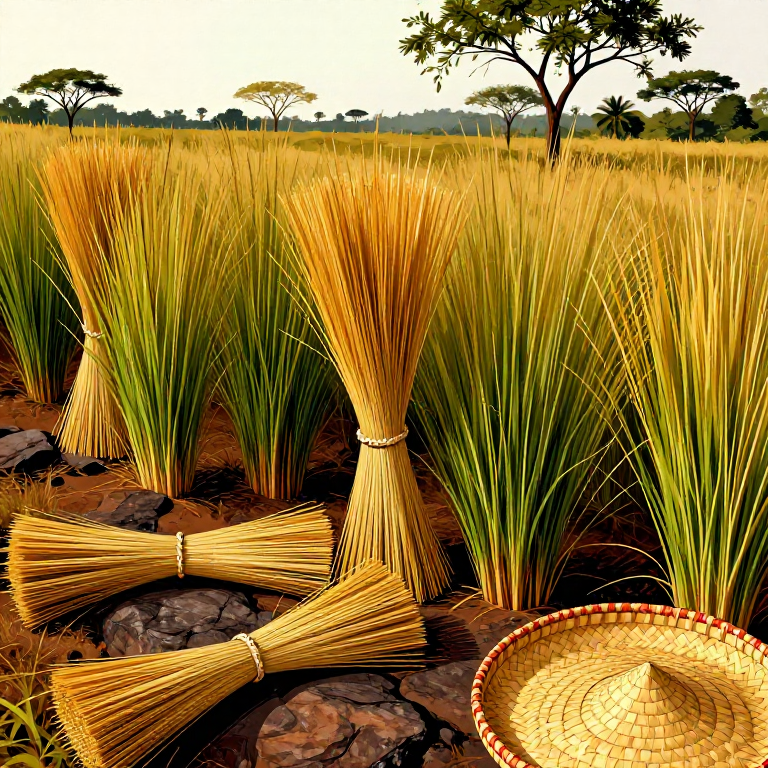
Sabai grass (Eulaliopsis binata), known in Odia as Babuai grass, is a perennial grass native to South and Southeast Asia. This blueprint describes the complete process of collecting sabai grass, drying it, and preparing it for rope making. In the Mayurbhanj and Keonjhar districts of Odisha, sabai grass is a major source of livelihood for indigenous communities. It grows spontaneously on hills and infertile lands and is also cultivated. Its uses include rope making, mats, baskets, and the paper industry. It is a sustainable crop — the plant can be harvested

Początkujący
3-4 hours per harvest session

Instrukcje

1

Understanding Sabai Grass

Sabai grass (Eulaliopsis binata) is a perennial grass native to South and Southeast Asia, known in Odia as babui grass. It grows 30-60 cm tall in clumps. The leaves are thin and strong. It thrives on hillslopes, barren land, and rocky soil where other crops cannot grow. For the tribal communities of Mayurbhanj and Keonjhar districts of Odisha, it is an important livelihood source. It is used for rope, mats, baskets, and the paper industry (a major use in Indian paper manufacturing).
2

Identifying Mature Grass

Sabai grass ready for harvesting turns golden or straw-colored. Green grass is immature — do not cut it. Two harvests per year are possible: after the rains (October-November) and in winter (January-February). Leaves should feel dry and flexible — if brittle, the grass is over-dried. New green shoots visible in the center of clumps indicate active roots.
3

Preparing Harvesting Tools

A sharp sickle is essential for cutting sabai grass. The sickle must be sharp — a blunt sickle pulls and tears the grass, damaging the roots. Keep binding twine or straw for bundling. Bring a large bag or bamboo basket for carrying. Wear gloves for hand protection — the grass edges are sharp and can cut skin.

Materiały do tego kroku:

Binding TwineBinding Twine5 metrów

Tools needed:

Sickle (curved harvest blade)Sickle (curved harvest blade)
WhetstoneWhetstone
Cotton Work GlovesCotton Work Gloves
Bamboo BasketBamboo Basket
4

Cutting Process

Cut grass at ground level — as low as possible from the clump base. Hold the clump with one hand and cut with a swift sickle motion with the other. Do not uproot — the root crown will regrow in 2-3 months. This is sabai grass's sustainable nature: it is perennial, requires no fertilizer, and regenerates naturally. Move to the next clump after finishing one.

Tools needed:

Sickle (curved harvest blade)Sickle (curved harvest blade)
5

Tying into Bundles

Tie cut grass into small bundles of approximately 15-20 cm diameter. Use some grass strands or twine for binding. Do not make bundles too large — small bundles dry evenly. Arrange bundles in bamboo baskets or tie into portable loads. One person can collect 15-25 kg of green grass per session.

Materiały do tego kroku:

Binding TwineBinding Twine5 metrów
6

Sun Drying

Spread cut grass bundles in open sunlight in thin layers so all parts get sun. Dry for 2-3 days, turning once in between. Well-dried grass becomes light, golden-colored, and makes a snapping sound when broken. Protect from rain — wetting causes mold and spoils the grass. Incompletely dried grass develops mold during storage.

Tools needed:

Bamboo Drying MatBamboo Drying Mat
7

Sorting by Length

Sort dried grass by length. Long strands (40-60 cm) are best for rope making. Short strands (20-40 cm) are used for mats and baskets. Remove broken or damaged strands. Tie each grade into separate bundles. Proper sorting fetches better prices — paper mills buy dried sabai at 3-5 rupees per kg (price varies by season).
8

Soaking Grass for Rope Making

For rope making, soak dried grass in water for 30-60 minutes. Soaked grass becomes flexible and does not break during twisting. Do not over-soak — soaking longer than 1 hour weakens the grass. Begin twisting when the grass is slightly damp — not fully dry or fully wet.

Materiały do tego kroku:

Clean WaterClean Water20 litrów

Tools needed:

Soaking TroughSoaking Trough
9

Basic Rope Twisting Technique

Take 5-8 dampened grass strands and hold from one end. Divide strands into two groups. Twist each group clockwise, then wrap the two groups around each other counter-clockwise. This two-direction twist makes the rope strong and permanent — it does not unravel. When adding new strands, overlap 5-8 cm with old strands for a strong joint.
10

Rope Quality Check

Good quality sabai rope should have uniform thickness, not break when pulled, and be golden in color. Re-twist any loose or weak joints. After fully drying, the rope will slightly reduce in thickness — this is normal. Test the load-bearing capacity for your intended use — rope made from 5-8 strands is sufficient for general tying and load carrying.
11

Tying into Bales for Sale

Tie dried sabai grass into large bales of 15-25 kg for sale. Bind bales firmly with rope so they do not come apart during transport. Sell at paper mills, rope factories, and local markets (haats). Paper mills pay 3-5 rupees per kg (price varies by season). Finished rope fetches a higher price.

Materiały do tego kroku:

Binding TwineBinding Twine10 metrów

Tools needed:

Weighing ScaleWeighing Scale
12

Storage

Store dried sabai grass and rope in a dry, shaded place. Keep above ground level — arrange on bamboo or wooden platforms. Protect from rainwater — moisture causes mold and rot. Check storage area regularly for termite damage. Well-dried and properly stored sabai grass keeps for many months.

Tools needed:

Raised Storage PlatformRaised Storage Platform

Materiały

2

Wymagane narzędzia

8

CC0 Domena publiczna

Ten plan jest udostępniany na licencji CC0. Możesz go swobodnie kopiować, modyfikować, rozpowszechniać i wykorzystywać do dowolnych celów, bez konieczności uzyskiwania zgody.

Wesprzyj Makera kupując produkty przez jego plan, za co zarabia Prowizja Makera ustalony przez sprzedawców, lub stwórz nową iterację tego planu i dołącz go jako połączenie w swoim własnym planie, aby dzielić się przychodami.

Dyskusja

(0)

Zaloguj się aby dołączyć do dyskusji

Ładowanie komentarzy...