SZTUKA
Piękno i dobre samopoczucie
RZEMIOSŁO
KULTURA I HISTORIA
ROZRYWKA
ŚRODOWISKO
JEDZENIE I NAPOJE
INŻYNIERIA ODWROTNA
NAUKI
LEKKOATLETYKA
TECHNOLOGIA
URZĄDZENIA DO NOSZENIA
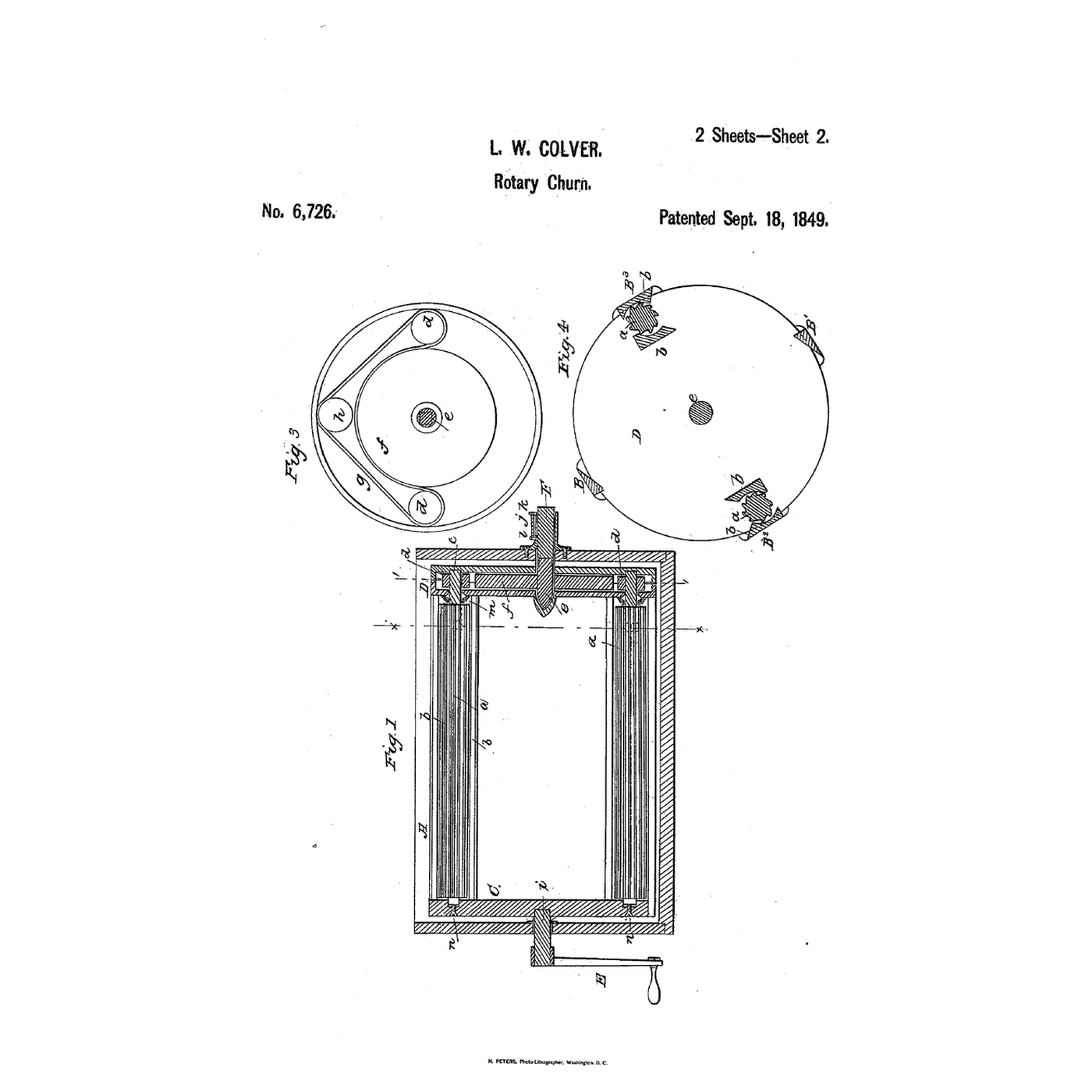


Self-Turning Roller Churn: Fluted Rollers Spun by a Fixed Wheel as the Dasher Turns
Colver's improvement consisted "in giving the beaters of a churn dasher a revolving motion on their own axis."
Lewis W. Colver of St. Louis, Missouri, received US 6,726, dated 18 September 1849, for a rotary churn-dasher of four horizontal beaters between a cross at one end and a round flat case at the other. Two are wedge beaters; the other two are fluted rollers with hook-shaped flutes, each between two edge-beaters whose inner faces curve in toward it. A belt from a large stationary pulley inside the case turns the rollers fast as the dasher goes round; "the granules of butter are drawn by the hooked flutes into the converging spaces between the rolls and the edge beaters, thus compressing them together."
This rung works out the rollers' speed, then prints the fixed gear, rollers, beaters and end pieces, builds the dasher in a box, and makes butter.
Zaawansowany
About 6 hours, plus printing
Instrukcje
1
1
How fast the rollers spin
How fast the rollers spin
Wczytywanie notatnika Jupyter…
2
2
Wheels carried round a fixed wheel
Wheels carried round a fixed wheel
The embedded blueprint explains gears carried round a central gear. Colver's rollers are such planets: the central wheel stands still and the dasher carries them round it.
3
3
Read US 6,726
Read US 6,726
"The central pulley is held stationary and the dasher is revolved around it, and as the central pulley is much larger than the others the velocity of the rollers are proportionately increased." And: "I have hitherto described the fluted rollers as driven by a belt, that being most convenient in practice, but it is evident that cogwheels may be employed for the same purpose."
4
4
Print the parts
Print the parts
Print the fixed gear (/uploads/blueprints/self-turning-roller-churn-fixed-gear.stl), two fluted rollers with their pinions (/uploads/blueprints/self-turning-roller-churn-fluted-roller.stl), two pairs of edge-beaters (/uploads/blueprints/self-turning-roller-churn-edge-beaters.stl), two wedge beaters (/uploads/blueprints/self-turning-roller-churn-wedge-beater.stl), the cross (/uploads/blueprints/self-turning-roller-churn-cross.stl), the case plate (/uploads/blueprints/self-turning-roller-churn-case-plate.stl) and the crank arm (/uploads/blueprints/self-turning-roller-churn-crank-arm.stl). Print in PETG at 0.2 mm layers, 30 % infill, 4 walls; wash before first use.
Materiały do tego kroku:
 Filament PETG1 sztuka
Potrzebne narzędzia:
 Drukarka 3D z filamentem (FDM)
5
5
Build the dasher
Build the dasher
Bolt the beaters between the cross and the case plate with M3 screws: wedge beaters on two opposite arms, edge-beater pairs on the other two. Drop a fluted roller between each pair, its gudgeons in the cross and the case plate, its pinion beyond the plate. Screw a short 10 mm square hardwood stub into the cross's centre for the crank.
Materiały do tego kroku:
 Śruby maszynowe1 sztuka
 Nakrętka sześciokątna1 sztuka
 Kołki z twardego drewna1 sztuka
Potrzebne narzędzia:
 Zestaw wkrętaków
 Klucz nastawny
 Piła ręczna
6
6
Fix the gear and fit the box
Fix the gear and fit the box
Take a food-safe box about 230 × 190 × 190 mm. Screw the fixed gear to the inside of one end on the dasher's axis, with a 10 mm steel pin through its centre into the case plate's hole, so the dasher turns round it and its teeth mesh the rollers' pinions. Drill the other end for the crank stub and glue the crank arm and handle on.
Materiały do tego kroku:
 Pojemnik do przechowywania klasy spożywczej1 sztuka
 Pręt ze stali niskowęglowej1 sztuka
 Wkręt do drewna #8 x 1"1 sztuka
 Klej do drewna1 sztuka
Potrzebne narzędzia:
 Wiertarko-wkrętarka akumulatorowa
 Zestaw wierteł
 Piła do metaluZestaw wkrętaków
7
7
The build in 3D
The build in 3D
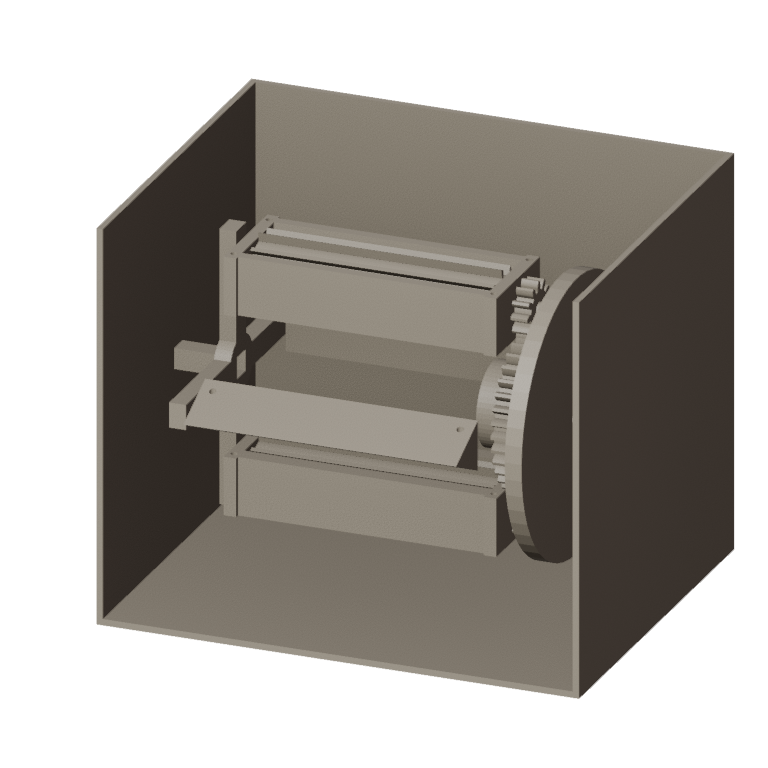
FreeCAD model of this build, not of the patent: the box with one side off to show the dasher of wedge beaters and fluted rollers between edge-beaters, the fixed gear meshing the rollers' pinions at the case end, and the crank.
8
8
Crank and make butter
Crank and make butter
Let the heavy cream stand until it reaches about 15 °C, checked with the thermometer. Pour in 1.5 litres. Crank steadily; the rollers spin on their own as the dasher turns. Time until the butter comes. Pour off the buttermilk, add cold water, churn a little and pour off again until it runs clear; work in a pinch of salt and weigh the butter.
Materiały do tego kroku:
 Śmietanka kremówka1500 ml
 Sól morska gruboziarnista1 sztuka
 Woda1 sztuka
Potrzebne narzędzia:
 Termometr z sondą pozostawianą w potrawie
 Stoper
 Cyfrowa waga kuchenna
 Duża misa ze stali nierdzewnej
9
9
Rollers that do not spin, gears that jam
Rollers that do not spin, gears that jam
Self-turning roller churn troubleshooting.
Flow
Loading...
10
10
History and honest limits
History and honest limits
**Lewis W. Colver** of St. Louis, Missouri, received US 6,726, dated 18 September 1849, signed 9 July 1849. The dasher was held by a sliding bolt and wedge so it could be withdrawn; the gudgeons and the round case were packed so the cream could not get into it; a fourth pulley kept the belt's sides from rubbing. He claimed making the beaters of revolving churn dashers to turn upon their own axes.
**Honest limits.** Printed gears stand in for his belt and pulleys, as he allowed; our gears are open to the cream, where his were inside a packed case. FDM prints hold food in their layer lines, so wash well and replace when worn. Your times and weights are the result.
Materiały
11- 1 sztukaZastępnik
- 1 sztukaZastępnik
- 1 sztukaZastępnik
- 1 sztukaZastępnik
- Zastępnik
- 1 sztukaZastępnik
- 1 sztukaZastępnik
- 1 sztukaZastępnik
- 1500 mlZastępnik
- 1 sztukaZastępnik
- 1 sztukaZastępnik
Wymagane narzędzia
11- Zastępnik
- Zastępnik
- Zastępnik
- Zastępnik
- 1 vendor sell this, none ship to you yetZastępnik
- Zastępnik
- Zastępnik
- Zastępnik
- Zastępnik
- Zastępnik
Pliki projektowe
1Powiązane blueprinty
Te blueprinty dzielą się wiedzą — technikami, materiałami lub zasadami


CC0 Domena publiczna
Ten plan jest udostępniany na licencji CC0. Możesz go swobodnie kopiować, modyfikować, rozpowszechniać i wykorzystywać do dowolnych celów, bez konieczności uzyskiwania zgody.
Wesprzyj Makera kupując produkty przez jego plan, za co zarabia Prowizja Makera ustalony przez sprzedawców, lub stwórz nową iterację tego planu i dołącz go jako połączenie w swoim własnym planie, aby dzielić się przychodami.