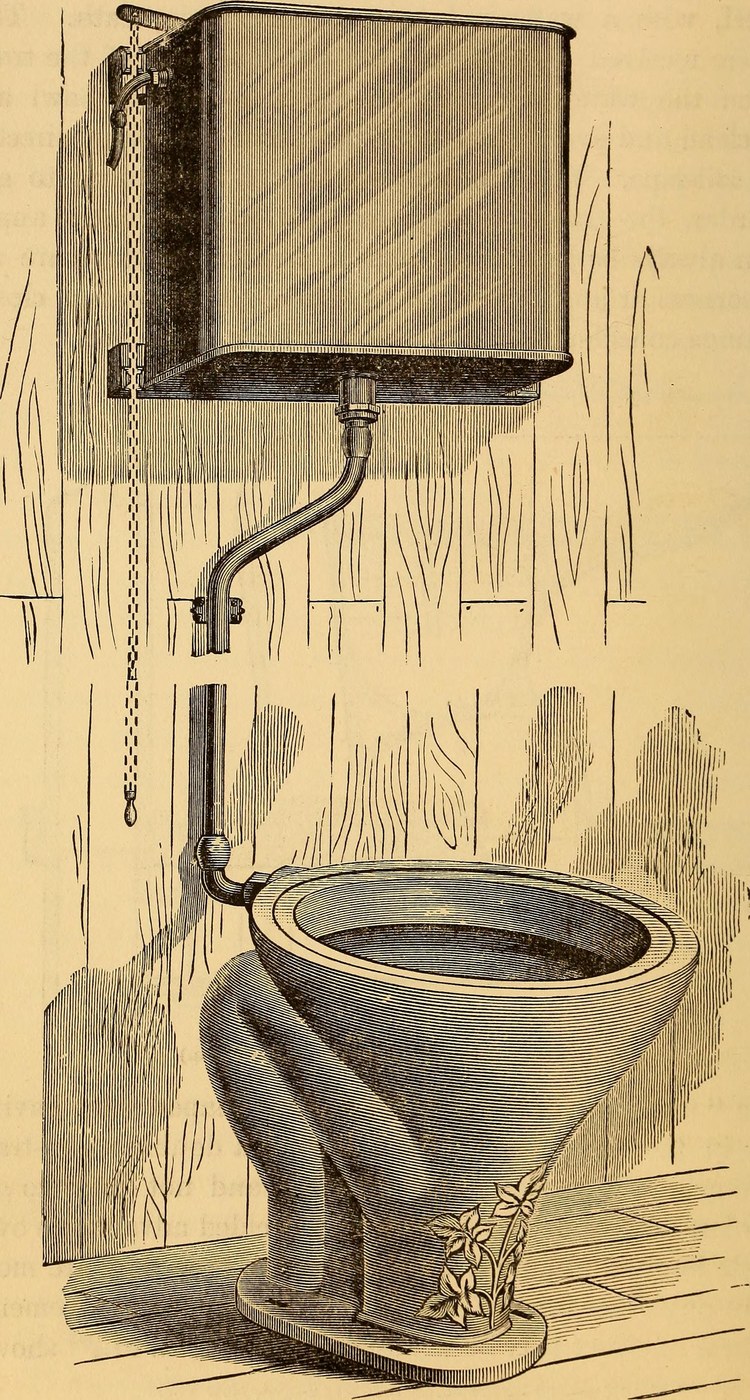


The Siphonic Flush Cistern
A flush needs a large volume delivered fast — a slow trickle will not clear a pan however much water it eventually uses. So the cistern must dump several litres in a few seconds, then stop completely, then refill and hold that water indefinitely without losing a drop.
The obvious answer is a valve at the bottom, and it is the wrong one. A valve holding back a standing head of water is being pushed open every second of its life, and the moment its seal degrades it weeps continuously into the pan. It fails silently, into the drain, and a cistern that leaks a little forever wastes far more water than any flush.
The siphon removes the seal entirely. The water is held by gravity and geometry — an inverted U with its crest above the water line. Nothing is pressing on anything. There is no seal that can fail because there is no seal.
Pulling the lever lifts a diaphragm that throws a slug of water over the crest. Once flow is established, the falling column's momentum drags the rest after it, and the cistern empties itself with no further help. Then the level drops below the siphon's foot, air breaks the column, and it stops instantly and absolutely.
The mechanism cannot dribble. It is either siphoning or it is not.
Instrukcje
Start a siphon and find what actually drives it
Start a siphon and find what actually drives it
Run tubing from a full jar up over the rim and down to a lower bucket. Fill the tube and release it.
Measure the flow rate, then raise and lower the outlet end and measure again.
Expect the flow to depend on the height difference between the two water surfaces — not on how high the crest is.
The crest is only a barrier the water must be got over once. After that the falling leg is doing the work, and the drop is the power source.
Materiały do tego kroku:
 Wężyk silikonowy1 m
Potrzebne narzędzia:
 Miara zwijana
Find the height it cannot beat
Find the height it cannot beat
Raise the crest higher and higher and find where the siphon fails to start or breaks.
In practice you will fail long before the theoretical limit, but the limit is worth knowing: a water siphon cannot lift the crest more than about 10 metres above the source surface, because atmospheric pressure is what holds the column up and that is all the pressure there is.
A cistern crest is a few centimetres, so the design sits nowhere near the limit — but the number tells you what is really holding the water: the atmosphere, pushing.
Prove it stops dead, and cannot weep
Prove it stops dead, and cannot weep
Let the siphon run until the source level falls below the tube's inlet.
Expect it to stop abruptly when air reaches the inlet — not to taper off.
Now try to make it leak: refill the source to just below the crest and wait.
Nothing happens, and nothing can. Below the crest there is no path; above it there is full flow. The mechanism has two states and no in-between, which is exactly the property a valve cannot offer.
Compare against the valve it replaced
Compare against the valve it replaced
Set up a simple valve — a bung or a flap — holding water in a container, and deliberately foul the seat with grit or a hair.
Measure the leak over an hour and scale it to a year.
Even a slow weep runs to thousands of litres. Now consider that nobody sees it: it goes straight to the drain, makes almost no sound, and appears on no meter reading anyone examines.
The siphon's real advantage is not efficiency, it is that its failure mode is obvious. A siphon that stops working refuses to flush, and you fix it that day.
Find the trade the flap valve made
Find the trade the flap valve made
Compare the effort to start a siphon with the effort to lift a flap valve, and compare how each behaves if you release the lever halfway.
Expect the siphon to need a decisive stroke, and to be all-or-nothing. Expect the flap to be easy, and to allow a partial flush.
That is the whole reason modern cisterns went back to valves: a dual flush needs a mechanism that can be stopped early, and a siphon by its nature cannot be.
The industry traded a fail-silent component for water saving on every use — a defensible bargain, but it is a bargain, and the leaking cistern came back with it.
History & Context
History & Context
Why Britain made it compulsory. The siphonic cistern — associated with Albert Giblin and sold widely by Thomas Crapper's firm — was mandated in British water regulations for most of the twentieth century precisely because it cannot leak. Water undertakings had measured what a population of slowly weeping valve cisterns costs, and legislated the failure mode out of existence. It is a rare example of a plumbing detail being decided by regulators on the evidence.
Then the rule was reversed, for a good reason and a real cost. The ban on valve cisterns was lifted in the UK in 2001 to allow dual-flush fittings, which save several litres on most uses. The saving is genuine. So is the return of the silent leak: surveys since have repeatedly found a meaningful share of dual-flush toilets leaking continuously, and estimates of the water lost are comparable to the water the design saves. A change that is right per-use can be wrong per-fleet, and this is the clearest domestic example of it.
The name everybody knows is mostly wrong. Thomas Crapper was a real and successful sanitary engineer who held genuine patents and did much to popularise the flushing toilet, but he did not invent it and the siphon patent was Giblin's. The word predates him. What Crapper actually did — showrooms, standardised fittings, a trusted brand — mattered enormously for adoption, and is the less glamorous half of how an invention reaches people.
The same idea elsewhere. A siphon that starts itself when a level is reached and stops when the level falls is a complete self-emptying controller with no moving parts: dosing siphons in septic drainfields, automatic flush tanks in old sewers, tipping-bucket rain gauges by a mechanical analogy, and the toy "drinking bird". Wherever a tank must empty in bulk at a set level and never in between, this is the answer.
Honest limits. A siphon needs a decisive stroke and a certain head to prime, so it is less forgiving to a weak hand or a low cistern; it cannot deliver a partial flush; and it is bulkier than a flap. The diaphragm that throws the priming slug is a perishing part — when a siphonic cistern needs several pulls to flush, that diaphragm has usually split, and it is a five-minute repair with a piece of plastic sheet.
Materiały
1- Zastępnik
Wymagane narzędzia
1- Zastępnik
Materiały z połączonych planów
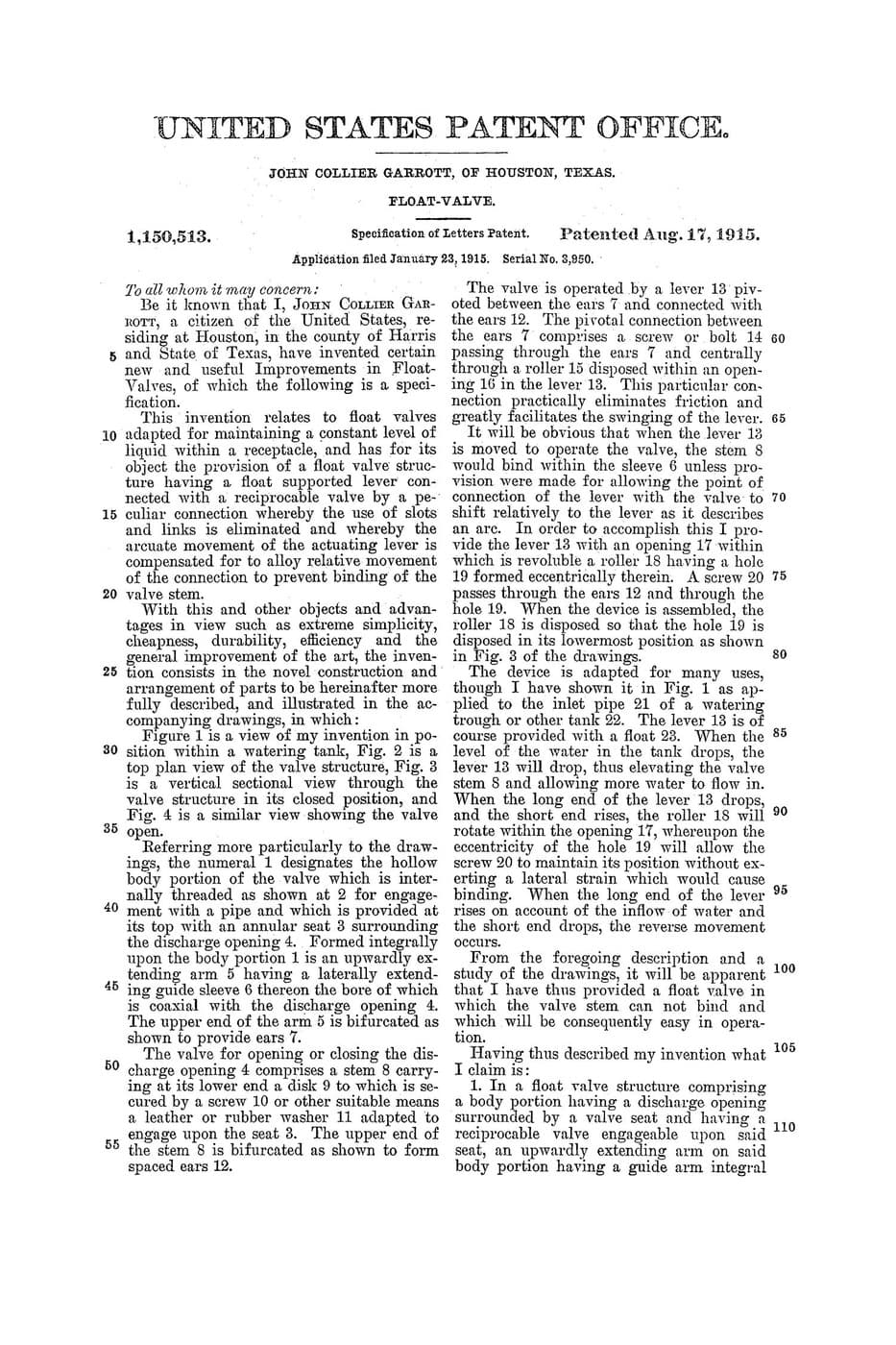

Powiązane blueprinty
Te blueprinty dzielą się wiedzą — technikami, materiałami lub zasadami
CC0 Domena publiczna
Ten plan jest udostępniany na licencji CC0. Możesz go swobodnie kopiować, modyfikować, rozpowszechniać i wykorzystywać do dowolnych celów, bez konieczności uzyskiwania zgody.
Wesprzyj Makera kupując produkty przez jego plan, za co zarabia Prowizja Makera ustalony przez sprzedawców, lub stwórz nową iterację tego planu i dołącz go jako połączenie w swoim własnym planie, aby dzielić się przychodami.