SZTUKA
Piękno i dobre samopoczucie
RZEMIOSŁO
KULTURA I HISTORIA
ROZRYWKA
ŚRODOWISKO
JEDZENIE I NAPOJE
INŻYNIERIA ODWROTNA
NAUKI
LEKKOATLETYKA
TECHNOLOGIA
URZĄDZENIA DO NOSZENIA
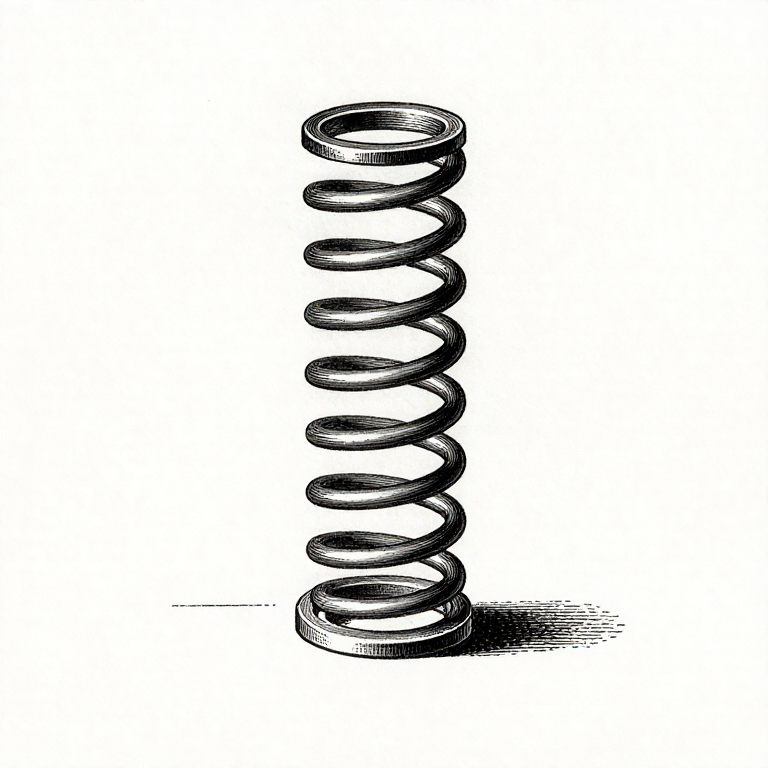


Sizing a Compression Spring: From a Requirement to Three Numbers
A real spring requirement arrives as a sentence, not a formula: *this much force, at this length, inside this hole*. That is three constraints, and the spring has three free numbers — wire diameter, coil diameter, coil count — so it looks like it should solve exactly. It does not, because two of the constraints are inequalities and one of the variables only comes in stock sizes.
So it is a search, and the skill is not in the arithmetic but in knowing what to check once a candidate exists: does it hit the rate, is the index sane, does it fit the bore, does it go solid before it reaches its working length, and is the wire inside its allowable stress — both at work and if something presses it flat.
This rung walks a requirement through every one of those checks and shows what to do when nothing passes.
Średniozaawansowany
4 hours
Instrukcje
1
1
Turning a requirement into a rate
Turning a requirement into a rate
**A force alone is not a requirement.** 'It needs 60 newtons' does not specify a spring, because any spring gives 60 N somewhere. What is needed is a force AT a length, and preferably two of them.
**Two points give the rate and the free length together.** If the spring must give 20 N at 45 mm and 60 N at 35 mm, then the rate is 40 N over 10 mm = 4 N/mm, and the free length is 45 + 20/4 = 50 mm. This is the honest way in, and it is worth pushing back for the second point when only one is offered.
**One point plus a free length also works**, which is the case the notebook takes: the spring is 50 mm relaxed, must be 35 mm in use, and must give 60 N there. The rate follows as 60 / (50 − 35) = 4 N/mm.
**Write down the space, not just the force.** The bore it sits in, or the rod it sits over, sets the coil diameter before anything else does. A spring over a rod needs the INSIDE diameter to clear it; a spring in a bore needs the OUTSIDE to clear that. Half a millimetre each way, more if it will be guided over a length.
**And write down what happens at the extremes.** Is there a stop that prevents the spring being pressed fully solid? If not, the spring must survive solid, which is a much harder requirement and changes the answer.
Materiały do tego kroku:
 Zestaw sprężyn naciskowych1 sztuka
Potrzebne narzędzia:
 Suwmiarka
 Linijka
2
2
The search, and the five checks
The search, and the five checks
Wczytywanie notatnika Jupyter…
Potrzebne narzędzia:
 Komputer stacjonarny
3
3
Ends, and why they are not free coils
Ends, and why they are not free coils
The coils at each end of a compression spring do not all push. How many are lost depends on how the ends are finished, and getting this wrong is the most common reason a calculated rate and a measured rate disagree.
**Open ends.** The helix simply stops. Nothing is lost, so active coils = total coils, and the spring sits on a point and will not stand up straight. Only used where something else locates it.
**Squared (closed) ends.** The last coil at each end is wound with no pitch, so it lies flat against its neighbour. Those two coils are dead: active = total − 2. The spring now stands up but rocks slightly, because the end coil finishes on a wire diameter.
**Squared and ground.** As above, then the ends are ground flat, square to the axis, over about three quarters of a turn. Active = total − 2 still, and now the spring sits truly flat and loads evenly. This is the default for anything that matters, and it is why solid length is d × total coils rather than something cleverer.
**Ground ends cost a length of wire and buy squareness.** The test is simple: stand the spring on a flat surface next to a square. A good compression spring leans by less than about 3 degrees.
**Count coils by looking along the axis**, not from the side. Turn the spring until the wire end points at you, and count the times it crosses your starting line. Total coils are usually a whole number plus a fraction, and the fraction matters for the solid length.
Materiały do tego kroku:
Zestaw sprężyn naciskowych1 sztuka Zestaw sprężyn naciskowych1 sztuka
Potrzebne narzędzia:
SuwmiarkaLinijka Lupa zegarmistrzowska
4
4
When nothing passes
When nothing passes
A search that returns no candidate is not a failure of the method. It is the method telling you that the requirement as stated cannot be met by one helical spring in that space, and one of the constraints has to move. In rough order of how cheap they are to move:
**Give it more length.** Free length is usually the softest constraint and the most effective: more coils at the same wire and diameter reduce the rate, reduce the stress at the working load, and cost only space.
**Change the wire grade.** Music wire at a small diameter will take a much higher stress than hard-drawn. Same geometry, different allowable, problem gone. It costs money and it costs nothing in space.
**Let the outside diameter grow.** A bigger coil is a softer spring at the same wire, which is often what is wanted — but the stress goes up with D, so check it rather than assuming.
**Use two springs.** Nested one inside the other (wound opposite hands so they cannot tangle) they act in parallel and share the load, and each one is easier to make than the single spring would have been. This is why valve springs are often in pairs.
**Add a stop.** If the spring is failing only on the stress-at-solid check, a mechanical stop that prevents solid removes the check entirely. This is a design change outside the spring and is frequently the right answer.
**Change the spring type.** A wave washer, a Belleville stack or a torsion bar may fit where a helical spring cannot. A Belleville stack in particular gives a very high force in very little length, and its rate can even be made to fall with deflection, which no helical spring will do.
**What NOT to do:** quietly accept an index of 2.5, or a spring that goes solid 0.2 mm before its working length. Both will work on the bench and fail in service.
Materiały do tego kroku:
Zestaw sprężyn naciskowych1 sztuka Resor piórowy1 sztuka
Potrzebne narzędzia:
Komputer stacjonarnyMateriały
3- 1 sztukaZastępnik
- 1 sztukaZastępnik
- 1 sztukaZastępnik
Powiązane blueprinty
Te blueprinty dzielą się wiedzą — technikami, materiałami lub zasadami


CC0 Domena publiczna
Ten plan jest udostępniany na licencji CC0. Możesz go swobodnie kopiować, modyfikować, rozpowszechniać i wykorzystywać do dowolnych celów, bez konieczności uzyskiwania zgody.
Wesprzyj Makera kupując produkty przez jego plan, za co zarabia Prowizja Makera ustalony przez sprzedawców, lub stwórz nową iterację tego planu i dołącz go jako połączenie w swoim własnym planie, aby dzielić się przychodami.