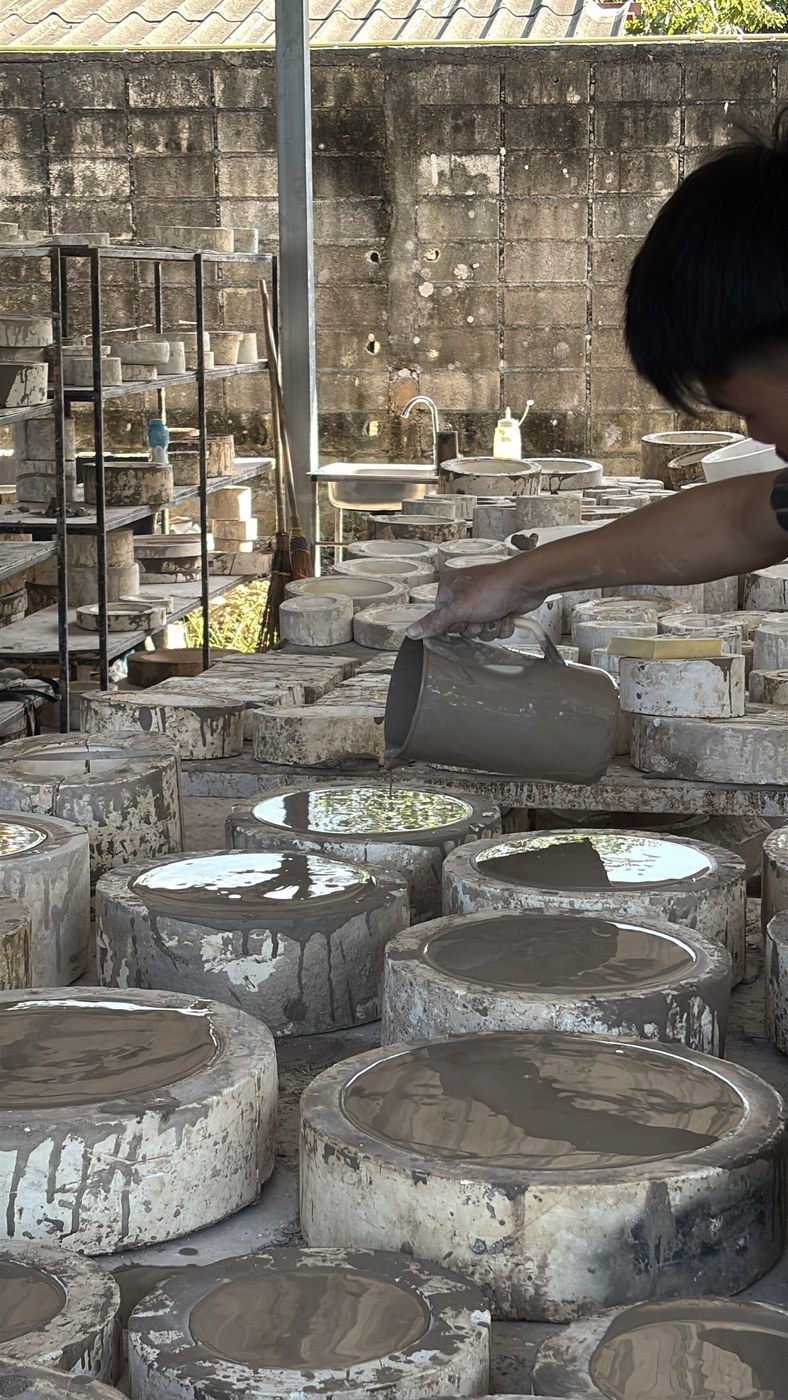
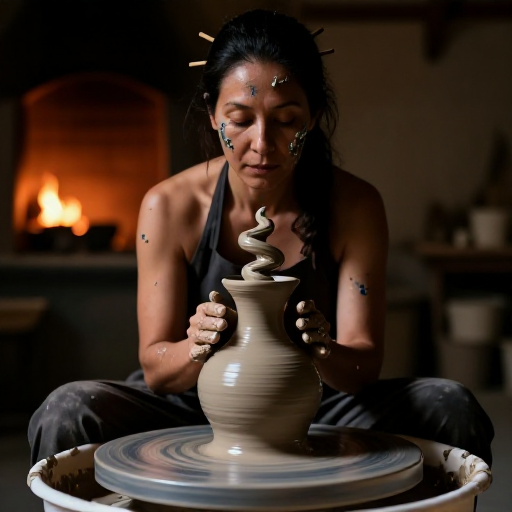

Slip Casting
Instrukcje
Make the plaster mould
Make the plaster mould
Everything depends on the plaster being genuinely absorbent.
- Mix plaster of Paris to the recommended water ratio and pour it around a model.
- Let it set, remove the model, and dry the mould completely — a day or more.
- Test it: a drop of water on the surface should soak in within seconds.
Materiały do tego kroku:
 Gips modelarski2 kg
Mix slip with a deflocculant
Mix slip with a deflocculant
The trick is to make clay flow with as little water as possible.
- Blend clay and water to a pourable consistency and note how much water it took.
- Now make a second batch, adding a few drops of sodium silicate as you go.
- Compare — the deflocculated slip pours freely with markedly less water.
Materiały do tego kroku:
 Masa porcelanowa2 kg
 Cyfrowa waga kuchenna1 sztuka
Cast and time the wall
Cast and time the wall
Wall thickness is set by nothing but the clock.
- Fill the mould to the top with slip.
- Top it up as the level drops — the mould is absorbing water and the slip is shrinking.
- After a measured interval, pour the liquid centre back out and invert the mould to drain.
Materiały do tego kroku:
 Stoper1 sztuka
 Linijka1 sztuka
Release, fettle and dry
Release, fettle and dry
The cast releases itself if you let it.
- Leave the mould until the cast has stiffened and pulled away from the walls.
- Open the mould and lift the piece out.
- Trim the pouring rim and smooth the mould seams with a damp sponge.
History and context
History and context
Slip casting emerged in the eighteenth century as European factories chased complex porcelain shapes, and became central to the Staffordshire potteries. It solved a problem throwing cannot: a thrown pot is necessarily a body of revolution, and anything else has to be assembled from parts.
What it changed commercially is reproducibility. A mould makes the same object every time, so quality no longer depended on which thrower was on shift, and unskilled labour could produce complex ware. That was a large part of the economics of industrial pottery — and, as with most such shifts, it displaced the skill it replaced.
The plaster is a consumable. Moulds absorb salts and clay particles into their pores and gradually stop drawing; a working mould has a life of perhaps a few dozen to a couple of hundred casts. Potteries therefore keep master models to make replacement moulds, which is why the model — not the mould — is the valuable object.
Still the standard method. Toilets, basins, teapots, figurines and technical ceramics are slip cast. Modern industrial versions use pressure casting, forcing slip into porous resin moulds at several bar, which cuts a twenty-minute wait to a couple of minutes — the same physics, hurried along.
Materiały
5- 2 kgZastępnik
- 2 kgZastępnik
- 1 sztukaZastępnik
- 1 sztukaZastępnik
- 1 sztukaZastępnik
Powiązane blueprinty
Te blueprinty dzielą się wiedzą — technikami, materiałami lub zasadami
CC0 Domena publiczna
Ten plan jest udostępniany na licencji CC0. Możesz go swobodnie kopiować, modyfikować, rozpowszechniać i wykorzystywać do dowolnych celów, bez konieczności uzyskiwania zgody.
Wesprzyj Makera kupując produkty przez jego plan, za co zarabia Prowizja Makera ustalony przez sprzedawców, lub stwórz nową iterację tego planu i dołącz go jako połączenie w swoim własnym planie, aby dzielić się przychodami.