SZTUKA
Piękno i dobre samopoczucie
RZEMIOSŁO
KULTURA I HISTORIA
ROZRYWKA
ŚRODOWISKO
JEDZENIE I NAPOJE
INŻYNIERIA ODWROTNA
NAUKI
LEKKOATLETYKA
TECHNOLOGIA
URZĄDZENIA DO NOSZENIA
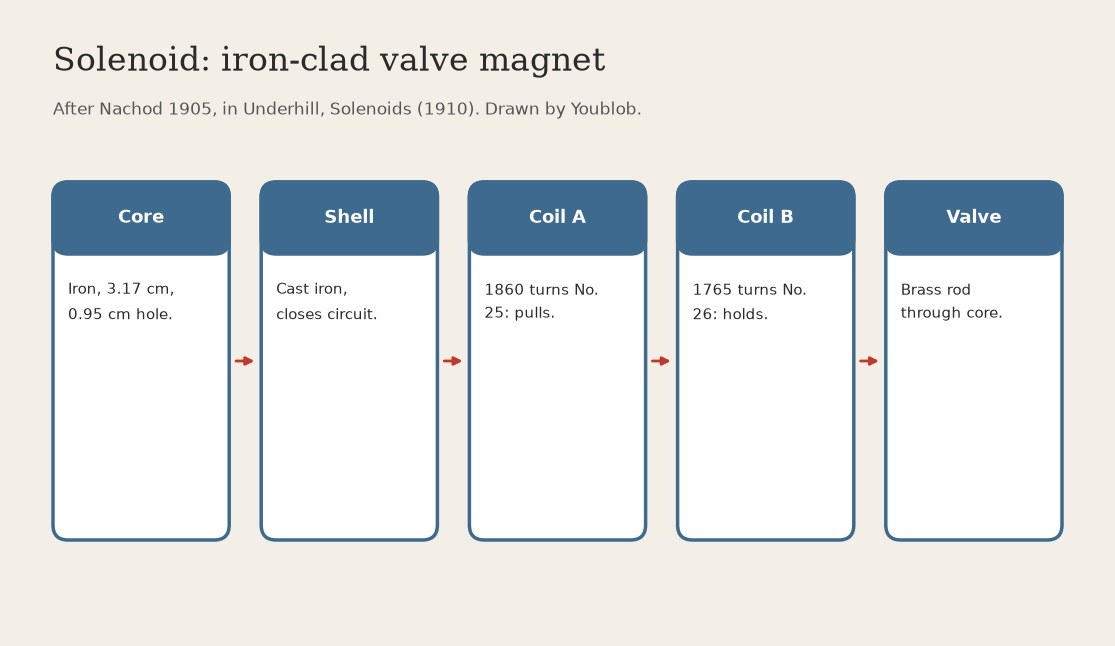


Solenoid: Iron-Clad Valve Magnet with Two Coils, 1860 and 1765 Turns (Nachod 1905, in Underhill 1910)
A short-stroke solenoid that opens an air valve. One coil pulls the iron armature down; a second, weaker coil holds it there against the air pressure once the first is switched off. A cast-iron shell closes the magnetic circuit around both.
Result: an iron-clad plunger solenoid driving a brass valve rod through its hollow core.
Source: C. P. Nachod's test (Electrical World, 1905) in Underhill, Solenoids, Electromagnets and Electromagnetic Windings (1910), pp. 125-129. Unknown: the wire insulation; the test does not give it. Not given: shell and armature sizes, voltage. Picture drawn by Youblob.
Zaawansowany
2 days
Instrukcje
1
1
Turn the core and armature
Turn the core and armature
Turn the core from Norway iron to 3.17 cm outside diameter and bore a 0.95 cm hole through it for the valve rod. Turn the armature from the same iron. Ours: wrought iron bar; the armature size is not given.
Materiały do tego kroku:
 Pręt z kutego żelaza1 as required
Potrzebne narzędzia:
 Zestaw dłut tokarskich (HSS)
2
2
Cast the shell and top
Cast the shell and top
Cast the shell and top in cast iron so they close the magnetic circuit round the coils, leaving a round clearance gap for the armature in the top. Sizes: not given (Underhill's Fig. 92 shows the layout).
Materiały do tego kroku:
 Gąski surówki żelaza1 as required
Potrzebne narzędzia:
 Żeliwiak
 Skrzynka formierska
 Piasek formierski
3
3
Wind coil A: 1860 turns of No. 25
Wind coil A: 1860 turns of No. 25
Wind the operating coil, 1860 turns of No. 25 wire, and place it where it encircles the working air gap between armature and core. Copper, as Underhill gives for magnet windings. Unknown: the insulation; the test does not give it.
Materiały do tego kroku:
 Drut miedziany1 as required
 Nieznany materiał izolacyjny1 as required
Potrzebne narzędzia:
Zestaw dłut tokarskich (HSS)4
4
Wind coil B: 1765 turns of No. 26
Wind coil B: 1765 turns of No. 26
Wind the retaining coil, 1765 turns of No. 26 wire, and place it below coil A on the core. Being away from the gap, it pulls only 0.4-0.8 as hard as A, enough to hold the armature down.
Materiały do tego kroku:
Drut miedziany1 as requiredPotrzebne narzędzia:
Zestaw dłut tokarskich (HSS)5
5
Assemble with the brass valve rod
Assemble with the brass valve rod
Fit core, coils and armature in the shell and pass the brass rod through the core to the valve. Nachod set test gaps of 0.41 and 2.05 mm with brass washers.
Materiały do tego kroku:
 Pręt mosiężny1 as required
Potrzebne narzędzia:
Zestaw dłut tokarskich (HSS)Materiały
5- 1 as requiredZastępnik
- 1 as requiredZastępnik
- 2 as requiredZastępnik
- 1 as requiredZastępnik
- 1 as requiredZastępnik
Według tego planu powstaje
Powiązane blueprinty
Te blueprinty dzielą się wiedzą — technikami, materiałami lub zasadami

CC0 Domena publiczna
Ten plan jest udostępniany na licencji CC0. Możesz go swobodnie kopiować, modyfikować, rozpowszechniać i wykorzystywać do dowolnych celów, bez konieczności uzyskiwania zgody.
Wesprzyj Makera kupując produkty przez jego plan, za co zarabia Prowizja Makera ustalony przez sprzedawców, lub stwórz nową iterację tego planu i dołącz go jako połączenie w swoim własnym planie, aby dzielić się przychodami.