SZTUKA
Piękno i dobre samopoczucie
RZEMIOSŁO
KULTURA I HISTORIA
ROZRYWKA
ŚRODOWISKO
JEDZENIE I NAPOJE
INŻYNIERIA ODWROTNA
NAUKI
LEKKOATLETYKA
TECHNOLOGIA
URZĄDZENIA DO NOSZENIA
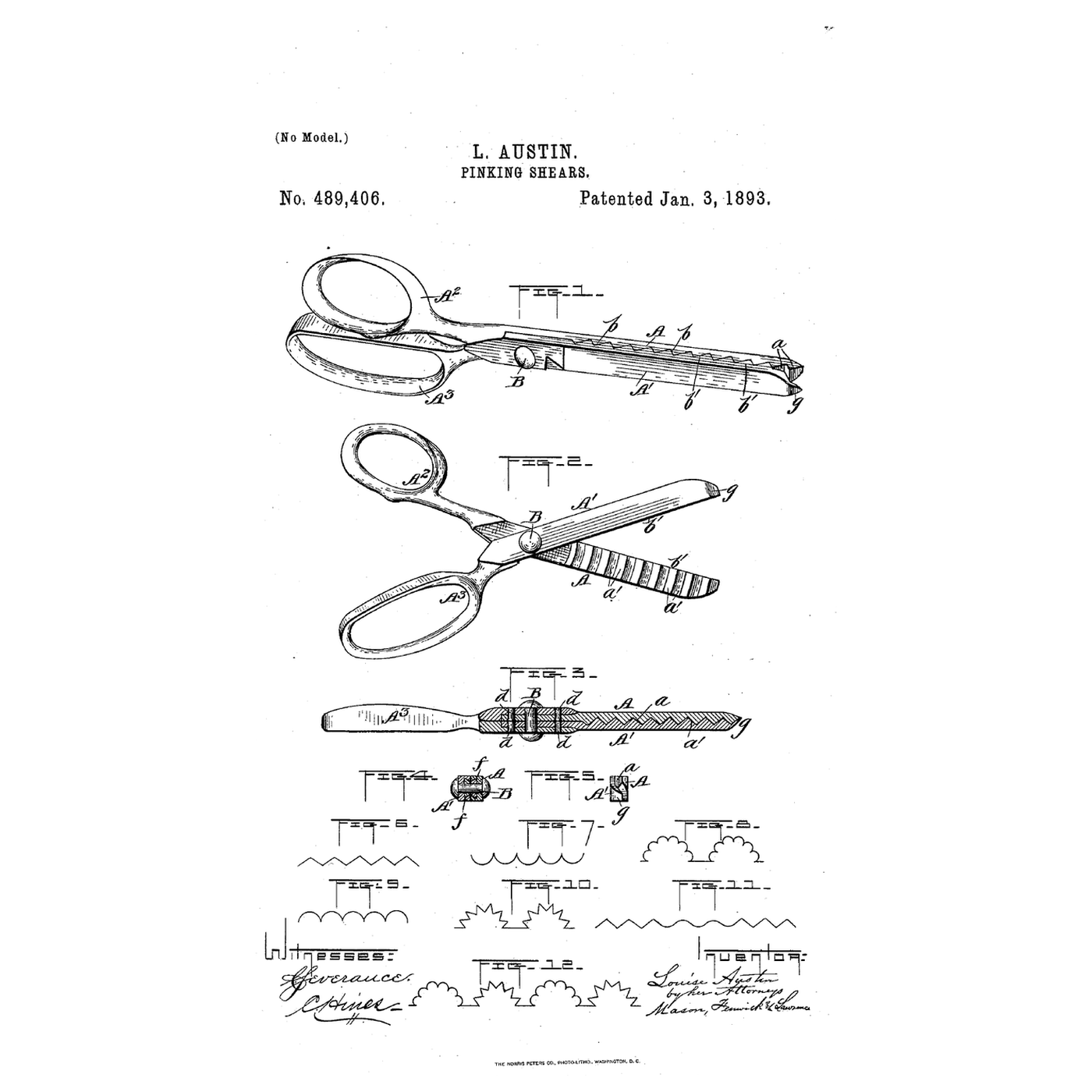


The Pinking Shears: A Zigzag in One Stroke
A cut edge of woven cloth frays. Pinking it in a zigzag slows that, and until pinking shears it was done with a punch or iron, a notch at a time.
Louise Austin of Whatcom, Washington, received US 489,406, dated 3 January 1893 (filed 16 June 1892), for pinking shears "having their blades made much thicker than in ordinary scissors or shears, and provided with male and female matching projections and depressions" across their faces, so pinking is done "by a continuous cutting operation, similar to that of cutting fabrics with ordinary scissors".
This rung works out why a zigzag edge frays less, then cuts and washes straight and pinked edges side by side.
Początkujący
About 1 hour
Instrukcje
1
1
Why the zigzag stops the run
Why the zigzag stops the run
Wczytywanie notatnika Jupyter…
2
2
What fraying is
What fraying is
The embedded blueprint covers why raw edges fray and the ways of stopping them; pinking is one of them.
3
3
Read US 489,406
Read US 489,406
"My invention relates to method of and means for pinking cloth, silk, oiled fabrics, paper, leather, and other materials; and its object is to provide a hand implement wherewith the pinking can be done very rapidly by a continuous cutting operation, similar to that of cutting fabrics with ordinary scissors or shears."
The blades are "made much thicker than in ordinary scissors or shears, and provided with male and female matching projections and depressions of any desired configuration on their inner broad faces, the projections and depressions running transversely to the length of the blades".
"With my improved pinking scissors or shears, the pinking or scalloping can always be made uniform and in line; and it is performed by cutting continuously through the fabric from end to end or edge to edge; thus the work is very rapidly done, and, where the fabric is severed, two scalloped edges will be produced at the same operation."
4
4
Cut, wash and compare
Cut, wash and compare
Cut four strips of the same cotton fabric along the weave: two with ordinary fabric scissors and two with pinking shears. Measure each strip's width with the ruler.
Wash all four together in warm water, rub them, and let them dry. Look at the edges under the loupe, measure the longest loose thread on each edge, and measure the widths again. Note how much each edge lost, and compare with the notebook.
Materiały do tego kroku:
 Tkanina bawełniana (lekka)1 sztuka
 Woda1 sztuka
Potrzebne narzędzia:
 Nożyce ząbkujące
 Nożyce krawieckie
 Linijka
 Lupa zegarmistrzowska
 Miska
Miska5
5
Pinking that chews, skips or still frays
Pinking that chews, skips or still frays
Pinking shears troubleshooting.
Flow
Loading...
6
6
History and honest limits
History and honest limits
**Louise Austin** of Whatcom, Washington, filed US 489,406 on 16 June 1892; it is dated 3 January 1893. She contrasts her shears with pinking irons, which are slow, and with pinking cutters that must be held still at right angles to the edge.
**Honest limits.** The notebook's geometry assumes 90-degree teeth cut along the weave and counts a thread as loose only where it lies inside the cut; real fraying also depends on the weave, the fibre and the washing. Pitch and thread count are examples. Your measured loose threads are the measurement.
Wymagane narzędzia
5- Zastępnik
- Zastępnik
- Zastępnik
- Zastępnik
- Zastępnik
Powiązane blueprinty
Te blueprinty dzielą się wiedzą — technikami, materiałami lub zasadami
CC0 Domena publiczna
Ten plan jest udostępniany na licencji CC0. Możesz go swobodnie kopiować, modyfikować, rozpowszechniać i wykorzystywać do dowolnych celów, bez konieczności uzyskiwania zgody.
Wesprzyj Makera kupując produkty przez jego plan, za co zarabia Prowizja Makera ustalony przez sprzedawców, lub stwórz nową iterację tego planu i dołącz go jako połączenie w swoim własnym planie, aby dzielić się przychodami.