SZTUKA
Piękno i dobre samopoczucie
RZEMIOSŁO
KULTURA I HISTORIA
ROZRYWKA
ŚRODOWISKO
JEDZENIE I NAPOJE
INŻYNIERIA ODWROTNA
NAUKI
LEKKOATLETYKA
TECHNOLOGIA
URZĄDZENIA DO NOSZENIA
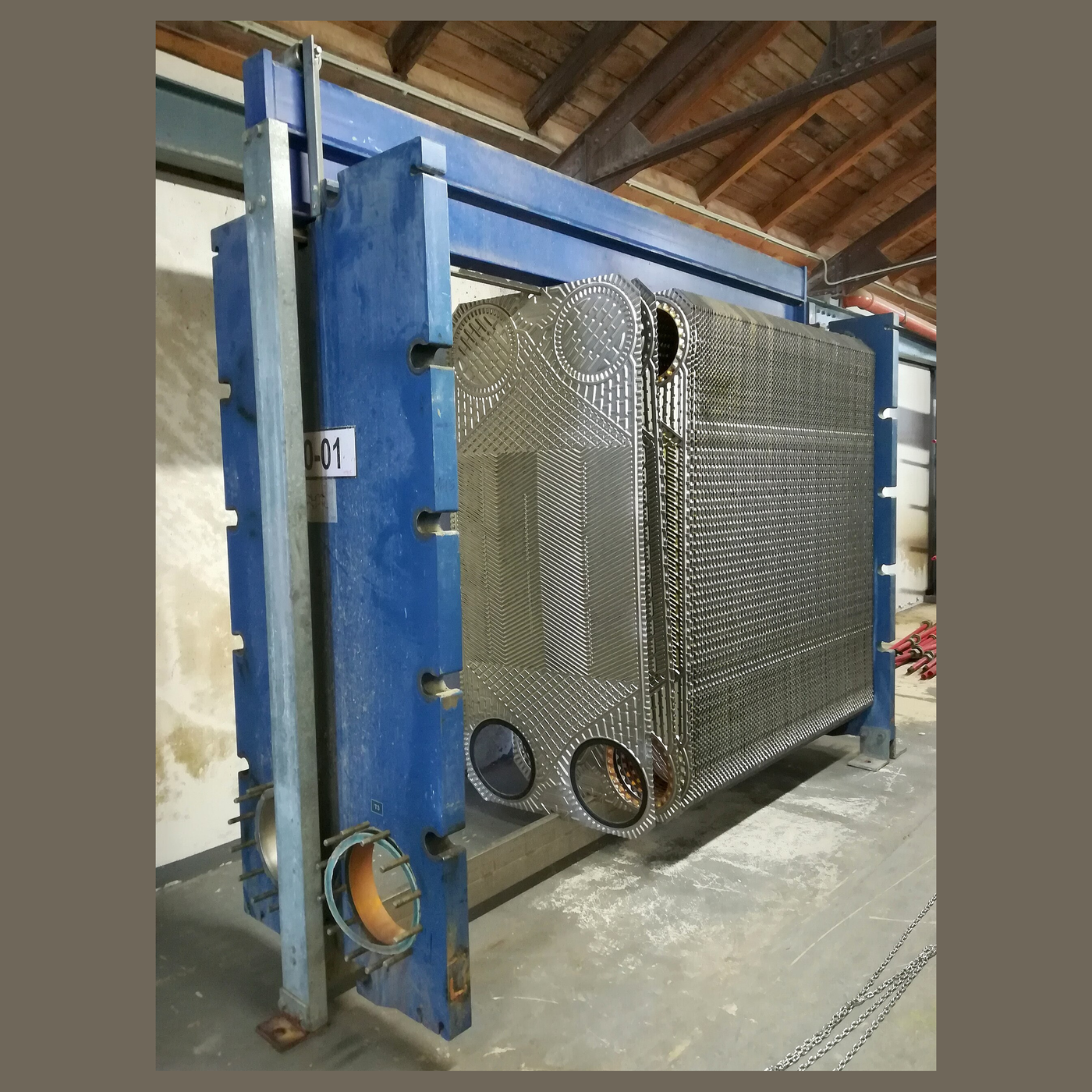

The Plate Heat Exchanger: Thin Plates, Turbulence, and a Frame You Can Open
A stack of thin pressed-metal plates, each sealed to the next by a gasket round its edge, clamped between two heavy frame plates by long bolts. Hot and cold liquids flow in alternate gaps, so every plate has hot on one face and cold on the other.
Richard Seligman's plate heat exchanger of 1923, made by his Aluminium Plate & Vessel Company (APV), was built for the dairy: milk had to be heated and cooled quickly for pasteurisation, and the equipment had to come apart for cleaning every day. Thin corrugated plates give very high heat transfer in a small space; the gasketed frame opens with a spanner.
This rung works out where the size advantage comes from, and builds a two-channel plate exchanger from copper sheet, printed gaskets and a clamped frame.
Średniozaawansowany
About 6 hours
Instrukcje
1
1
Where the high U comes from, and what fouling costs
Where the high U comes from, and what fouling costs
Wczytywanie notatnika Jupyter…
2
2
Plate exchangers run in counterflow
Plate exchangers run in counterflow
A plate exchanger's ports are arranged so the two liquids run in opposite directions through alternate gaps. The embedded blueprint explains why, and measures it on a tube-in-tube exchanger.
3
3
Build a two-channel plate exchanger
Build a two-channel plate exchanger
Cut three copper sheets 150 × 100 mm. The middle one is the heat-transfer plate; the outer two are blanks. Print two gasket frames in TPU, 3 mm thick, each the outline of the plate with a 10 mm border, so each frame encloses a flow gap.
Stack: acrylic end plate / copper blank / gasket frame / copper plate / gasket frame / copper blank / acrylic end plate. Drill four corner bolt holes through everything and clamp with threaded rod and wing nuts, tightening evenly.
Drill and fit hose tails so that gap 1 is fed at the top-left and drains at the bottom-right, and gap 2 is fed at the bottom-right and drains at the top-left — counterflow across the plate. Add ridges to the gasket frames or press shallow chevrons into the copper with a blunt punch to break up the flow.
Materiały do tego kroku:
 Blacha miedziana1 arkusz
 Elastyczny filament TPU40 g
 Płyta akrylowa1 arkusz
 Pręt gwintowany1 sztuka
 Nakrętka motylkowa4 sztuk
 Zestaw złączek do rur PVC1 zestaw
 Uszczelniacz silikonowy1 sztuka
Potrzebne narzędzia:
 Drukarka 3D z filamentem (FDM)
 Wiertarko-wkrętarka akumulatorowa
 Zestaw wierteł
 Linijka
 Klucz nastawny
 Skórzane rękawice robocze
4
4
Test it, then open it
Test it, then open it
Run hot water through one gap and cold through the other at equal, timed flows, and read the four temperatures with the thermometer (or reuse the four-probe logger from the counterflow rung). Work out the heat carried by each side.
Now the reason the design exists: undo the wing nuts, lift the stack apart and look. Any sediment, scale or film is on the copper where you can wipe it. Wipe, restack and tighten. An exchanger you can open is an exchanger you can keep clean — which in a dairy is the difference between a safe product and a spoiled one.
Retighten evenly: a gasket squeezed harder on one side leaks on the other.
Materiały do tego kroku:
 Woda30 litrów
Potrzebne narzędzia:
 Czajnik elektryczny szklany
 Wiadro
 Dzbanek miarowy
 Stoper
 Termometr kuchennyKlucz nastawny
5
5
History and context
History and context
**Richard Seligman, 1923** — the first commercially successful plate heat exchanger, made by the Aluminium Plate & Vessel Company he had founded in London in 1910, for the high-temperature short-time pasteurisation of milk. No patent number is asserted here: it could not be read from a primary source, and the design is fully documented.
Plate exchangers now run in food, brewing, district heating, heat pumps and chemical plant; brazed versions with no gaskets at all are the small cube in many domestic boilers.
**Honest limits.** Gaskets limit the temperature and pressure, and the chemicals they can meet. Narrow gaps clog on fibrous or particle-laden liquids, where shell-and-tube exchangers still win. And the high pressure drop of those turbulent gaps costs pumping power.
Materiały
8- 1 arkuszZastępnik
- Zastępnik
- 1 arkuszZastępnik
- 1 sztukaZastępnik
- Nakrętka motylkowa10% prowizji4 sztukZastępnik
- 1 zestawZastępnik
- 1 sztukaZastępnik
- 30 litrówZastępnik
Wymagane narzędzia
11- Zastępnik
- 1 vendor sell this, none ship to you yetZastępnik
- Zastępnik
- Zastępnik
- Zastępnik
- Zastępnik
- Zastępnik
- Zastępnik
- Zastępnik
- Zastępnik
- Zastępnik
Powiązane blueprinty
Te blueprinty dzielą się wiedzą — technikami, materiałami lub zasadami
Counterflow: The Same Area Does More When the Streams Run Opposite
autor: Emma
Mechanika
15
0
0
0
0
0

The Economiser: The Heat Still Going Up the Chimney
autor: Martin
Mechanika
15
0
0
0
0
0
The Centrifugal Pump: Speed Squared, and Why It Cannot Lift Air
autor: Emma
Mechanika
17
0
0
0
0
0
The Ferrule Fitting: Gripping and Sealing With One Nut
autor: Emma
Narzędzia
17
0
0
0
0
0
CC0 Domena publiczna
Ten plan jest udostępniany na licencji CC0. Możesz go swobodnie kopiować, modyfikować, rozpowszechniać i wykorzystywać do dowolnych celów, bez konieczności uzyskiwania zgody.
Wesprzyj Makera kupując produkty przez jego plan, za co zarabia Prowizja Makera ustalony przez sprzedawców, lub stwórz nową iterację tego planu i dołącz go jako połączenie w swoim własnym planie, aby dzielić się przychodami.