SZTUKA
Piękno i dobre samopoczucie
RZEMIOSŁO
KULTURA I HISTORIA
ROZRYWKA
ŚRODOWISKO
JEDZENIE I NAPOJE
INŻYNIERIA ODWROTNA
NAUKI
LEKKOATLETYKA
TECHNOLOGIA
URZĄDZENIA DO NOSZENIA

The Ratchet Socket Wrench: Turn the Nut Without Letting Go
A spanner turns a nut a sixth of a turn and then has to come off and go back on. Where there is no room to swing it, the nut cannot be turned at all.
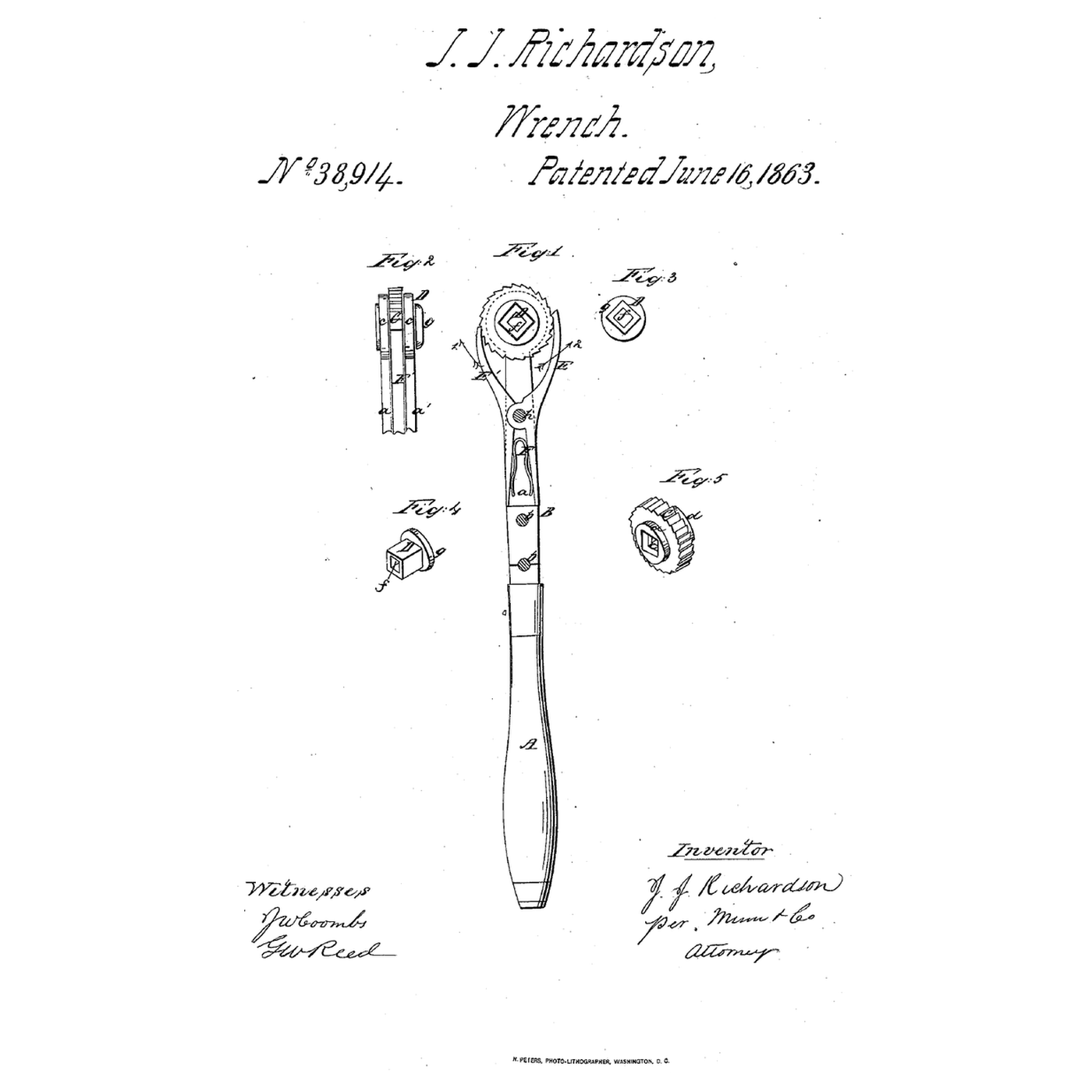
J. J. Richardson of Woodstock, Vermont, patented a ratchet wrench in US 38,914, dated 16 June 1863. A ratchet with a square hole through it turns in the eyes of a two-part shank; two pawls held in by a spring catch its teeth one way and slip over them the other, and removable sockets, all the same size outside but with square openings of different sizes, fit different nuts. The nut is turned "by an oscillating movement without taking the wrench from it".
This rung works out how much swing a ratchet needs and what its teeth carry, and measures both on a modern socket set.
Początkujący
About 2 hours
Instrukcje
1
1
Swing, teeth and tooth load
Swing, teeth and tooth load
Wczytywanie notatnika Jupyter…
2
2
The mechanism inside the head
The mechanism inside the head
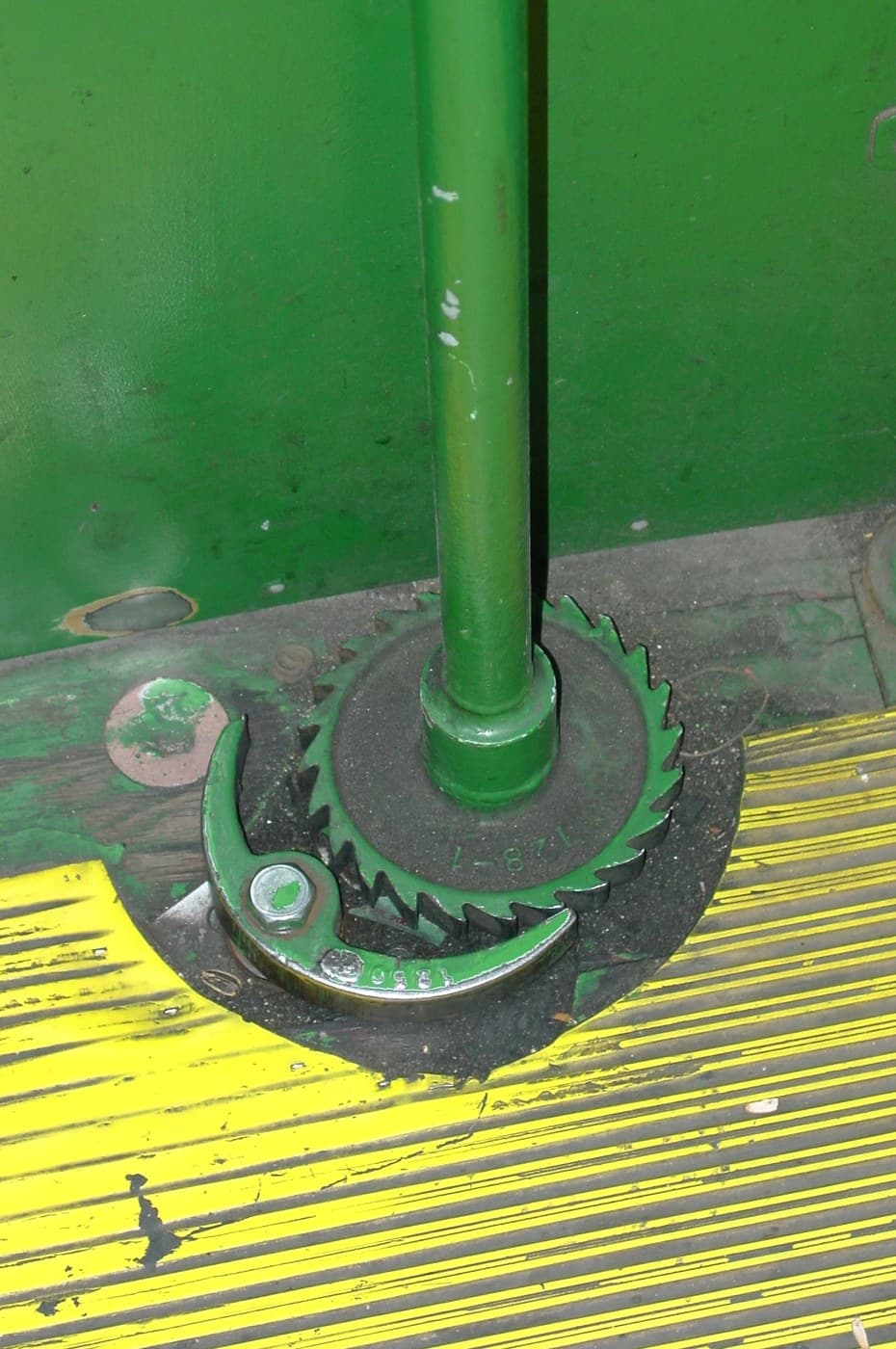
The toothed wheel and pawl that allow motion one way and refuse it the other. The embedded blueprint explains the tooth and pawl geometry the wrench relies on.
3
3
Read the 1863 ratchet wrench
Read the 1863 ratchet wrench
In US 38,914 the handle A "may be of wood" and the metal shank B is made in two parts a and a′, screwed together. Their outer ends form eyes c in which two cylindrical bosses d, one on each side of the ratchet C, turn freely. Ratchet and bosses have a square opening e right through them, and into it fits a socket D with a square opening f and a flange g at one end.
Two pawls, E and E′, sit on one pin h between the two parts of the shank: "One of these pawls, E, is a pulling one, and the other, E′, a pushing or shoving one." A spring F between them keeps both engaged. Swinging the handle one way (arrow 1) the pawls drive the teeth; the other way (arrow 2) they slip over them.
"Several sockets, D, are used with the same wrench. These sockets are all of the same size externally, but the square openings f are of different dimensions to suit different-sized nuts." The patent names its purpose: cases where it would be "inconvenient or impossible, on account of a restricted space", to use an ordinary wrench.
4
4
The swing-and-return cycle
The swing-and-return cycle
Przestrzeń Blockly
Loading Blockly workspace...
5
5
Count the teeth and measure the room it needs
Count the teeth and measure the room it needs
Take the ratchet from a socket set, fit a socket on a nut clamped in the bench vise, and turn the handle one full revolution slowly, counting the clicks. Clicks per revolution is the number of positions the ratchet can take up; 360° divided by it is the smallest swing that gains ground. (Some ratchets use two offset pawls and click twice per tooth.)
Now build a 'cramped corner': screw two offcuts of pine board to the bench either side of a hex bolt so that only a 30° swing is free. Try to run the nut down with a combination spanner, then with the ratchet. The spanner has to come off and be flipped at every stroke; the ratchet does not.
Finally tighten the nut with the torque wrench to a set value and note how many ratchet strokes it took from finger-tight.
Materiały do tego kroku:
 Zestaw śrub sześciokątnych1 sztuka
 Nakrętka sześciokątna2 sztuk
 Deska sosnowa1 sztuka
 Wkręt do drewna4 sztuk
Potrzebne narzędzia:
 Zestaw nasadek
 Komplet kluczy płasko-oczkowych
 Klucz dynamometryczny
 Imadło warsztatowe
 Kątomierz
 Wiertarko-wkrętarka akumulatorowa
6
6
A ratchet that will not drive
A ratchet that will not drive
Ratchet wrench troubleshooting.
Flow
Loading...
7
7
History and honest limits
History and honest limits
**J. J. Richardson** of Woodstock, Vermont, received US 38,914, dated 16 June 1863, for a ratchet wrench with a pulling pawl, a pushing pawl, a spring and interchangeable sockets. Its claim is the ratchet C with its two bosses turning in the eyes of the shank, combined with the pawls, spring and removable socket.
**Honest limits.** Richardson's sockets had square openings, for square nuts. The tooth loads in the notebook are an example, not his dimensions. A ratchet is for running nuts; the highest torques are safer on a solid breaker bar.
Materiały
4- 1 sztukaZastępnik
- 2 sztukZastępnik
- 1 sztukaZastępnik
- Wkręt do drewna10% prowizji4 sztukZastępnik
Wymagane narzędzia
6- Zestaw nasadek10% prowizjiZastępnik
- Komplet kluczy płasko-oczkowych10% prowizjiZastępnik
- Zastępnik
- Zastępnik
- Zastępnik
- 1 vendor sell this, none ship to you yetZastępnik
Powiązane blueprinty
Te blueprinty dzielą się wiedzą — technikami, materiałami lub zasadami
Ratchet and Pawl
autor: Forge
RZEMIOSŁO
39
0
0
0
0
0

The Law of the Lever — Archimedes' Balance of Weight and Distance
autor: Martin
Fizyka
54
0
0
0
1
0
What a Screw Thread Is: A Ramp Wrapped Round a Cylinder
autor: Forge
Obróbka metali
27
0
0
0
0
0
Choosing the Fastener: Screw, Bolt, Stud, Rivet
autor: Martin
Narzędzia do obróbki drewna
22
0
0
0
0
0
CC0 Domena publiczna
Ten plan jest udostępniany na licencji CC0. Możesz go swobodnie kopiować, modyfikować, rozpowszechniać i wykorzystywać do dowolnych celów, bez konieczności uzyskiwania zgody.
Wesprzyj Makera kupując produkty przez jego plan, za co zarabia Prowizja Makera ustalony przez sprzedawców, lub stwórz nową iterację tego planu i dołącz go jako połączenie w swoim własnym planie, aby dzielić się przychodami.