SZTUKA
Piękno i dobre samopoczucie
RZEMIOSŁO
KULTURA I HISTORIA
ROZRYWKA
ŚRODOWISKO
JEDZENIE I NAPOJE
INŻYNIERIA ODWROTNA
NAUKI
LEKKOATLETYKA
TECHNOLOGIA
URZĄDZENIA DO NOSZENIA
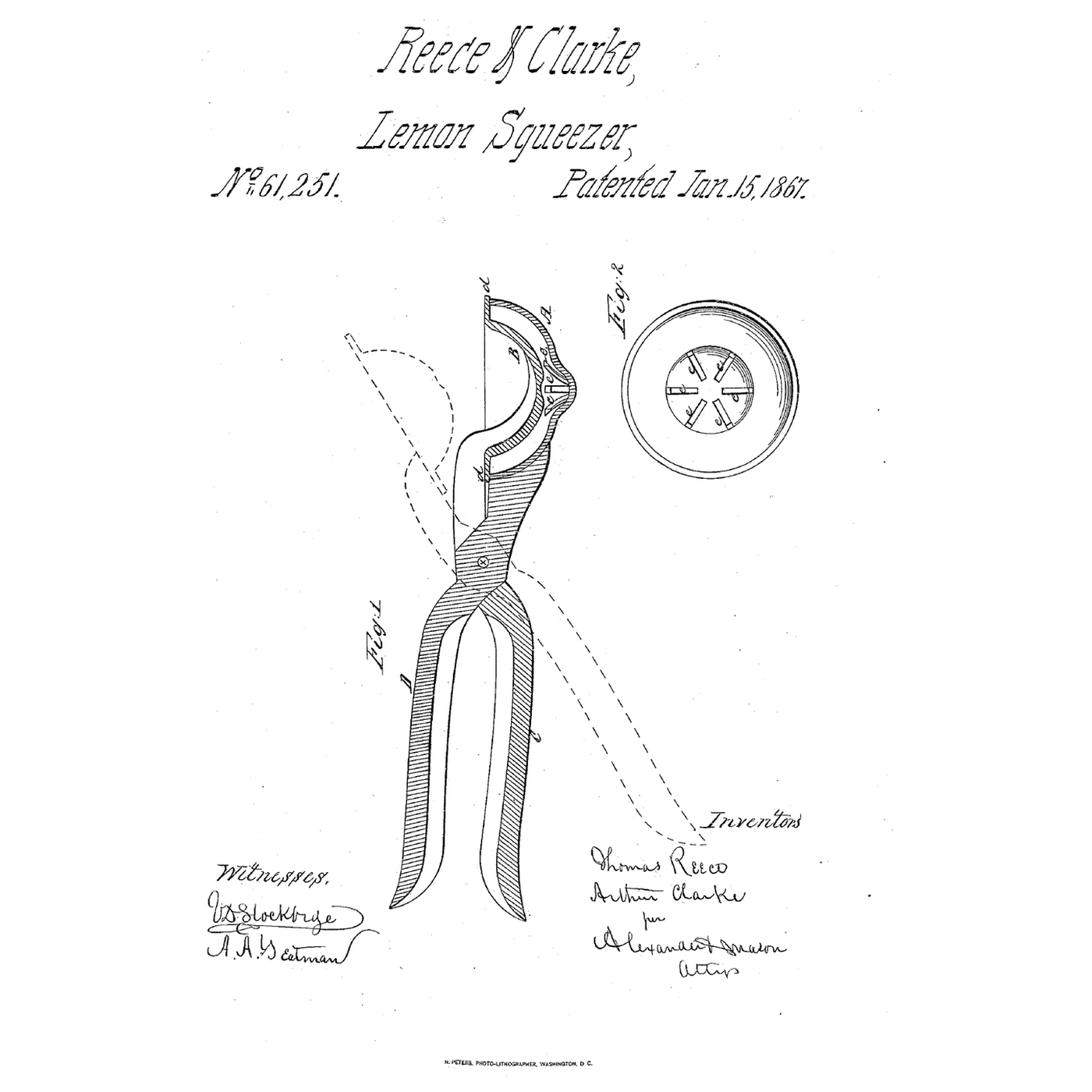


The Shears-Cup Lemon Squeezer: Two Cups on Crossed Handles, a Slotted Recess for the Juice
A lemon squeezer lets the seeds through with the juice, or crushes them into it, and its holes clog with pulp.
Thomas Reece and Arthur Clarke of Philadelphia, Pennsylvania, received US 61,251, dated 15 January 1867, for a squeezer of two cups of metal or wood on handles "pivoted together at x, so that the cups may be separated or brought together similar to the blades of a pair of shears." The larger cup has a small recess in its bottom with slots radiating from its centre, so formed "as not to allow any seed to pass through them", and the smaller cup has a flange that stops it going too far into the other.
This rung works out the squeeze through the crossed handles, with a work check, then makes the squeezer from two tins on flat-bar handles, and squeezes lemons with it.
Średniozaawansowany
About 4 hours
Instrukcje
1
1
Crossed handles
Crossed handles
Wczytywanie notatnika Jupyter…
2
2
A hinged squeezer before it
A hinged squeezer before it
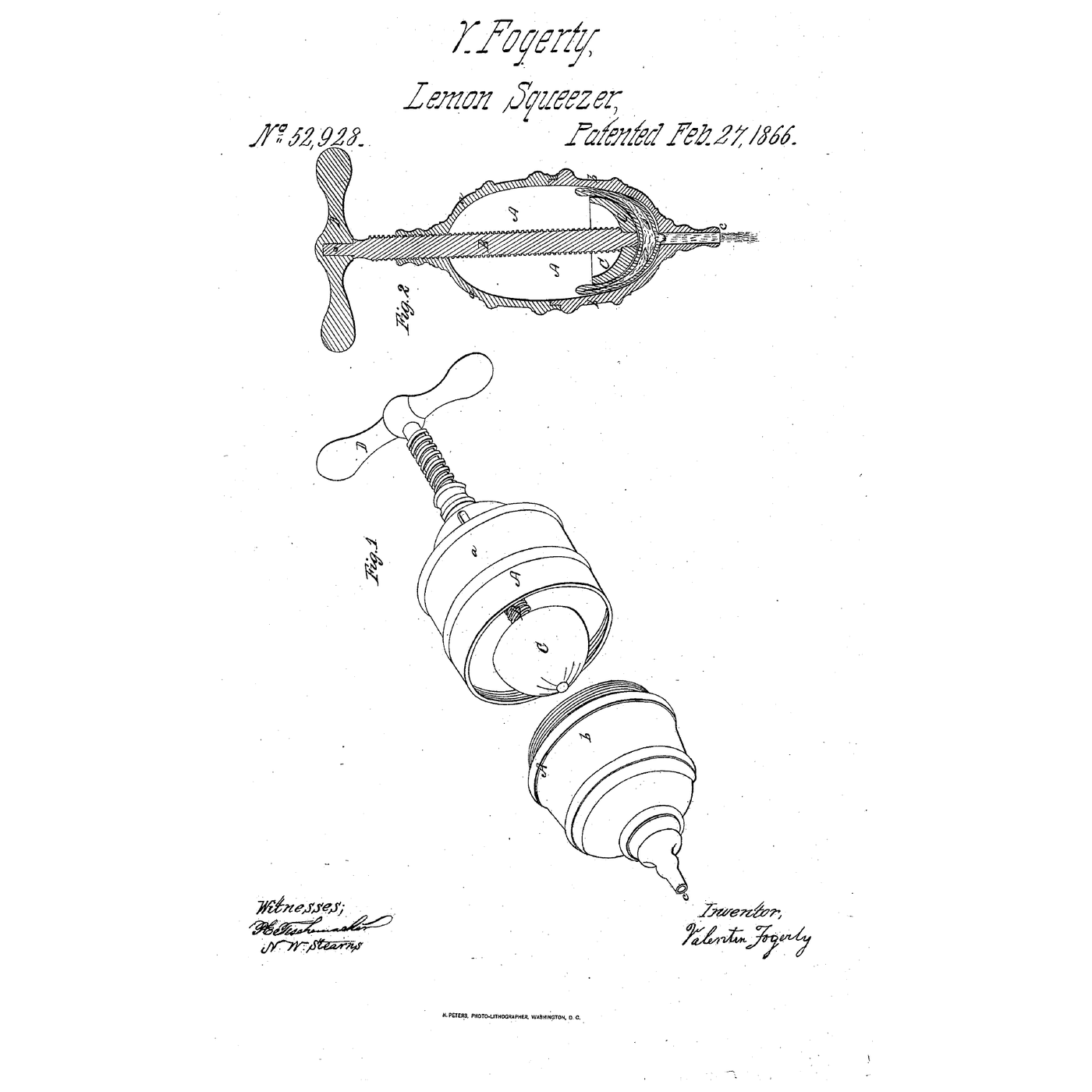
The embedded blueprint pins its handles at their front ends. Reece and Clarke cross theirs like shears and slot the recess so seeds stay behind.
3
3
Read US 61,251
Read US 61,251
"The cup B is made smaller than cup A, and works within it with its bottom down. This cup B is provided around its mouth with a flange, d, which catches upon the mouth of cup A when the two cups are brought together, as shown in Figure 1. These cups are provided with the handles C and D, which said handles are pivoted together at x, so that the cups may be separated or brought together similar to the blades of a pair of shears."
"The space between the two cups allows the juice to be pressed out through the slots or openings without breaking the seed, and the slots are so formed and are of such a size as not to allow any seed to pass through them."
4
4
Make the squeezer and press lemons
Make the squeezer and press lemons
**Handles.** Cut two 25 cm lengths of 20 × 5 mm mild steel flat bar and drill each 8 cm from one end for an M6 pivot bolt, so they cross like shears.
**Cups.** Cut the bottoms from two clean tin cans, one about 8 cm across and one about 6.5 cm, each 3 cm deep. In the larger one's base, hammer a small recess over a hole in a hardwood block, and cut four narrow slots in it radiating from the centre, 2 mm wide. Rivet a ring of tinplate round the smaller one's mouth as the flange d.
**Assemble.** Rivet each cup to the short end of a handle so the smaller cup, bottom down, closes into the larger one when the handles are squeezed, and bolt the handles at the pivot.
**Test.** Halve a lemon, put one half cut side down in the larger cup over a glass, and squeeze. Count the seeds left in the cup and in the glass, and weigh the juice.
Materiały do tego kroku:
 Płaskownik ze stali miękkiej0.5 metr
 Puszka blaszana2 sztuk
 Arkusz blachy białej1 sztuka
 Nity jednostronne8 sztuk
 Zestaw śrub sześciokątnych1 sztuka
 Nakrętka sześciokątna1 sztuka
 Klocek z drewna twardego1 sztuka
 Cytryna2 sztuk
Potrzebne narzędzia:
 Piła do metalu
 Wiertarko-wkrętarka akumulatorowa
 Zestaw wierteł
 Pilniki (pilnik ręczny)
 Zestaw pilników iglaków
 Imadło warsztatowe
 Nożyce do blachy
 Młotek
 Zestaw nitownicy jednostronnej
 Klucz nastawny
 Nóż kuchenny
 Cyfrowa waga kuchenna
 Szklanka
 Skórzane rękawice robocze
5
5
A squeezer that lets seeds through, clogs or sprays
A squeezer that lets seeds through, clogs or sprays
Shears-cup lemon squeezer troubleshooting.
Flow
Loading...
6
6
History and honest limits
History and honest limits
**Thomas Reece and Arthur Clarke** of Philadelphia, Pennsylvania, received US 61,251, dated 15 January 1867. The cups could be metal, galvanized, or wood tinned against the acid; the peculiar shape of cup A with its recess kept the squeezer from clogging or choking. Their claim is the two hinged handles with the two cups, one with a slotted recess and the other with a flange.
**Honest limits.** Tin cans and flat bar stand in for their made-up cups and handles. The notebook ignores friction; its forces and lengths are examples. Your seed count and juice are the result.
Materiały
8- 0.5 metrZastępnik
- 2 sztukZastępnik
- 1 sztukaZastępnik
- 8 sztukZastępnik
- 1 sztukaZastępnik
- 1 sztukaZastępnik
- 1 sztukaZastępnik
- 2 sztukZastępnik
Wymagane narzędzia
14- Zastępnik
- 1 vendor sell this, none ship to you yetZastępnik
- Zastępnik
- Zastępnik
- Zastępnik
- Zastępnik
- Zastępnik
- Zastępnik
- Zastępnik
- Zastępnik
- Zastępnik
- Zastępnik
- Zastępnik
- Zastępnik
Powiązane blueprinty
Te blueprinty dzielą się wiedzą — technikami, materiałami lub zasadami




CC0 Domena publiczna
Ten plan jest udostępniany na licencji CC0. Możesz go swobodnie kopiować, modyfikować, rozpowszechniać i wykorzystywać do dowolnych celów, bez konieczności uzyskiwania zgody.
Wesprzyj Makera kupując produkty przez jego plan, za co zarabia Prowizja Makera ustalony przez sprzedawców, lub stwórz nową iterację tego planu i dołącz go jako połączenie w swoim własnym planie, aby dzielić się przychodami.