SZTUKA
Piękno i dobre samopoczucie
RZEMIOSŁO
KULTURA I HISTORIA
ROZRYWKA
ŚRODOWISKO
JEDZENIE I NAPOJE
INŻYNIERIA ODWROTNA
NAUKI
LEKKOATLETYKA
TECHNOLOGIA
URZĄDZENIA DO NOSZENIA
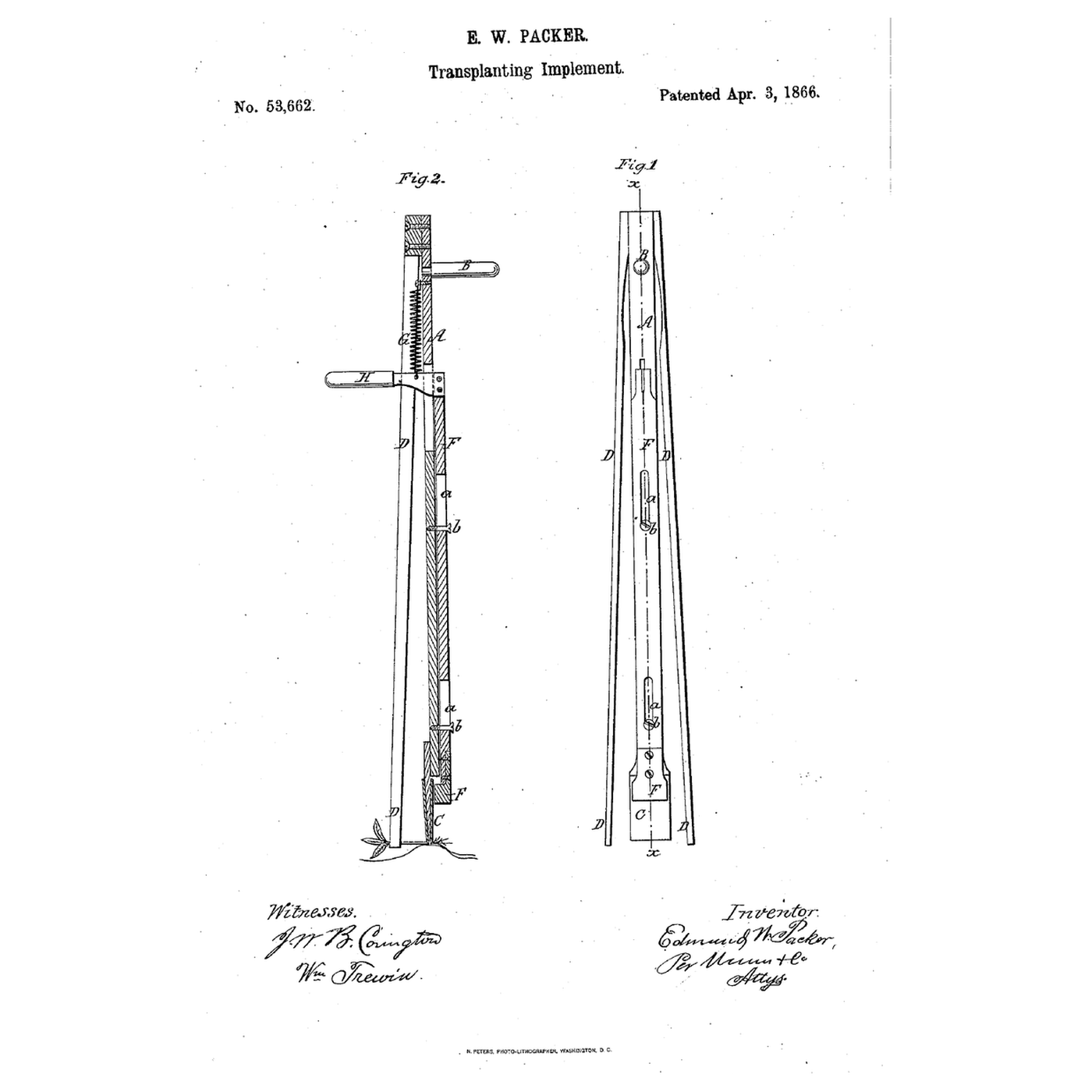


The Standing Transplanter: Set Out Plants Without Stooping
Setting out hundreds of young plants by hand means bending to the ground for every one, and the back pays for it.
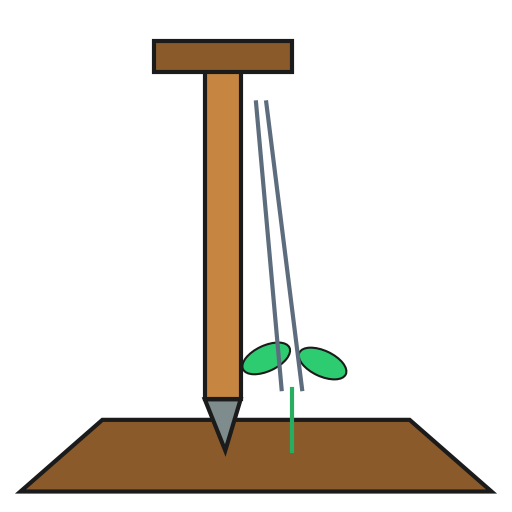
Edmund W. Packer of Paulsborough, New Jersey, received US 53,662, dated 3 April 1866, for an implement for setting out sweet-potato, cabbage and other plants "not requiring the person using it to stoop". A staff with a wedge-shaped foot carries tong-levers that hold the plant, and a spring-returned ram firms the earth around it.
This rung works out the load stooping puts on the lower back, then builds a standing transplanter and sets out a row of seedlings with it.
Początkujący
About 3 hours
Instrukcje
1
1
Back load, upright against stooped
Back load, upright against stooped
Wczytywanie notatnika Jupyter…
2
2
Getting the plants ready
Getting the plants ready
The embedded blueprint hardens seedlings and plants them out. Packer's staff sets them out without bending.
3
3
Read US 53,662
Read US 53,662
"The object of this invention is to provide a tool or implement with which sweet-potato, cabbage, and other plants can be expeditiously set out or planted in the ground, and with but very little manual labor, the implement embraced by the present improvements not requiring the person using it to stoop, which by the mode hitherto practiced for the setting out of such plants with the hands occasioned much pain in the person's back".
The plant is "forced into the ground, and to any desired depth, by simply exerting more or less force upon the staff", after which the ram "is forced down, pressing the earth around and about the plant", and "is drawn back by the action of the spiral spring G".
4
4
Build a standing transplanter and plant a row
Build a standing transplanter and plant a row
Raise lettuce seedlings in a seedling tray.
Take a broom handle as the staff and fix a wedge-shaped hardwood foot to its lower end. Screw two long hardwood strips to its sides as tongs, hinged at the top, so their lower ends pinch a seedling's stem when squeezed together. Beside the staff, fit a sliding dowel with a flat foot as the ram, guided by two screw eyes and pulled back up by a spring.
Set out one row with the transplanter and one by hand with the trowel. Time each row, and note how often you had to bend.
Materiały do tego kroku:
 Deska z drewna liściastego1 sztuka
 Kołek drewniany1 sztuka
 Zestaw sprężyn naciskowych1 sztuka
 Wkręty do drewna8 sztuk
 Nasiona sałaty - mieszanka liści1 sztuka
 Ziemia do doniczek1 sztuka
Potrzebne narzędzia:
 Sadzarka ręczna
 Łopatka ogrodnicza
 Taca na rozsadę
 Konewka
 Piła ręczna
 Wiertarko-wkrętarka akumulatorowa
 Stoper
5
5
Transplants that wilt, lean or sit too shallow
Transplants that wilt, lean or sit too shallow
Transplanting troubleshooting.
Flow
Loading...
6
6
History and honest limits
History and honest limits
**Edmund W. Packer** of Paulsborough, Gloucester County, New Jersey, received US 53,662, dated 3 April 1866. The patent prints no filing date.
**Honest limits.** The notebook treats the upper body as one weight at one distance. It is a rough guide to how the back load grows, not a medical figure. The masses and distances are examples. Your timed rows are the measurement.
Materiały
6- 1 sztukaZastępnik
- 1 sztukaZastępnik
- 1 sztukaZastępnik
- 8 sztukZastępnik
- 1 sztukaZastępnik
- Ziemia do doniczek10% prowizji1 sztukaZastępnik
Wymagane narzędzia
7- Zastępnik
- Zastępnik
- Zastępnik
- Zastępnik
- Zastępnik
- 1 vendor sell this, none ship to you yetZastępnik
- Zastępnik
Powiązane blueprinty
Te blueprinty dzielą się wiedzą — technikami, materiałami lub zasadami

CC0 Domena publiczna
Ten plan jest udostępniany na licencji CC0. Możesz go swobodnie kopiować, modyfikować, rozpowszechniać i wykorzystywać do dowolnych celów, bez konieczności uzyskiwania zgody.
Wesprzyj Makera kupując produkty przez jego plan, za co zarabia Prowizja Makera ustalony przez sprzedawców, lub stwórz nową iterację tego planu i dołącz go jako połączenie w swoim własnym planie, aby dzielić się przychodami.