
The Streak Test
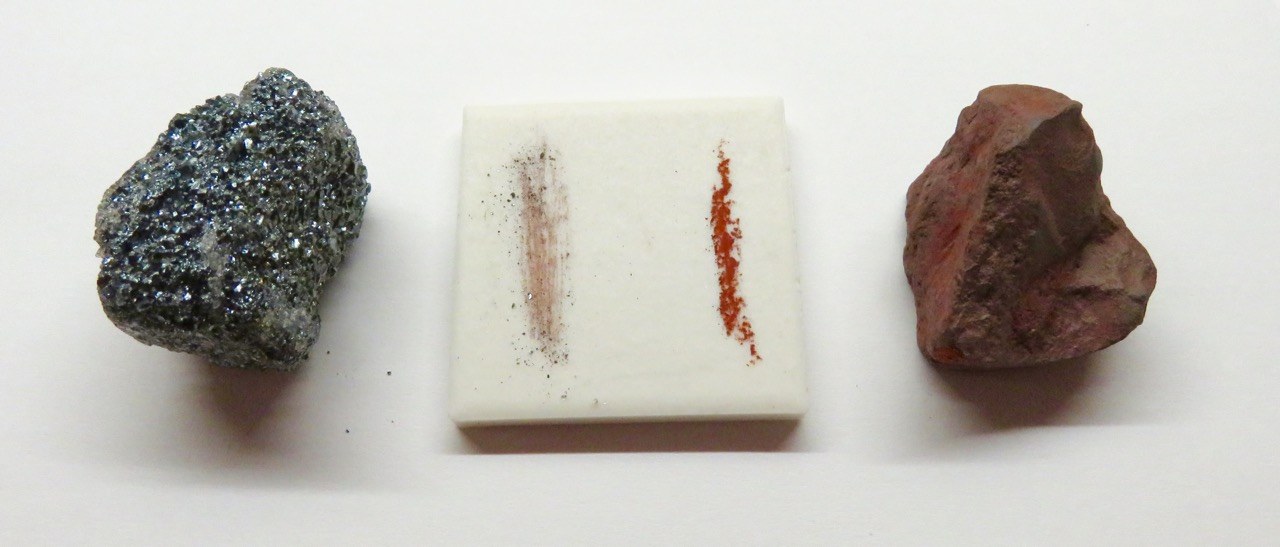
Colour is the first thing anyone notices about a mineral and one of the least reliable things about it. Hematite can turn up silver-grey, black, or brick red — the same mineral, three appearances, because bulk colour depends on crystal size, surface oxidation and trace impurities.
Drag it across a piece of unglazed porcelain and the argument ends. The line it leaves is always reddish brown, whatever the lump looked like. That line is the mineral powdered, and powder shows the mineral's true intrinsic colour because you have destroyed the surface effects and the reflections that were fooling your eye.
Pyrite makes the point the other way. It is brassy, metallic and famously mistaken for gold; its streak is greenish-black. Gold's streak is gold. Two seconds on a tile settles a question that has cost people a great deal of money.
The test has one built-in limit, and it is a feature rather than a fault. A streak plate is only about 6.5 to 7 on the Mohs scale, so anything harder than that will not powder — it scratches the plate instead, or chips. "No streak" is itself a measurement: it tells you the specimen is harder than 7, which rules out most of the mineral kingdom in one stroke.
Build a small identification kit, run streak and hardness together, and key out a handful of unknowns.
Instrukcje
Prepare the plate and a fresh surface
Prepare the plate and a fresh surface
Get an unglazed porcelain tile — the back of a bathroom tile works. Wash it and let it dry.
On each specimen, find or break a fresh, unweathered face to test.
A weathered crust gives the streak of the weathering product, not the mineral. Rust on the outside of a specimen streaks brown no matter what is underneath it.
Materiały do tego kroku:
 Płytka ceramiczna nieszkliwiona1 sztuka
Streak, and read it wet
Streak, and read it wet
Press firmly and drag the specimen once across the plate, about 20 mm. Look at the powder, then wipe a fingertip of water across it and look again.
Record the colour, and wipe the plate clean before the next specimen.
Wet streak is the standard. Dry powder scatters light and reads paler than the true colour, and it is why two people can disagree about the same streak.
Potrzebne narzędzia:
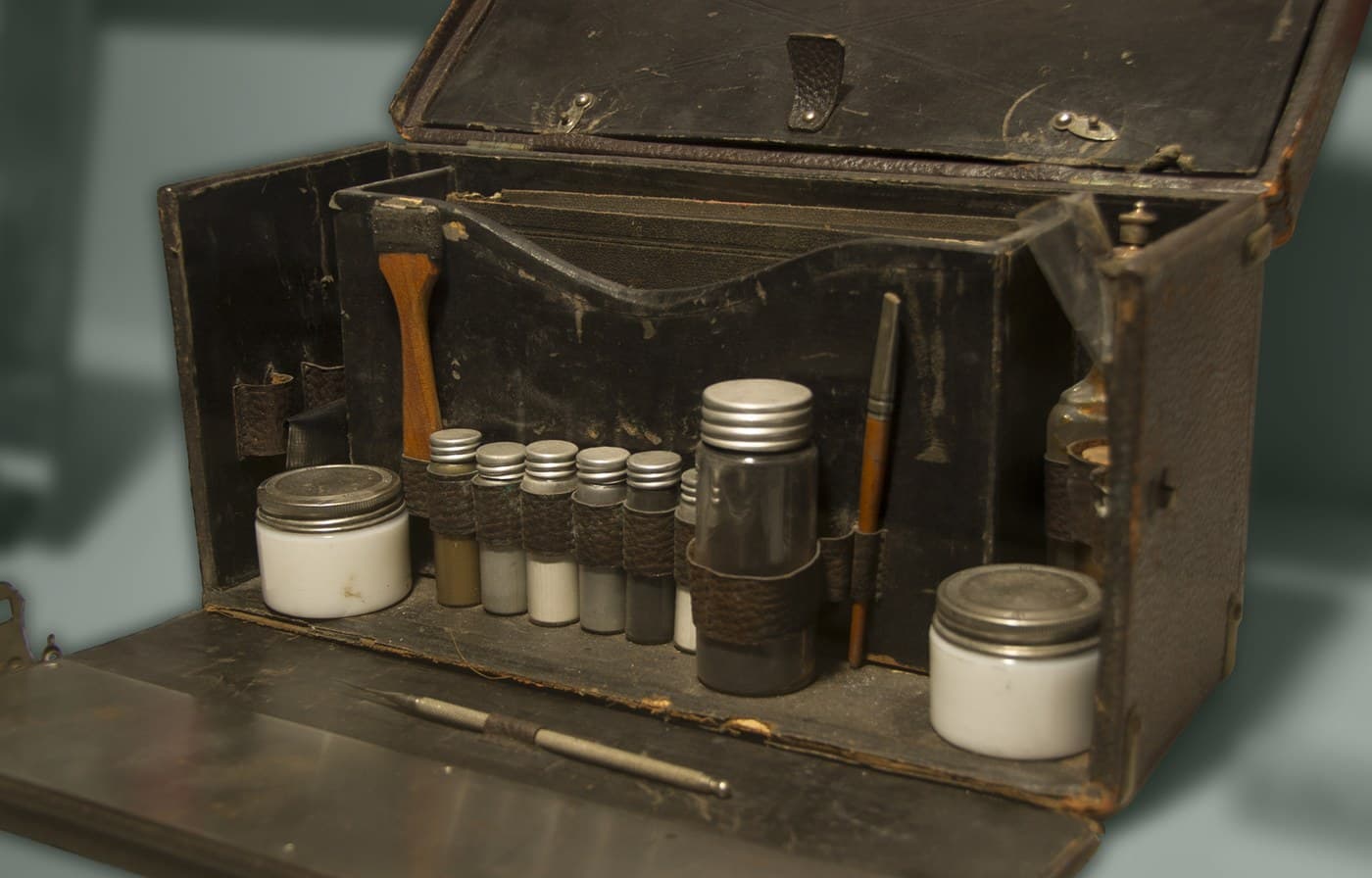
 Terenowy zestaw do badania skał i minerałów
Prove that bulk colour lies
Prove that bulk colour lies
If you can, get two or three specimens of hematite that look different — a grey metallic one, an earthy red one, a botryoidal one. Streak all of them.
Expect the same reddish-brown line every time.
Then streak pyrite: brassy specimen, greenish-black line.
Streak is a property of the substance; bulk colour is a property of the specimen. That distinction is the whole reason the test exists.
Run hardness alongside it
Run hardness alongside it
Work each unknown against a hardness set, from soft upwards, until something scratches it. Record the Mohs bracket.
Always check that the mark is a scratch and not a smear — rub it with a finger; a soft mineral leaves a streak on a hard one that wipes off.
Note which specimens refuse to streak at all, and record them as harder than 7.
Potrzebne narzędzia:
 Zestaw pilników do badania twardości materiałów
Add lustre, cleavage and heft
Add lustre, cleavage and heft
For each specimen also record: lustre (metallic or non-metallic — decide this first, it splits every key in two), whether it breaks along flat cleavage planes or in curved fracture, and whether it feels unusually heavy for its size.
Weigh a few and estimate density by water displacement if you can.
No single test identifies a mineral. Streak plus hardness plus lustre plus cleavage will get you there; any one alone will not.
Potrzebne narzędzia:
 Cyfrowa waga kuchenna
 Lupa zegarmistrzowska
Key out blind unknowns and score yourself
Key out blind unknowns and score yourself
Have someone hand you labelled-but-hidden specimens. Run the full battery, write an identification, then check.
Tally right and wrong, and look at which tests you got wrong.
Expect errors to cluster on weathered surfaces, mixed specimens, and fine-grained rocks that are not single minerals at all.
A rock is usually an assemblage. Identification keys work on minerals, and applying one to a granite is a category error a beginner makes exactly once.
Potrzebne narzędzia:
 Zestaw do analizy jakościowej nieznanych minerałów
 Notatnik terenowy na każdą pogodę
Compendium — why powder tells the truth
Compendium — why powder tells the truth
The physics of why streak beats colour. A solid specimen's appearance is dominated by what happens at its surface — specular reflection from crystal faces, interference in thin oxide films, scattering from a rough or weathered skin, and the way large crystals absorb light along particular directions. Grinding it to powder destroys all of that. Light enters countless tiny randomly-oriented grains, is scattered many times and partly absorbed, and what comes back out is dominated by the mineral's bulk absorption spectrum — its intrinsic colour. That is why powder is reproducible and lumps are not.
Which minerals it actually helps with. Streak is most decisive for metallic and opaque minerals, where the differences are stark: hematite reddish-brown, magnetite black, pyrite greenish-black, galena lead-grey, chalcopyrite greenish-black, gold gold. For most non-metallic minerals — quartz, feldspar, calcite — the streak is simply white or colourless whatever the specimen's colour, so the test cheerfully tells you nothing and you move on to hardness, cleavage and acid. Knowing which questions an instrument cannot answer is half of using it.
The Mohs scale is ordinal, not linear, and this trips people up. It ranks ten reference minerals by which scratches which — talc 1 to diamond 10 — but the intervals are wildly unequal. The jump from corundum (9) to diamond (10) is far larger in absolute hardness than the whole range from 1 to 9. Mohs numbers can be compared but never subtracted or averaged. Friedrich Mohs published the scale in 1812, and its enduring value is that it needs no apparatus at all.
Field substitutes worth memorising. A fingernail is about 2.5, a copper coin about 3.5, a steel knife or nail about 5.5, window glass about 5.5, a steel file about 6.5, and a streak plate 6.5-7 — which is why quartz, at 7, will not streak. With nothing but a nail, a coin, a knife and a tile you can bracket almost any common mineral.
Honest limits and care. Streak plates wear and load up with previous specimens, so clean between tests and replace a glazed-over plate. Testing damages the specimen, which matters for anything rare or beautiful — use an inconspicuous corner or a broken fragment, and never streak a museum piece or someone else's collection. Some minerals are genuinely toxic in powder form, cinnabar (mercury sulfide) and galena (lead sulfide) among them, so wash hands afterwards, do not eat while working, and do not deliberately grind or inhale mineral dust. Ordinary handling of ordinary rocks needs no gating; deliberate powdering of heavy-metal ores does need respect.
Materiały
1- 1 sztukaZastępnik
Wymagane narzędzia
6- Zastępnik
- Zastępnik
- Zastępnik
Materiały z połączonych planów

Powiązane blueprinty
Te blueprinty dzielą się wiedzą — technikami, materiałami lub zasadami


CC0 Domena publiczna
Ten plan jest udostępniany na licencji CC0. Możesz go swobodnie kopiować, modyfikować, rozpowszechniać i wykorzystywać do dowolnych celów, bez konieczności uzyskiwania zgody.
Wesprzyj Makera kupując produkty przez jego plan, za co zarabia Prowizja Makera ustalony przez sprzedawców, lub stwórz nową iterację tego planu i dołącz go jako połączenie w swoim własnym planie, aby dzielić się przychodami.