SZTUKA
Piękno i dobre samopoczucie
RZEMIOSŁO
KULTURA I HISTORIA
ROZRYWKA
ŚRODOWISKO
JEDZENIE I NAPOJE
INŻYNIERIA ODWROTNA
NAUKI
LEKKOATLETYKA
TECHNOLOGIA
URZĄDZENIA DO NOSZENIA
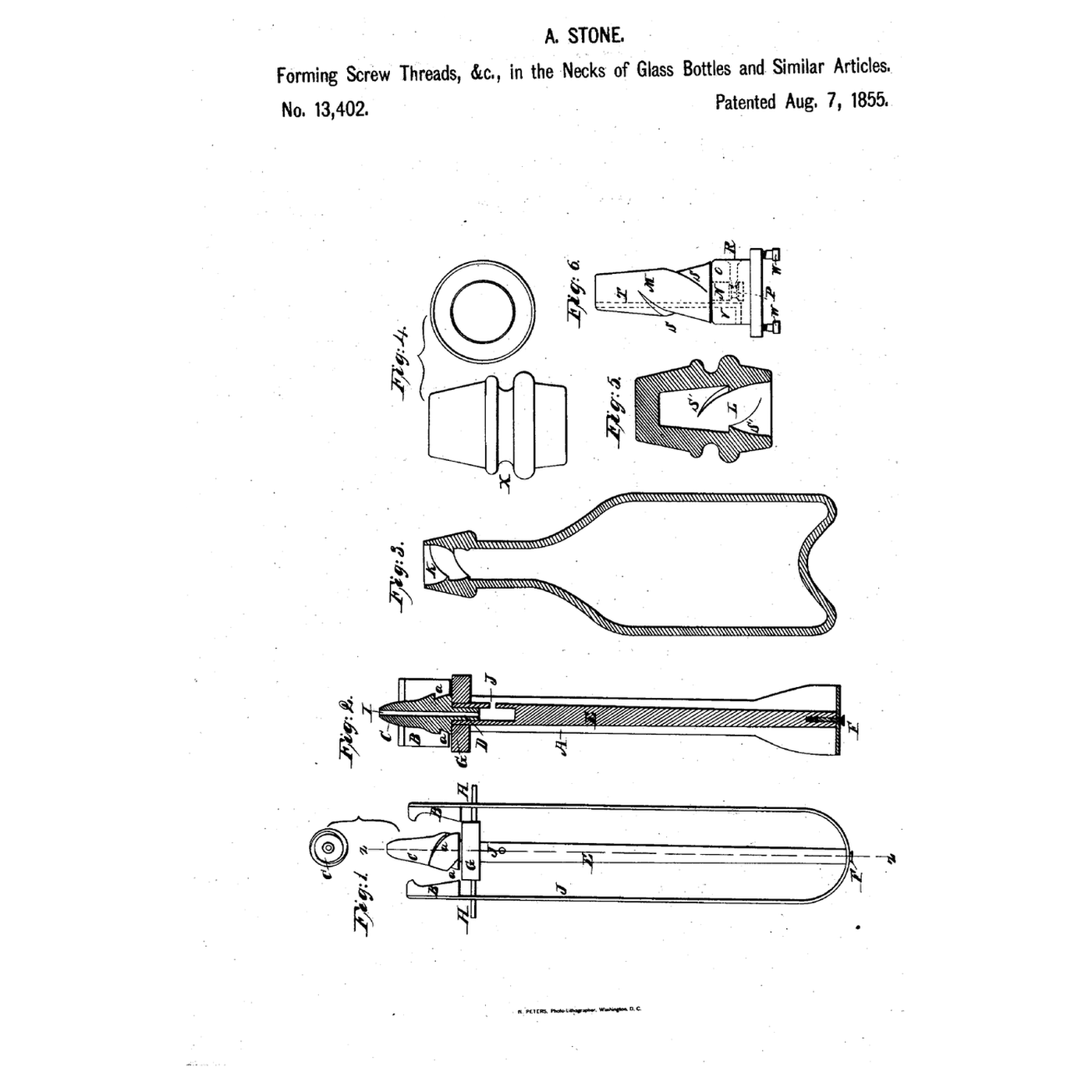


The Turning-Plug Thread Former: A Plug That Turns With the Bottle and Leaves a Screw in the Neck
A screw inside a bottle's neck holds a cork against the gas, but a plug that forms it cannot stay still while the neck is turned and shaped round it, or it tears the material.
Amasa Stone of Philadelphia received US 13,402, dated 7 August 1855, for tools "so as to allow the plug which forms the interior of the orifice to turn with the bottle; while the material of the neck is worked around it". Forming jaws on a spring shape the outside of the neck; the plug between them, on a spindle that turns freely, carries a two-threaded left-handed screw. A cork forced into the finished neck swells into the threads, and a right-handed corkscrew with a collar unscrews it.
This rung works out how far each turn draws the cork, then prints a plug on a free spindle, forms a stoneware neck round it, fires it, and unscrews a cork from it.
Zaawansowany
About 2 days, with drying and firing
Instrukcje
1
1
Turns to draw the cork
Turns to draw the cork
Wczytywanie notatnika Jupyter…
2
2
The corkscrew that unscrews it
The corkscrew that unscrews it
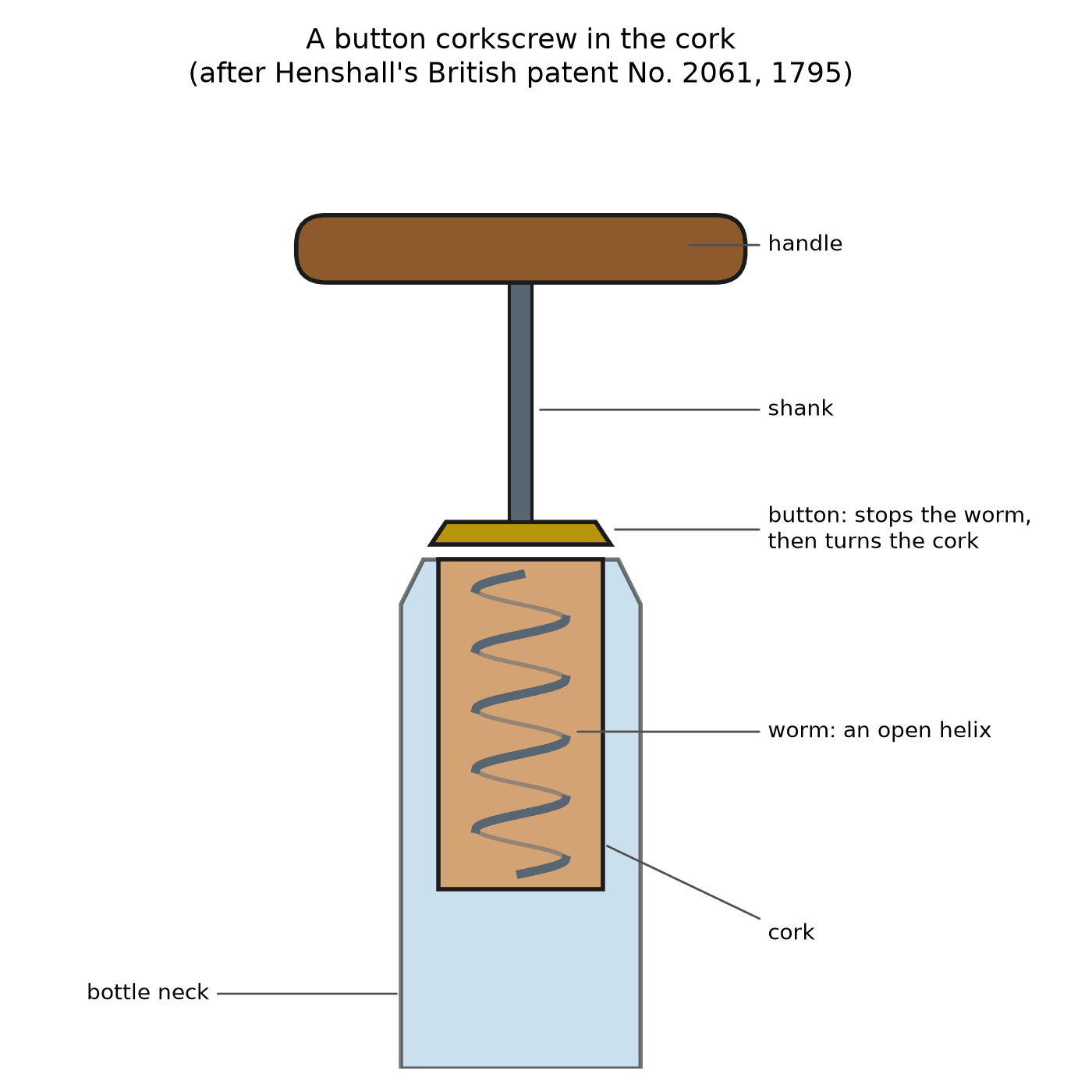
The embedded blueprint makes a corkscrew whose button stops against the cork. Stone's corks are removed by such a collared, right-handed corkscrew: once the collar meets the cork, turning on unscrews it.
3
3
Read US 13,402
Read US 13,402
"The plug C, is represented as having two angular scores a, a, made spirally upon it, so as to form a two threaded left handed male screw, the angle of the scores nearest or next to the apex, being made at a right angle to the center of the plug and the angle next to the base forming an acute angle with the center of the plug; the latter so as to give such a form to the orifice K, of the bottle Fig. 3, as will permit the cork to be readily forced in"
"What I claim as my invention in the construction of tools for forming screw threads, angular or other scores in the necks and orifices of glass, earthen, or other bottles, and other articles, is— Making the plug which forms the interior of the orifice, to turn with the bottle, jug, or other article while the material of the orifice is worked around it, substantially as described."
4
4
Form a threaded neck and unscrew a cork from it
Form a threaded neck and unscrew a cork from it
**Plug.** Print a plug that tapers from 24 mm at its base to 18 mm at its tip over 35 mm, with two left-handed spiral scores 6 mm apart, each square to the axis on the side toward the tip and sloping on the side toward the base, and a 4 mm hole through its length. Make it about 12% larger than the neck you want, for the clay's shrinkage.
**Spindle.** Fix the plug on a hardwood dowel and pass the dowel through a hole in a hardwood block clamped to the wheel's frame, so the plug turns freely point down over the wheel's centre.
**Neck.** Throw a small bottle on the wheel and close it in to a thick neck. Grease the plug with petroleum jelly, lower it into the neck, and shape the neck round it with the clay tools while the wheel turns: the plug turns with the bottle, as Stone's did, and the clay is pressed into its scores. Leave it until leather-hard, then turn the plug out by hand the way that unscrews it.
**Fire.** Dry the bottle slowly and fire it in the kiln at the clay's stated temperature.
**Test.** Fill the bottle with water and push in a squeezed cork. The next day, drive the button corkscrew in until its button meets the cork, keep turning the same way, and see the cork rise out.
Materiały do tego kroku:
 Glina kamionkowa2 kg
 Filament PETG1 sztuka
 Kołek drewniany0.3 metr
 Klocek z drewna twardego1 sztuka
 Wazelina1 sztuka
 Korki2 sztuk
 Woda0.5 litr
Potrzebne narzędzia:
 Drukarka 3D z filamentem (FDM)
 Koło garncarskie
 Zestaw narzędzi garncarskich
 Piec ceramiczny
 Wiertarko-wkrętarka akumulatorowa
 Zestaw wierteł
 Ściski
 Suwmiarka cyfrowa 6 cali
 Kombinerki
5
5
A neck that tears, sticks to the plug or will not hold the cork
A neck that tears, sticks to the plug or will not hold the cork
Turning-plug thread former troubleshooting.
Flow
Loading...
6
6
History and honest limits
History and honest limits
**Amasa Stone** of Philadelphia, Pennsylvania, received US 13,402, dated 7 August 1855. His plug C was pierced with a hole I through its length and a hole J through the spindle to let air in and out of the bottle; the spindle E turned in a block G on pivots H, H between the legs of the forceps. He described the same turning plug for the insides of telegraph insulators. After his death, Sarah T. Stone, administratrix of his estate, entered a disclaimer limiting the patent to glass, disclaiming earthen ware and other materials.
**Honest limits.** Stoneware on a potter's wheel stands in for glass worked hot in the forceps, because glass cannot be worked at home this way; the patent, as limited by the disclaimer, covers glass. The plug's sizes are not Stone's. The notebook ignores the cork's squeeze and friction; its pitches and heights are examples. Your unscrewed cork is the result.
Materiały
7- 2 kgZastępnik
- 1 sztukaZastępnik
- 0.3 metrZastępnik
- 1 sztukaZastępnik
- 1 sztukaZastępnik
- 2 sztukZastępnik
- 0.5 litrZastępnik
Wymagane narzędzia
9- Zastępnik
- Zastępnik
- Zastępnik
- Zastępnik
- 1 vendor sell this, none ship to you yetZastępnik
- Zastępnik
- Zastępnik
- Zastępnik
- Zastępnik
Powiązane blueprinty
Te blueprinty dzielą się wiedzą — technikami, materiałami lub zasadami
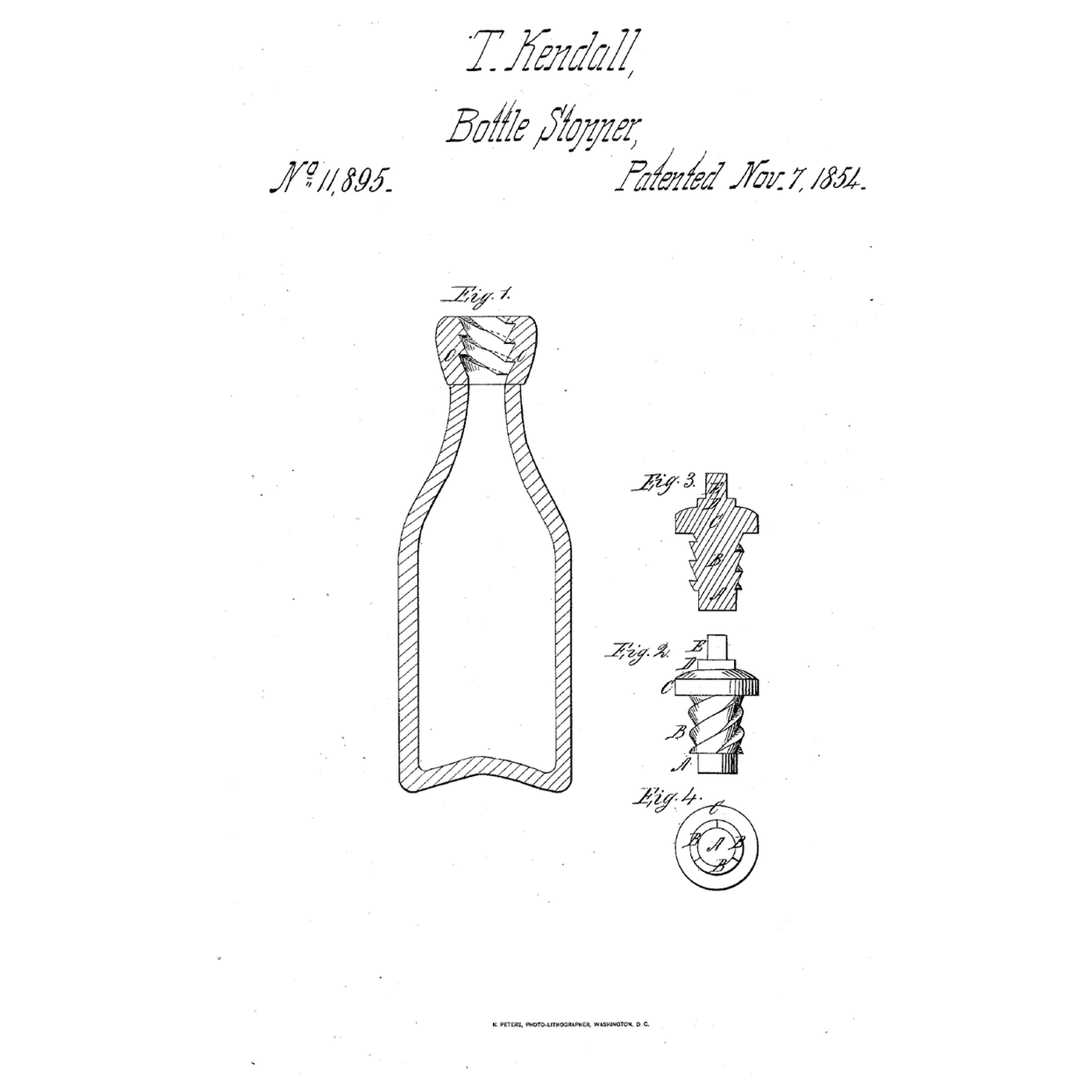
The Groove-Necked Bottle: Three Threads in the Neck That Hold the Cork
autor: Emma
Napoje
8
0
0
0
0
0
The Button Corkscrew: A Helix That Grips and a Disc That Stops It
autor: YourGrandma
JEDZENIE I NAPOJE
15
0
0
0
0
0
Blowing a Glass Bottle by Hand — Free-Blown Vessel Shaping
autor: Forge
Obróbka szkła
52
0
0
0
3
0
What a Screw Thread Is: A Ramp Wrapped Round a Cylinder
autor: Forge
Obróbka metali
32
0
0
0
0
0
CC0 Domena publiczna
Ten plan jest udostępniany na licencji CC0. Możesz go swobodnie kopiować, modyfikować, rozpowszechniać i wykorzystywać do dowolnych celów, bez konieczności uzyskiwania zgody.
Wesprzyj Makera kupując produkty przez jego plan, za co zarabia Prowizja Makera ustalony przez sprzedawców, lub stwórz nową iterację tego planu i dołącz go jako połączenie w swoim własnym planie, aby dzielić się przychodami.