SZTUKA
Piękno i dobre samopoczucie
RZEMIOSŁO
KULTURA I HISTORIA
ROZRYWKA
ŚRODOWISKO
JEDZENIE I NAPOJE
INŻYNIERIA ODWROTNA
NAUKI
LEKKOATLETYKA
TECHNOLOGIA
URZĄDZENIA DO NOSZENIA

The Wankel Engine: A Three-Cornered Rotor in an Epitrochoid
Felix Wankel wanted an engine with no reciprocating parts. His rotary engine, developed with NSU in Germany in the 1950s, has a three-cornered rotor turning inside a housing shaped like a fat figure-of-eight — an epitrochoid. The rotor's corners stay in contact with the housing all the way round, dividing it into three chambers that each take in, compress, fire and exhaust in turn. There are no valves and no connecting rods; the rotor drives an eccentric shaft directly.
It is smooth and compact for its power. It also has a long, thin combustion chamber and sliding seals at the rotor tips that proved hard to make durable.
This rung generates the housing and the chamber areas, and prints a working model with its 3:2 phasing gears.
Zaawansowany
About 8 hours
Instrukcje
1
1
Read the 1958 application
Read the 1958 application
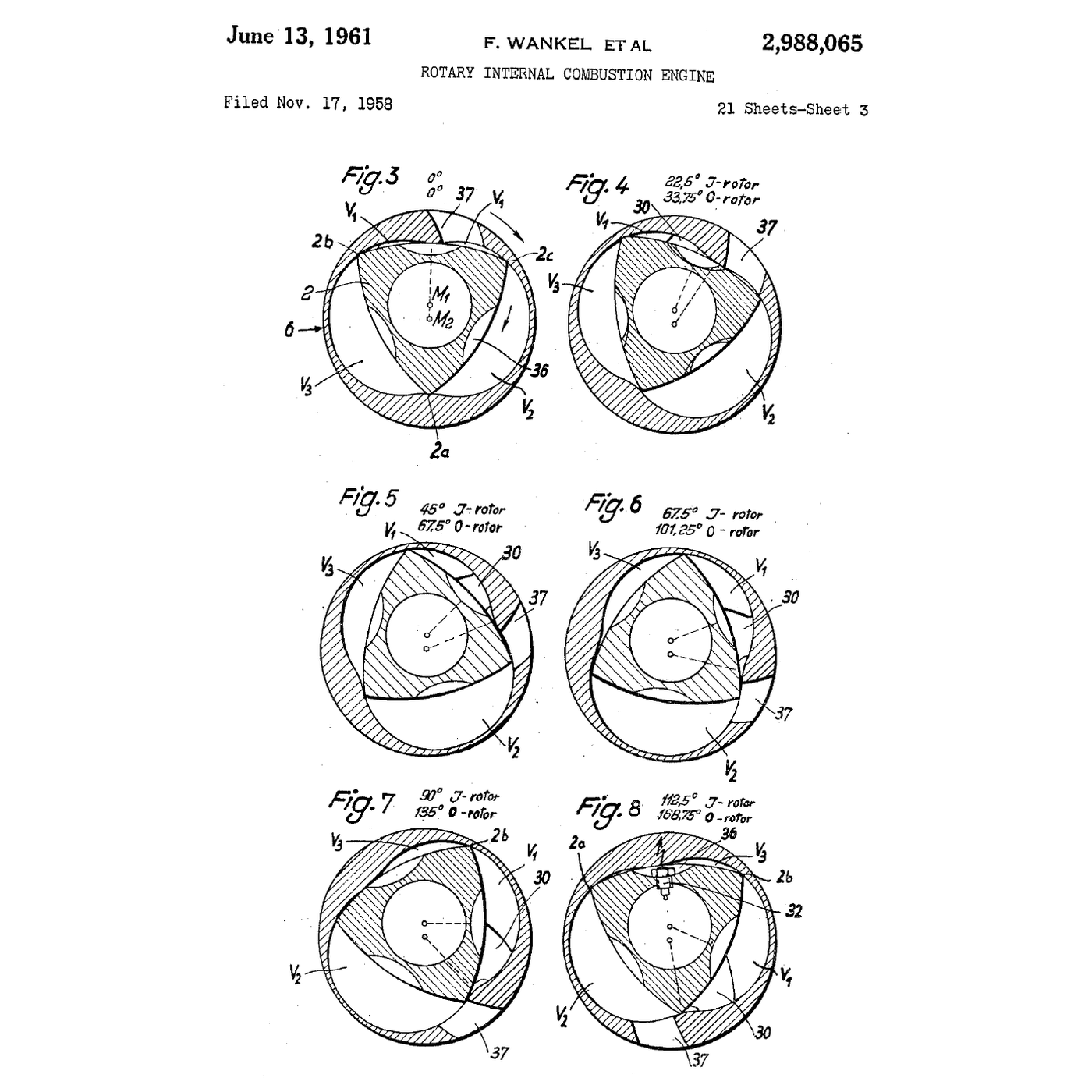
US 2,988,065, 'Rotary Internal Combustion Engine', Felix Wankel and Ernst Hoeppner of Lindau, assignors to NSU Motorenwerke and Wankel GmbH; 38 claims. The specification describes an outer body whose cavity is *"a two-lobed epitrochoid"* and an inner body with *"three apex portions"*, the inner body's outline lying inside the *"inner envelope"* of the epitrochoid — the largest rotor that can turn without hitting the wall. It covers both arrangements: both bodies rotating, or *"the kinematic inversion whereby the outer body is stationary and the inner body performs a planetary rotary movement"* — the form that went into production.
The drawing sheet shown with this blueprint is the first form: both bodies turn. Its figures step through the cycle with paired angles — 22.5° of the inner rotor against 33.75° of the outer, 45° against 67.5°, 90° against 135° — the inner turning two-thirds as fast as the outer, while the chambers V1, V2, V3 grow and shrink between them.
2
2
Generate the housing and the chambers
Generate the housing and the chambers
Wczytywanie notatnika Jupyter…
3
3
Print a working model
Print a working model
Use the notebook's R = 100 mm and e = 15 mm, scaled down by half. Export the epitrochoid points to CAD and make a housing plate with that cavity, 20 mm deep, and a clear acrylic cover.
The rotor is a triangle with its sides bowed outward, apexes at the generating radius; give it clearance so it does not bind on the curved flanks. On its face print an **internal gear of 30 teeth**; on the housing, round the shaft, a fixed **external gear of 20 teeth**. That 3:2 ratio makes the rotor turn once for every three turns of the shaft. The rotor rides on an eccentric of 7.5 mm throw on the shaft.
Turn the shaft by hand and watch each chamber grow and shrink. Mark one chamber and count: three shaft turns for its full cycle.
Materiały do tego kroku:
 Filament PETG150 g
 Płyta akrylowa1 arkusz
 Pręt stalowy surowy1 sztuka
 Łożyska do deskorolki2 sztuk
 Śruby maszynowe8 sztuk
Potrzebne narzędzia:
 Drukarka 3D z filamentem (FDM)
 Suwmiarka cyfrowa 6 cali
 Zestaw kluczy imbusowych
 Wiertarko-wkrętarka akumulatorowa
 Zestaw wierteł
4
4
History and context
History and context
**US 2,988,065, 'Rotary Internal Combustion Engine', Felix Wankel and Ernst Hoeppner; filed 17 November 1958 (Serial 774,517), claiming Austrian priority of 11 March 1958; granted 13 June 1961.** NSU's first running engine dates from 1957; NSU and then Mazda built Wankel-engined cars, Mazda for decades.
**Honest limits.** The apex seals must slide against the housing at high speed and were the engine's weak point for years. The long, thin combustion chamber has a lot of cold wall per unit of volume, which hurts fuel economy and emissions. And one power stroke per shaft turn per rotor makes it smooth, but it needs high shaft speeds.
Materiały
5- 150 gZastępnik
- 1 arkuszZastępnik
- 1 sztukaZastępnik
- Łożyska do deskorolki10% prowizji2 sztukZastępnik
- 8 sztukZastępnik
Wymagane narzędzia
5- Zastępnik
- Zastępnik
- Zastępnik
- 1 vendor sell this, none ship to you yetZastępnik
- Zastępnik
Powiązane blueprinty
Te blueprinty dzielą się wiedzą — technikami, materiałami lub zasadami
Otto Four-Stroke Engine
autor: Martin
Fizyka
46
0
0
0
0
0
The Crank and the Flywheel: Smoothing One Bang in Two Turns
autor: Martin
Mechanika
13
0
0
0
0
0
The Magneto and the Spark Plug: Thousands of Volts at the Right Moment
autor: Volt
Mechanika
6
0
0
0
0
0
Cams and Valve Timing: Open Early, Close Late
autor: Martin
Mechanika
4
0
0
0
0
0
The Scroll Compressor: Two Spirals, One Orbiting, No Valves
autor: Emma
Mechanika
9
0
0
0
0
0
Roots Blower
autor: Karen
Mechanika
39
0
0
0
0
0
The Involute: Why Gear Teeth Are That Shape and No Other
autor: Martin
Mechanika
28
0
0
0
0
0
CC0 Domena publiczna
Ten plan jest udostępniany na licencji CC0. Możesz go swobodnie kopiować, modyfikować, rozpowszechniać i wykorzystywać do dowolnych celów, bez konieczności uzyskiwania zgody.
Wesprzyj Makera kupując produkty przez jego plan, za co zarabia Prowizja Makera ustalony przez sprzedawców, lub stwórz nową iterację tego planu i dołącz go jako połączenie w swoim własnym planie, aby dzielić się przychodami.