SZTUKA
Piękno i dobre samopoczucie
RZEMIOSŁO
KULTURA I HISTORIA
ROZRYWKA
ŚRODOWISKO
JEDZENIE I NAPOJE
ZIELONA PRZYSZŁOŚĆ
INŻYNIERIA ODWROTNA
NAUKI
LEKKOATLETYKA
TECHNOLOGIA
URZĄDZENIA DO NOSZENIA
Understanding Rubidium from Lepidolite — The Alkali Metal That Defines Time
Średniozaawansowany
Instructions
1
1
Understand Rubidium's Spectroscopic Discovery
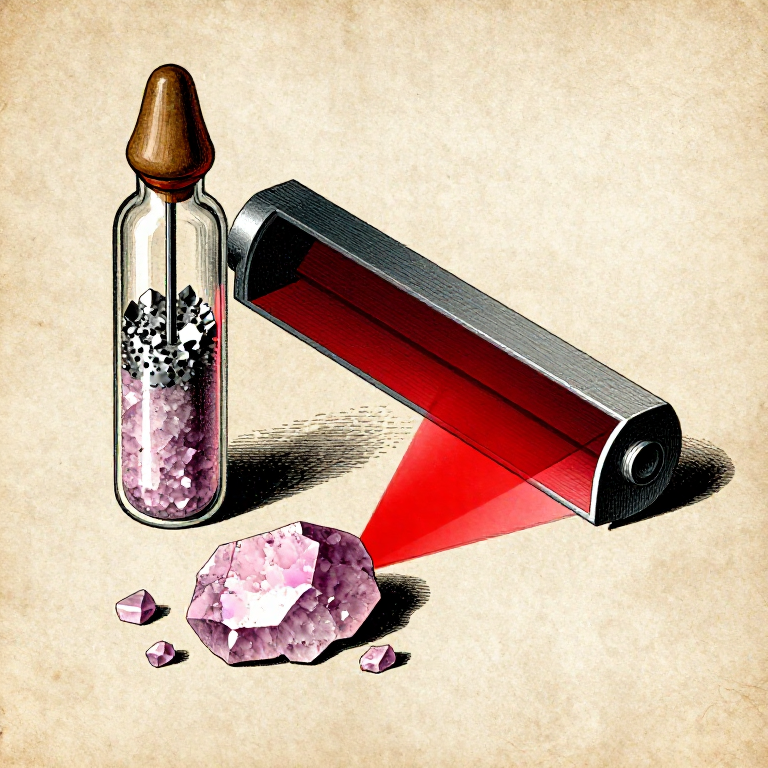
Robert Bunsen and Gustav Kirchhoff discovered rubidium in 1861 using the spectroscope they had invented just two years earlier. Examining the mineral lepidolite, they observed two deep red spectral lines never seen before — hence 'rubidium' from Latin 'rubidus' (deep red). It was the second element discovered by spectroscopy, after cesium. This demonstrated that spectral analysis could reveal elements invisible to chemical methods.
2
2
Identify Lepidolite as the Primary Source
Lepidolite is a lithium-bearing mica that contains 0.3-3.5% rubidium oxide. It forms distinctive lilac to rose-pink scaly masses in lithium pegmatites, often alongside spodumene, tourmaline, and beryl. Rubidium substitutes for potassium in the crystal lattice because both ions have similar size. Other sources include pollucite (a cesium mineral) and carnallite (a potassium-magnesium salt) from Stassfurt, Germany.
Tools needed:
Hand Lens (10x Magnification)3
3
Test Rubidium's Flame Color
Rubidium compounds produce a distinctive red-violet flame visible to the naked eye, though difficult to distinguish from potassium's lilac flame without a spectroscope. Using a cobalt blue glass filter blocks the yellow sodium emission that overwhelms most flame tests, revealing rubidium's deep red. The characteristic spectral lines at 780 nm and 795 nm are in the near-infrared, beyond what most eyes can see.
Materiały do tego kroku:
Litmus PaperTools needed:
Safety Goggles4
4
Understand Rubidium's Extreme Reactivity
Rubidium ignites spontaneously in air and reacts violently with water: 2Rb + 2H₂O → 2RbOH + H₂. The hydrogen produced ignites immediately from the reaction heat, creating a lilac-red flame. Rubidium must be stored under dry argon or in sealed glass ampoules under vacuum — even mineral oil is insufficient because rubidium slowly reacts with trace moisture. It is softer than wax and can be cut with a kitchen knife.
5
5
Trace the Industrial Extraction Process
Commercial rubidium is recovered from lithium ore processing waste. After extracting lithium from lepidolite or spodumene, the residual liquor is enriched in rubidium and cesium. Fractional crystallization of alums (double sulfates) or chlorides separates rubidium from potassium based on solubility differences. Ion exchange chromatography achieves higher purity. The metal itself is produced by reducing rubidium chloride with calcium in vacuum.
6
6
Explore Rubidium Atomic Clocks
Rubidium-87 vapor cell oscillators are the most widely deployed atomic clocks on Earth. The hyperfine transition at 6,834,682,610.904 Hz provides a stable frequency reference. While less accurate than cesium beam clocks, rubidium clocks are cheaper, smaller, and start up faster — making them ideal for telecommunications base stations, GPS satellites, and military equipment. Every GPS satellite carries rubidium clocks.
7
7
Understand Bose-Einstein Condensate Research
Eric Cornell and Carl Wieman used rubidium-87 atoms cooled to 170 nanokelvin to create the first Bose-Einstein condensate in 1995, earning the Nobel Prize. At this temperature — billionths of a degree above absolute zero — thousands of atoms merge into a single quantum state, behaving as one giant atom. This confirmed predictions from 1924 and opened the field of ultracold atomic physics.
8
8
Survey Rubidium Applications
Rubidium compounds serve specialized roles: rubidium carbonate is used in specialty glass to reduce electrical conductivity and increase stability. Rubidium silver iodide has the highest room-temperature ionic conductivity of any known crystal, making it valuable for thin-film battery research. Rubidium is used in photocells because it ionizes readily when struck by light — its low ionization energy of 4.18 eV is second only to cesium.
9
9
Compare Rubidium with Other Alkali Metals
Rubidium sits between potassium and cesium in Group 1: denser than water (1.532 g/cm³), melting at just 39.3°C — it melts on a hot summer day. Reactivity increases down the group: lithium fizzes in water, sodium burns, potassium explodes, and rubidium detonates on contact. Annual production is only 2-4 tonnes globally, making it one of the rarest commercially produced metals. Price ranges from $50-80 per gram.
Tools needed:
Precision Scale (0.01g)10
10
Document Findings and Market Context
Record rubidium's key data: atomic number 37, melting point 39.3°C, density 1.532 g/cm³, silvery-white metal that tarnishes instantly in air. The rubidium market is dominated by a single application — atomic frequency standards — which consumes most of the world's supply. As quantum computing and cold-atom research expand, demand for high-purity rubidium is growing, but the tiny market size means few dedicated mining operations exist.
Materials
1- 1 sztukaPlaceholder
Wymagane narzędzia
3- Placeholder
- Placeholder
- Placeholder
Materiały z połączonych planów
CC0 Public Domain
Ten plan jest udostępniany na licencji CC0. Możesz go swobodnie kopiować, modyfikować, rozpowszechniać i wykorzystywać do dowolnych celów, bez konieczności uzyskiwania zgody.
Wesprzyj Makera kupując produkty przez jego plan, za co zarabia Prowizja Makera ustalony przez sprzedawców, lub stwórz nową iterację tego planu i dołącz go jako połączenie w swoim własnym planie, aby dzielić się przychodami.