SZTUKA
Piękno i dobre samopoczucie
RZEMIOSŁO
KULTURA I HISTORIA
ROZRYWKA
ŚRODOWISKO
JEDZENIE I NAPOJE
INŻYNIERIA ODWROTNA
NAUKI
LEKKOATLETYKA
TECHNOLOGIA
URZĄDZENIA DO NOSZENIA
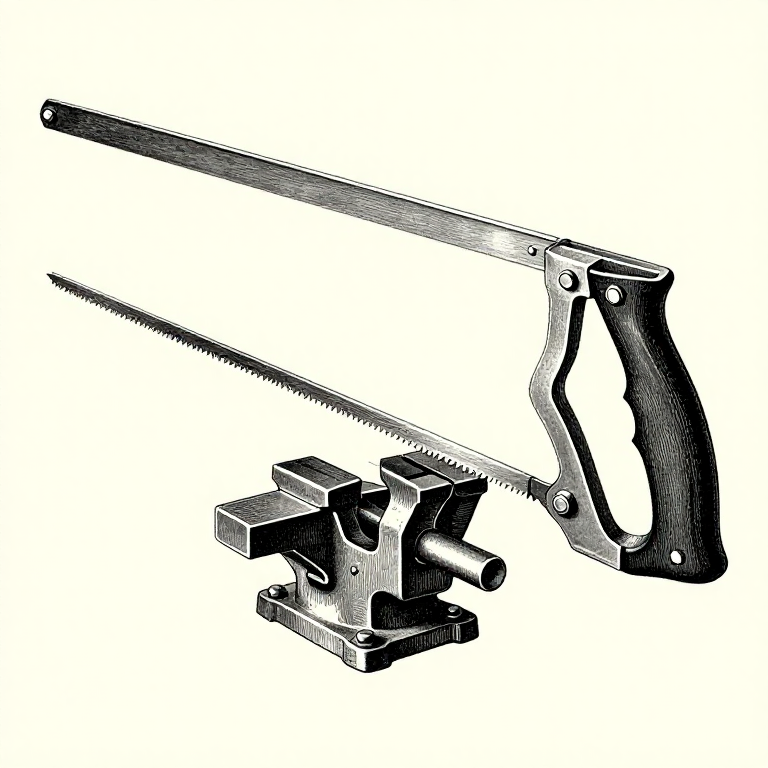


The Hacksaw: Blade Tension, TPI, and the Three-Tooth Rule
A hacksaw blade is a thin flexible strip that only works because the frame pulls it tight. Slack, it wanders and snaps; properly tensioned, it cuts straight and lasts.
The second thing that decides everything is the tooth pitch against the thickness of what you are cutting. At least three teeth must be in contact at all times, or the material drops between them, catches on one tooth, and strips it off. A coarse blade on thin tube destroys itself in seconds and it is not obvious why.
Those two rules cover almost every hacksaw failure, and both take five seconds to check.
Początkujący
2 hours
Instrukcje
1
1
Fit the blade teeth-FORWARD, and tension it hard
Fit the blade teeth-FORWARD, and tension it hard
A hacksaw cuts on the PUSH stroke, so the teeth point away from the handle. Fitted backwards it will rub, heat up and cut almost nothing, and it is a surprisingly common mistake because the blade goes in just as easily either way.
Tighten the wing nut until the blade rings when you pluck it — genuinely tight, far tighter than feels reasonable. A hacksaw blade is designed to be tensioned to a high load and the frame is built for it.
A slack blade twists in the cut, so the kerf wanders, and the twisting is what snaps blades. If your cuts come out curved or your blades keep breaking, tension is the first thing to check and it is usually the answer.
Potrzebne narzędzia:
 Ramka do piły do metalu z brzeszczotami
 Piła do metalu
 Okulary ochronne bezbarwne
2
2
The three-tooth rule
The three-tooth rule
Wczytywanie notatnika Jupyter…
Potrzebne narzędzia:
Ramka do piły do metalu z brzeszczotami Kalkulator
 Suwmiarka
3
3
Long slow strokes, and the whole blade
Long slow strokes, and the whole blade
Aim for around fifty strokes a minute — slower than feels natural. A hacksaw blade is hardened and it loses its temper if it gets hot, so speed is genuinely counterproductive.
Use the full length of the blade. Working in the middle third wears out those teeth while the ends stay sharp, and once the middle is blunt the blade is useless even though most of it has never cut anything.
Press on the push stroke and lift slightly on the return, as with a file and for the same reason: the teeth cut one way only and dragging them back under load wears them for nothing. A little cutting oil on steel helps; aluminium prefers paraffin; do not oil a blade cutting cast iron.
Materiały do tego kroku:
 Olej do cięcia1 sztuka
 Pręt ze stali niskowęglowej1 sztuka
Potrzebne narzędzia:
Ramka do piły do metalu z brzeszczotami Ciężkie imadło warsztatoweOkulary ochronne bezbarwne
4
4
Hold it close to the cut
Hold it close to the cut
Clamp the work in the vice so the cut line is within a centimetre or two of the jaws. Anything standing further out chatters, and chatter breaks teeth and wanders the cut.
For tube, use a piece of wood with a V cut in it, or wrap the tube in a scrap of sheet, so the vice does not crush it. A crushed tube is out of round permanently and often will not take its fitting.
Never finish a cut with the offcut unsupported. The last few strokes it hangs by a thread, snaps, and the ragged tear it leaves has to be filed off — and on a heavy piece it lands on your foot. Support it with your free hand or a block.
Materiały do tego kroku:
 Deska z drewna liściastego1 sztuka
 Blacha gruba ze stali niskowęglowej1 sztuka
Potrzebne narzędzia:
Ciężkie imadło warsztatoweRamka do piły do metalu z brzeszczotamiOkulary ochronne bezbarwneMateriały
4- 1 sztukaZastępnik
- 1 sztukaZastępnik
- 1 sztukaZastępnik
- Zastępnik
Powiązane blueprinty
Te blueprinty dzielą się wiedzą — technikami, materiałami lub zasadami

CC0 Domena publiczna
Ten plan jest udostępniany na licencji CC0. Możesz go swobodnie kopiować, modyfikować, rozpowszechniać i wykorzystywać do dowolnych celów, bez konieczności uzyskiwania zgody.
Wesprzyj Makera kupując produkty przez jego plan, za co zarabia Prowizja Makera ustalony przez sprzedawców, lub stwórz nową iterację tego planu i dołącz go jako połączenie w swoim własnym planie, aby dzielić się przychodami.