SZTUKA
Piękno i dobre samopoczucie
RZEMIOSŁO
KULTURA I HISTORIA
ROZRYWKA
ŚRODOWISKO
JEDZENIE I NAPOJE
INŻYNIERIA ODWROTNA
NAUKI
LEKKOATLETYKA
TECHNOLOGIA
URZĄDZENIA DO NOSZENIA


What Paint Is: Pigment, Binder, and the Ratio Between Them
All paint is the same three things: solid coloured PARTICLES, a liquid BINDER that glues them to each other and to the surface, and usually a SOLVENT that makes it workable and then leaves.
Change the binder and you change the medium entirely. Pigment in drying oil is oil paint; the same pigment in gum arabic is watercolour, in egg yolk is tempera, in acrylic dispersion is acrylic. The colour is identical and the material is not.
The ratio between pigment and binder decides almost everything else — gloss, opacity, flexibility, and whether the film holds together at all. There is a specific ratio above which a paint stops being a film and starts being loose powder, and it has a name.
Średniozaawansowany
3 hours
Instrukcje
1
1
Three components, and what each one does
Three components, and what each one does
PIGMENT is insoluble solid particles. It provides the colour and the hiding power, and it does not dissolve — a dye does, and that is the difference between a pigment and a dye.
BINDER is what turns a pile of powder into a film. It wets every particle, fills the space between them, and then hardens — by evaporating, by reacting with oxygen, or by particles coalescing.
SOLVENT or diluent makes the paint thin enough to apply and then leaves completely. It contributes nothing to the final film, which is why thinning too far leaves a weak paint: there is the same pigment with less binder per unit volume once the solvent has gone.
Materiały do tego kroku:
 Zestaw sproszkowanych pigmentów ziemnych1 sztuka
 Olej lniany1 sztuka
 Terpentyna balsamiczna1 sztuka
Potrzebne narzędzia:
 Ucieracz szklany
 Waga precyzyjna
 Rękawice nitrylowe
2
2
Pigment volume concentration, and the critical point
Pigment volume concentration, and the critical point
Wczytywanie notatnika Jupyter…
Materiały do tego kroku:
Zestaw sproszkowanych pigmentów ziemnych1 sztukaOlej lniany1 sztukaPotrzebne narzędzia:
Waga precyzyjna Komputer stacjonarnyUcieracz szklany
3
3
The binder decides the medium
The binder decides the medium
DRYING OIL hardens by absorbing oxygen and cross-linking into a tough flexible solid. It is slow, it can be worked wet-into-wet for days, and the film keeps moving for decades.
GUM ARABIC dissolves in water and hardens by simply drying. That makes watercolour re-wettable for ever, which is a feature when working and a vulnerability once framed.
EGG YOLK is an emulsion of oil and water that dries fast and then slowly polymerises into something extremely durable. ACRYLIC DISPERSION is solid polymer particles suspended in water: the water leaves, the particles coalesce, and the film is complete in minutes and is not re-soluble afterwards.
Materiały do tego kroku:
Olej lniany1 sztuka Guma arabska1 sztuka
Potrzebne narzędzia:
 Zlewka szklana
 Pręcik do mieszania
 Lupa zegarmistrzowska
4
4
Grind it properly, because dispersion is not mixing
Grind it properly, because dispersion is not mixing
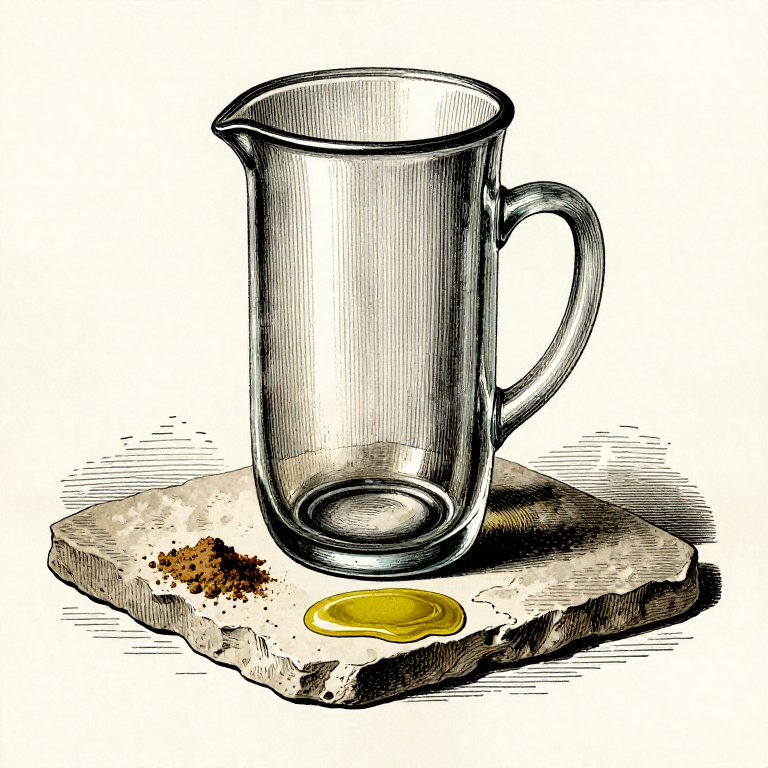
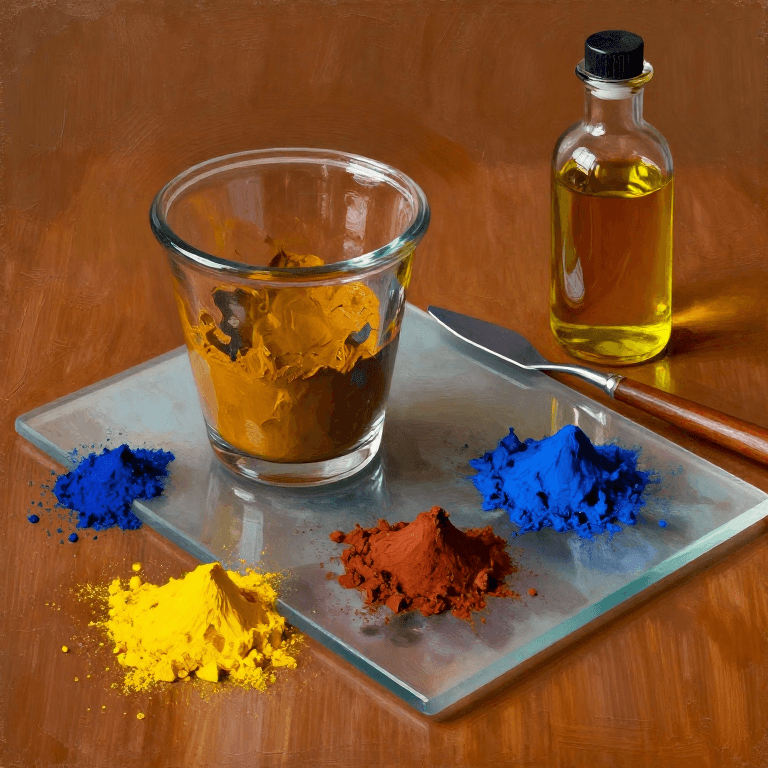
Grinding paint is not stirring pigment into oil. It is breaking up clumps of particles and wetting each one, so that every particle is surrounded by binder rather than sitting in a dry cluster.
A glass muller on a ground glass slab does this by shear: the paste is worked in figures of eight until it stops changing. An under-ground paint looks acceptable and is weaker, less colourful and more prone to cracking, because the dry clusters are voids waiting to happen.
You can see when it is done. Under-dispersed paint is grainy against the slab and slightly dull; properly dispersed paint turns noticeably more saturated and smooth. That colour change IS the dispersion, and it is the test.
Materiały do tego kroku:
Zestaw sproszkowanych pigmentów ziemnych1 sztukaOlej lniany1 sztukaPotrzebne narzędzia:
Ucieracz szklany ŁopatkaLupa zegarmistrzowskaRękawice nitrylowe
Materiały
4- Zastępnik
- 4 sztukZastępnik
- 1 sztukaZastępnik
- 1 sztukaZastępnik
Wymagane narzędzia
8- Zastępnik
- Zastępnik
- Zastępnik
- Zastępnik
- Zastępnik
- Zastępnik
- Zastępnik
- Zastępnik
Powiązane blueprinty
Te blueprinty dzielą się wiedzą — technikami, materiałami lub zasadami

CC0 Domena publiczna
Ten plan jest udostępniany na licencji CC0. Możesz go swobodnie kopiować, modyfikować, rozpowszechniać i wykorzystywać do dowolnych celów, bez konieczności uzyskiwania zgody.
Wesprzyj Makera kupując produkty przez jego plan, za co zarabia Prowizja Makera ustalony przez sprzedawców, lub stwórz nową iterację tego planu i dołącz go jako połączenie w swoim własnym planie, aby dzielić się przychodami.