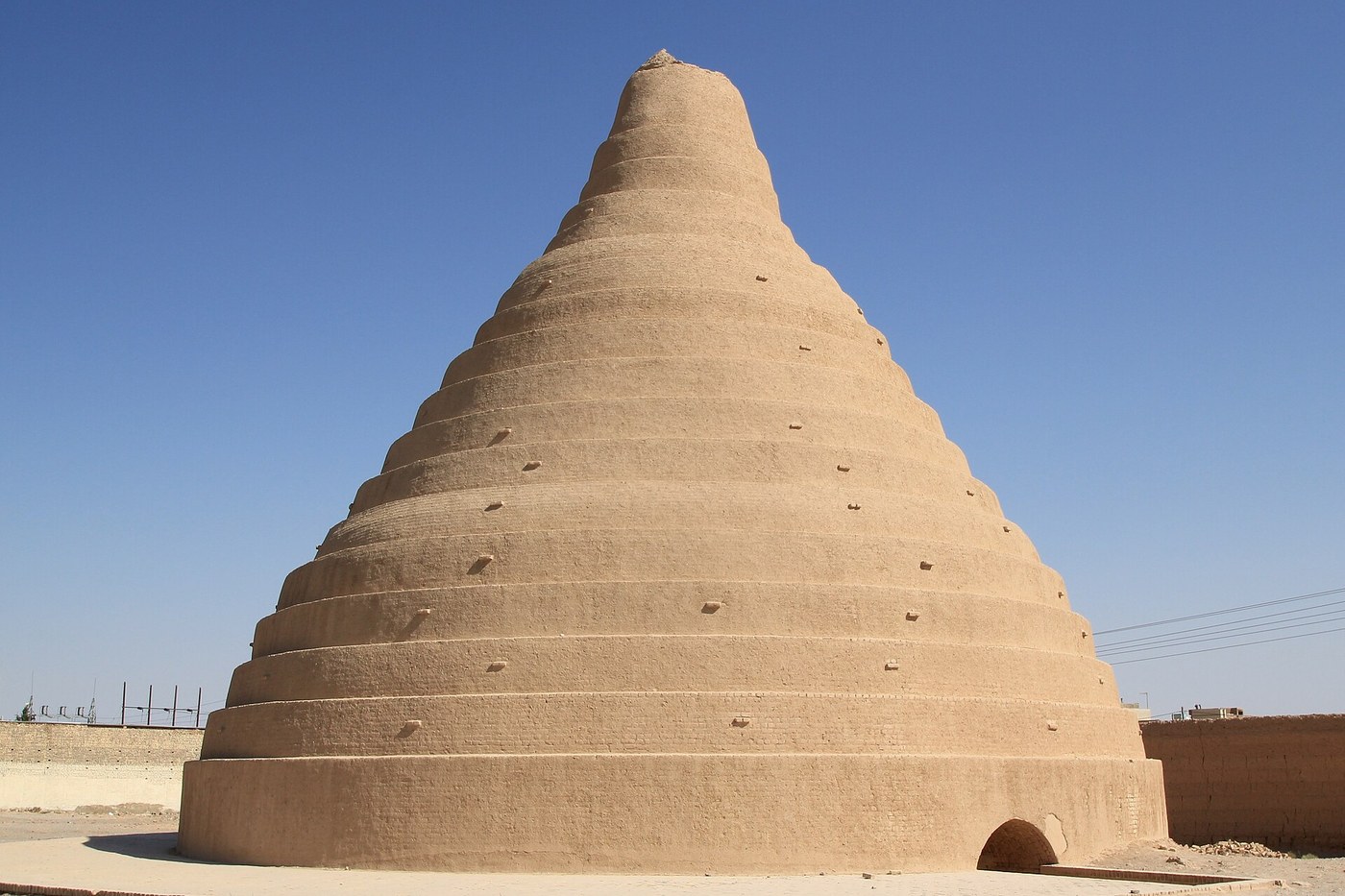


The Yakhchāl
A desert is the worst place to keep ice and the best place to make it, and the yakhchāl exploits both halves of that sentence.
It is a tall mud-brick dome over a deep pit, built across the Iranian plateau from around the fourth century BC, and it kept ice through summers of 40 °C with no power of any kind. It works by stacking four separate mechanisms that each attack a different heat path.
Radiation makes the ice. Shallow channels beside the dome freeze on clear winter nights by radiating to the sky, exactly as in the previous blueprint.
The pit stores it. Ice goes below ground, where the earth's temperature is the local annual average rather than today's weather.
The dome kills the sun. Walls up to two metres thick of sārooj — a lime, clay, ash, goat-hair and egg-white mortar that is both insulating and water-resistant — and a tall conical shape so that the hot upper air is far from the ice, with a vent at the apex to let it escape.
Shade walls and evaporation do the rest, cooling the air before it ever reaches the dome.
No single trick is remarkable. The engineering is that all four are present, and each one handles the leak the others cannot.
Instrukcje
List the heat paths before designing anything
List the heat paths before designing anything
Take a model store — an insulated box with ice in it — and measure how long the ice lasts. Then repeat while deliberately opening ONE path at a time: sit it on warm ground, expose it to sun, blow air across it, open the lid periodically.
Rank the four by how much ice each cost you.
Expect sun and air exchange to dominate in a hot climate, and ground conduction to matter more than people expect.
Design against the ranked list, not against 'heat' in general. Every feature of the yakhchāl maps to one line of it, which is why it looks over-engineered until you make the list.
Materiały do tego kroku:
 Kostki lodu1 sztuka
Potrzebne narzędzia:
 Termometr
Measure how steady the ground is
Measure how steady the ground is
Bury thermometers at increasing depths — 10 cm, 50 cm, and as deep as you can manage — and read them at midday and before dawn over several days.
Expect the daily swing to shrink rapidly with depth, and the deep reading to sit near the local annual average rather than near today's weather.
That is the prize: below a metre or so the ground has already averaged away the day, and deeper still it averages away the season.
Soil is a low-pass filter for temperature, and burying a store is the cheapest thermal engineering that exists.
Potrzebne narzędzia:
TermometrBuild the dome tall and vent the apex
Build the dome tall and vent the apex
Make two model stores of equal wall thickness: one squat, one a tall cone with a small opening at the top. Put equal ice in each, in the sun, and time them.
Expect the tall vented cone to win, and put a thermometer near its apex to see why — the air up there is far hotter than the air at the base.
Hot air rises and leaves through the vent, taking heat with it, and the height keeps that hot layer physically distant from the ice.
A tall shape is not decoration and not just structure; it is a thermal stratifier — the same reason a high ceiling is cooler to stand under.
Make a mortar that insulates and refuses water
Make a mortar that insulates and refuses water
Mix test blocks: plain clay, clay with sand, and a sārooj-style mix of clay, sand, lime, wood ash and chopped fibre. Dry them, then measure how fast heat passes through each and how much water each absorbs.
Expect the fibre-and-lime mix to be both a better insulator and far more water-resistant.
Both properties matter and the second is easy to forget: a wet insulator is not an insulator, because water conducts heat far better than the air it displaced.
Melting ice produces water continuously, so an ice store that cannot shed water destroys its own walls — which is why sārooj's waterproofing is as important as its bubbles.
Materiały do tego kroku:
 Glina1 sztuka
 Piasek1 sztuka
 Wapno gaszone (wodorotlenek wapnia)1 sztuka
 Nawóz z popiołu drzewnego1 sztuka
 Słoma1 sztuka
Cool the air before it arrives
Cool the air before it arrives
Set up a long shading wall on the sun side of your model, and wet its base or run a shallow channel of water along it. Measure air temperature upwind, in the shade behind the wall, and at the store's entrance.
Expect a measurable drop across the shaded, damp stretch, and a bigger one in dry air than in humid air.
The wall does two jobs — it blocks direct sun and it holds a pocket of air long enough for evaporation to chill it.
Conditioning the surroundings is cheaper than defending the box, and it is why yakhchāls sit behind long east–west walls rather than standing alone.
Materiały do tego kroku:
 Woda1 sztuka
History & Context
History & Context
They are ancient, numerous and still standing. Yakhchāls are documented on the Iranian plateau from around 400 BC, and dozens of the great conical domes survive — at Yazd, Kerman, Meybod and elsewhere — as some of the most recognisable structures in Iran. They supplied ice for food, for medicine and for chilled drinks in a climate where summer shade temperatures pass 40 °C.
They were part of a system, not standalone. Many were fed by qanats — gently sloping underground channels bringing mountain water for tens of kilometres without pumps — and paired with bâdgirs, the windcatchers of the next blueprint. The interesting artefact is the network: water supply, ventilation and cold storage designed together, all powered by nothing but climate and geometry.
Sārooj is a genuinely sophisticated composite. Sand and clay for bulk, lime for chemical set and water resistance, ash as a pozzolan, and chopped goat hair as reinforcing fibre against cracking. Descriptions also mention egg white. That is a fibre-reinforced hydraulic mortar arrived at empirically, and it is why two-metre walls have stood for centuries in a climate that destroys plain mud brick.
The reason to publish it now is not nostalgia. Every mechanism here — burying for thermal mass, venting stratified hot air, shading and pre-cooling intake air, radiative night cooling — is in current use in passive building design, and all of them run on zero electricity. The yakhchāl is a worked example of what a building can do before a machine is switched on, which is exactly the question an energy-constrained century keeps asking.
Honest limits. It needs a dry climate with clear winter nights below freezing, and does not work in humid ones. It needs winter cold to make the ice — it stores cold, it does not generate it on demand. It is a large, labour-intensive masonry structure, so the capital cost is a building. Access is a hole in the top of an insulated pit, which is awkward and lossy. And it delivers ice, not controlled temperature: you get what the winter gave you, rationed until it runs out.
Materiały
7- 1 sztukaZastępnik
- 1 sztukaZastępnik
- 1 sztukaZastępnik
- Zastępnik
- 1 sztukaZastępnik
- 1 sztukaZastępnik
- 1 sztukaZastępnik
Materiały z połączonych planów

CC0 Domena publiczna
Ten plan jest udostępniany na licencji CC0. Możesz go swobodnie kopiować, modyfikować, rozpowszechniać i wykorzystywać do dowolnych celów, bez konieczności uzyskiwania zgody.
Wesprzyj Makera kupując produkty przez jego plan, za co zarabia Prowizja Makera ustalony przez sprzedawców, lub stwórz nową iterację tego planu i dołącz go jako połączenie w swoim własnym planie, aby dzielić się przychodami.