SZTUKA
Piękno i dobre samopoczucie
RZEMIOSŁO
KULTURA I HISTORIA
ROZRYWKA
ŚRODOWISKO
JEDZENIE I NAPOJE
INŻYNIERIA ODWROTNA
NAUKI
LEKKOATLETYKA
TECHNOLOGIA
URZĄDZENIA DO NOSZENIA
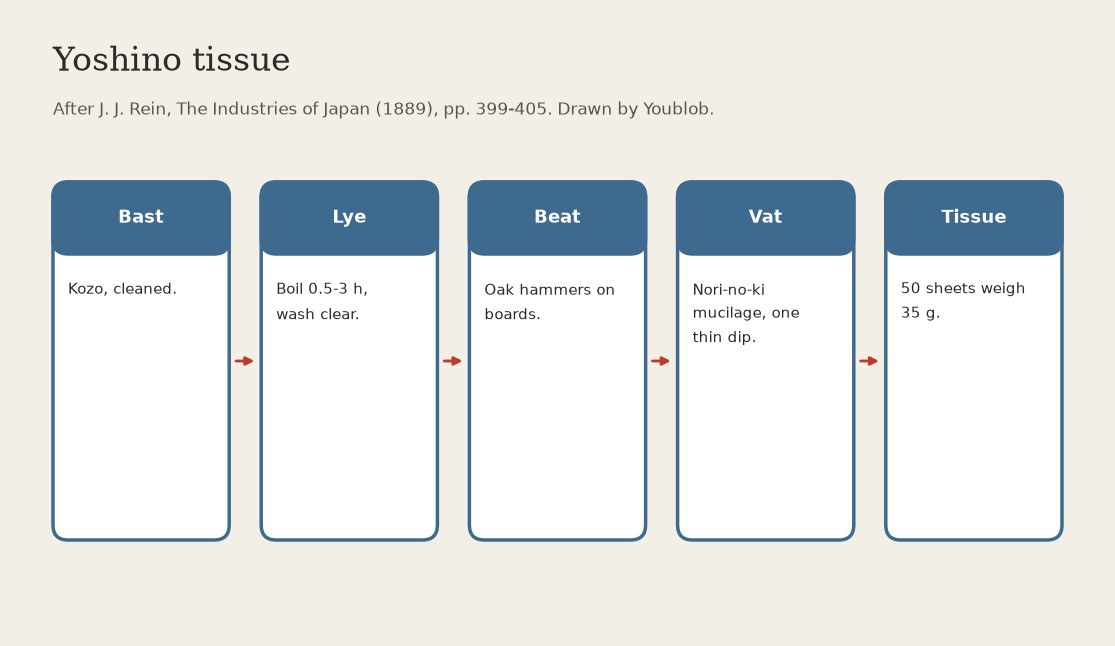


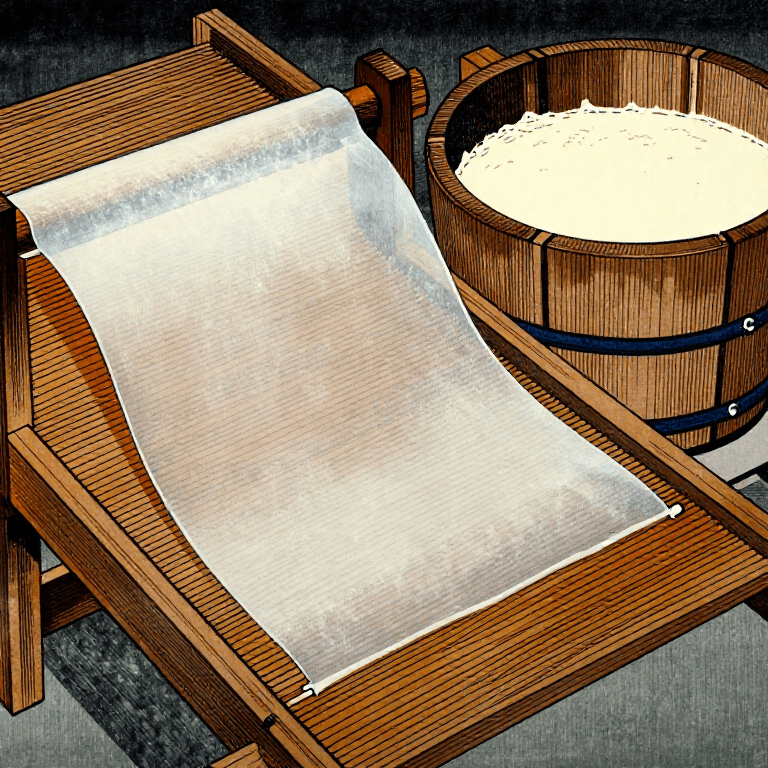
Yoshino Tissue: Kozo Paper So Thin Fifty Sheets Weigh 35 Grams (Nibu, after Rein 1889)
Yoshino-gami from Nibu in Yamato was the finest tissue of Japan: so thin that fifty sheets weigh 35 g, yet so strong that lacquer makers wrung thick lacquer through two or three layers and used them again. Light, tough tissue like this is what covers model wings.
Result: kozo tissue, sheets 48 x 25.5 cm, 50 sheets 35 g (about 5.7 g per square metre).
Source: J. J. Rein, The Industries of Japan (1889), pp. 399-405. Not given: amounts per vat, lye strength, beating time. Picture drawn by Youblob.
Zaawansowany
3 days
Instrukcje
1
1
Clean the bast
Clean the bast
Take kozo bast freed of the dark outer skin and green parts, and cut out knot-holes and faulty spots.
Materiały do tego kroku:
 Kora kozo1 as required
2
2
Boil in ash lye
Boil in ash lye
Boil the bast in an iron kettle with lye made from ashes, half an hour to three hours, until it is soft and crushes between the fingers.
Potrzebne narzędzia:
 Ług z popiołu drzewnego
 Czajnik żeliwny
3
3
Wash clear
Wash clear
Wash the soft bast in a tub of fresh water, changing it four or five times until the water stays clear.
Materiały do tego kroku:
 Woda1 as required
Potrzebne narzędzia:
 Drewniana balia
4
4
Beat to pulp
Beat to pulp
Lay the wet bast on a thick hardwood board and beat it with oak hammers of 1 to 2 lb, stirring and mixing in water often, until it is an even fibrous pulp. If the fibres are not yet apart, boil it again in plain water.
Potrzebne narzędzia:
 Płaska deska drewniana
 Pobijak drewnianyCzajnik żeliwny
5
5
Charge the vat
Charge the vat
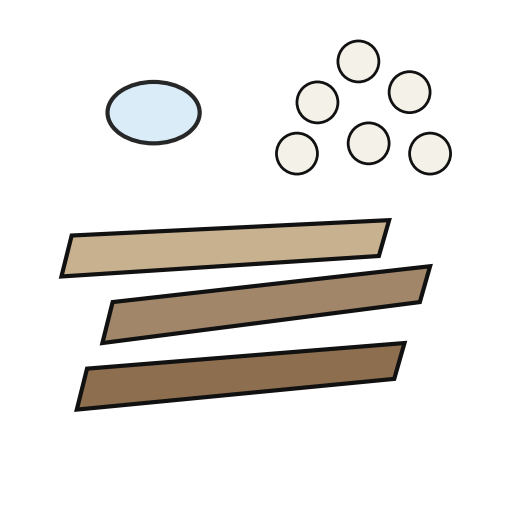
Put the pulp in the vat with water. Press out Nori-no-ki (Hydrangea paniculata) bark in water and add the slippery mucilage; it keeps the fibres floating apart. Ours: press the bark out in a linen bag.
Materiały do tego kroku:
 Kora nori-no-ki (hortensja bukietowa)1 as requiredWoda1 as required
Potrzebne narzędzia:
 Kadź
 Lniany worek
6
6
Scoop one thin layer
Scoop one thin layer
Dip a mould of fine bamboo sticks bound with silk thread and let the stuff flow toward you, so the fibres lie parallel. Fill it once only: a second, crossed filling makes a thicker paper.
Potrzebne narzędzia:
 SugetaKadź
7
7
Pile and dry on boards
Pile and dry on boards
Pile the wet sheets on a mat with bamboo splints between them. When dry enough, brush each onto a smooth board and stand it slantwise in the sun; the dry sheet comes off by itself.
Potrzebne narzędzia:
 Mata bambusowa
 Szeroki pędzelPłaska deska drewniana
8
8
Check the tissue
Check the tissue
Sheets 48 x 25.5 cm; fifty of them should weigh about 35 g. The tissue is yellowish, silky and strong enough to be wrung without tearing.
Materiały
3- 1 as requiredZastępnik
- 2 as requiredZastępnik
- 1 as requiredZastępnik
Wymagane narzędzia
10- Zastępnik
- Zastępnik
- Zastępnik
- Zastępnik
- Zastępnik
- Zastępnik
- Zastępnik
- Zastępnik
- Zastępnik
- Zastępnik
Według tego planu powstaje
Powiązane blueprinty
Te blueprinty dzielą się wiedzą — technikami, materiałami lub zasadami

CC0 Domena publiczna
Ten plan jest udostępniany na licencji CC0. Możesz go swobodnie kopiować, modyfikować, rozpowszechniać i wykorzystywać do dowolnych celów, bez konieczności uzyskiwania zgody.
Wesprzyj Makera kupując produkty przez jego plan, za co zarabia Prowizja Makera ustalony przez sprzedawców, lub stwórz nową iterację tego planu i dołącz go jako połączenie w swoim własnym planie, aby dzielić się przychodami.