

The Anchor Escapement
A pendulum is a beautiful timekeeper and a hopeless one, because it will not keep swinging. Something has to push it, and whatever pushes it also disturbs it.
The verge escapement pushed hard and often, and to work at all it needed the pendulum to swing through a wide arc — 40 degrees or more. That is the fatal detail, because a pendulum is only isochronous for SMALL swings. Widen the arc and the period grows, so any change in the driving force changes the arc, which changes the rate. A verge clock is a device whose accuracy depends on how dirty its gears are.
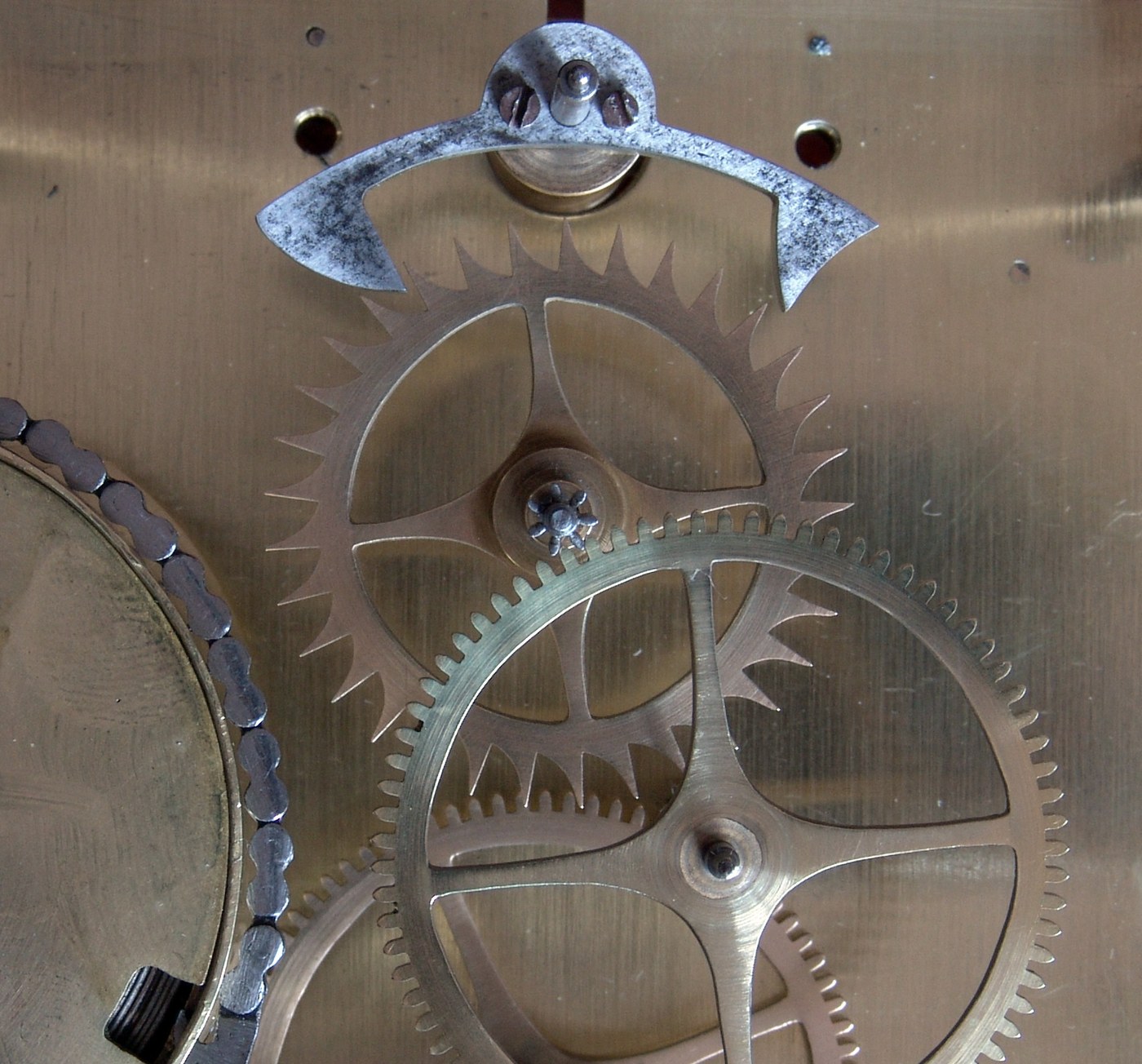
The anchor escapement fixes it by reaching further along the lever. Two pallets on a curved arm straddle the escape wheel several teeth apart, so a small pendulum movement is enough to release a tooth.
The arc collapses from tens of degrees to three or four. Now the pendulum lives in the region where its period barely depends on amplitude — and it becomes possible to use a long, slow, heavy pendulum beating exact seconds.
That is where the longcase clock comes from. The case is not decoration: it is the length of a seconds pendulum, about 994 mm, plus room to swing. Geometry set the furniture.
Инструкции
Measure the error that only appears at wide swings
Measure the error that only appears at wide swings
Hang a pendulum and time fifty swings released from 5°, then from 20°, then from 45°.
Divide to get the period each time.
Expect the period to be almost identical for the two small angles and measurably longer at 45°.
Write down the size of the error in seconds per day. It is not small.
This is circular error, and it is the reason an escapement's job is not merely to keep the pendulum going: it must keep it going through a SMALL and CONSTANT arc.
Материалы для этого шага:
 Оцинкованная стальная проволока2 m
Необходимые инструменты:
 Рулетка
Show that the driving force sets the arc
Show that the driving force sets the arc
Give your pendulum a small push once per swing, by hand or by a weight-driven arm, and vary the size of the push.
Measure the resulting arc each time, and the period.
Expect a bigger push to give a bigger arc, and a bigger arc to give a slower clock.
Now say what that means for a real mechanism: friction, dirt, oil thickening in winter and a spring running down all change the push. Any escapement that couples force to arc turns every mechanical nuisance into a timekeeping error.
Build the anchor and watch the arc collapse
Build the anchor and watch the arc collapse
Cut an anchor-shaped arm from sheet metal or stiff card with two pallets that straddle several teeth of a toothed wheel, and pivot it on the pendulum's axis.
Compare the pendulum swing needed to release one tooth with what a verge-style arrangement demands.
Expect the anchor to work at a few degrees where the verge needed tens.
Then measure the rate at this small arc and compare with step 1.
The gain is not that the anchor is gentler. It is that it operates in the part of the pendulum's behaviour where amplitude stops mattering.
Материалы для этого шага:
 Медная фольга1 лист
Find the recoil, and admit it is still there
Find the recoil, and admit it is still there
Watch the escape wheel closely, with a paper flag on one tooth, as the pendulum swings.
Expect to see the wheel step forward and then be pushed slightly BACKWARDS at each swing.
That is recoil: after a tooth lands on a pallet, the pendulum keeps travelling and drives the whole train in reverse for a moment.
Note both consequences honestly. It wastes energy and wears the teeth — but it also acts as a brake that damps variations, which is why recoil clocks are forgiving of a rough train. The next blueprint removes it, and pays for the privilege with a need for better workmanship.
Let the pendulum choose the furniture
Let the pendulum choose the furniture
Compute the length of a pendulum whose half-period is exactly one second, using T = 2π√(L/g).
Expect roughly 994 mm at ordinary gravity.
Now build or measure it, and time it against a known reference for an hour.
Then note the two consequences that follow from that single number: the clock must be about two metres tall, and the same clock will run at a different rate somewhere else on Earth, because g is not constant.
That second fact turned clocks into gravity meters and is exactly what the pendulum-isochronism blueprint exploits.
History & Context
History & Context
It appeared around 1670 and its authorship is genuinely disputed. The anchor escapement is credited variously to Robert Hooke and to the London clockmaker William Clement, who was certainly making longcase clocks with it by the mid-1670s. Per this corpus's rule the mechanism is the payload: the geometry in step 3 is unambiguous, the name on it is not.
It made clock accuracy jump by more than an order of magnitude. Verge-and-foliot clocks lost or gained on the scale of a quarter of an hour a day. An anchor clock with a seconds pendulum could hold to a handful of seconds. That is not a refinement; it is the difference between a device that tells you roughly when to eat and an instrument you can do astronomy with.
The longcase clock is a consequence, not a style. The tall case exists because a seconds pendulum is about a metre long and needs protection from draughts and from being knocked. When a device's dimensions are set by physics, the furniture around it stops being a design decision — the same reason a pipe organ's case follows its longest pipe.
Then the trade split in two. Recoil escapements stayed in domestic clocks, because they tolerate poor pivots and dirty oil and just keep going. Observatories went the other way and demanded no recoil at all, which produced Graham's deadbeat and a century of regulator clocks. Both branches are correct; they are optimising different things — robustness against precision, which is the oldest trade in engineering.
Honest limits. Recoil wastes energy and wears the escape wheel. The escapement still touches the pendulum on every swing, so it still disturbs what it is meant to be reading. Rate depends on local gravity, so a clock cannot simply be moved and trusted. It needs to stand still and stay level, which rules out ships and is precisely the gap the marine chronometer had to fill. And a pendulum's length changes with temperature — a defect this blueprint does nothing about and the gridiron blueprint exists to solve.
Материалы
2- Заполнитель
- 1 листЗаполнитель
Материалы из связанных чертежей

Связанные чертежи
Эти чертежи делятся знаниями — техники, материалы или принципы

CC0 Общественное достояние
Этот чертёж выпущен под лицензией CC0. Вы можете свободно копировать, изменять, распространять и использовать эту работу в любых целях без запроса разрешения.
Поддержите мейкера, покупая товары через его чертёж, где он получает Комиссию мейкера установленную продавцами, или создайте новую итерацию этого чертежа и включите его как связь в свой чертёж для распределения дохода.