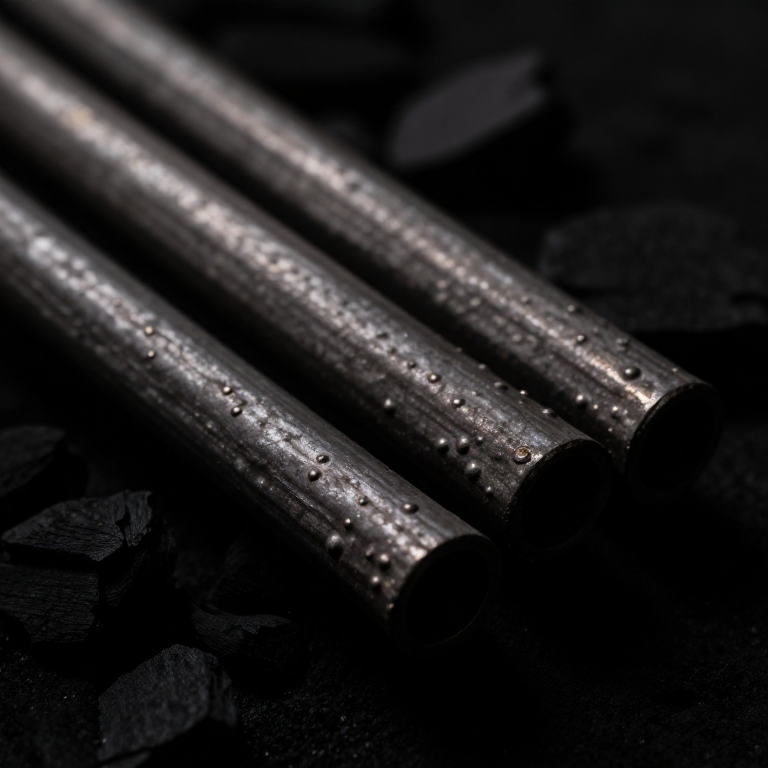


Making Blister Steel by Cementation — Carburizing Wrought Iron into Steel
Wrought iron bends but will not hold an edge; cast iron holds an edge but shatters. Steel — iron with just the right sliver of carbon — does both, and for centuries the great problem of metalworking was how to make it reliably. The cementation process, used across Europe from the 1600s, was the first method to manufacture steel in quantity from ordinary wrought iron bars.
The idea is to add carbon to solid iron without ever melting it. Bars of wrought iron are packed in powdered charcoal inside a sealed stone chest and roasted for a week at a bright red heat. Over those days, carbon slowly creeps out of the charcoal and diffuses into the surface of the iron, turning the skin into steel. Gas trapped under the surface raises little blisters across the bars — which is why the product is called blister steel.
Blister steel is uneven, carbon-rich at the surface and soft in the core, so smiths refined it further: forge-welding and folding it into shear steel, or melting it in crucibles into perfectly uniform cast steel. But cementation was the foundation — the step that first made steel an industrial material rather than a rare treasure.
Инструкции
Understand cementation
Understand cementation
Select wrought iron bars
Select wrought iron bars
Материалы для этого шага:
 Прутки кованого железа20 кг
Build the cementation chest
Build the cementation chest
Материалы для этого шага:
 Огнеупорный кирпич60 штук
Необходимые инструменты:
 Садовый совок
Crush the charcoal
Crush the charcoal
Материалы для этого шага:
 Древесный уголь кусковой15 кг
Необходимые инструменты:
 Молоток
Pack iron and charcoal in layers
Pack iron and charcoal in layers
Seal the chest with clay
Seal the chest with clay
Материалы для этого шага:
 Глина10 кг
Fire at red heat for days
Fire at red heat for days
Материалы для этого шага:
 Каменный уголь битуминозный200 кг
Let the carbon diffuse
Let the carbon diffuse
Recognise the blisters
Recognise the blisters
Необходимые инструменты:
 Волочильные клещи
Cool slowly and open
Cool slowly and open
Необходимые инструменты:
Волочильные клещиRefine into shear steel
Refine into shear steel
Необходимые инструменты:
МолотокTest that it is steel
Test that it is steel
Материалы для этого шага:
 Вода5 литров
Материалы
6- Заполнитель
- 60 штукЗаполнитель
- Заполнитель
- 10 кгЗаполнитель
- Заполнитель
- 5 литровЗаполнитель
Материалы из связанных чертежей


Связанные чертежи
Эти чертежи делятся знаниями — техники, материалы или принципы

CC0 Общественное достояние
Этот чертёж выпущен под лицензией CC0. Вы можете свободно копировать, изменять, распространять и использовать эту работу в любых целях без запроса разрешения.
Поддержите мейкера, покупая товары через его чертёж, где он получает Комиссию мейкера установленную продавцами, или создайте новую итерацию этого чертежа и включите его как связь в свой чертёж для распределения дохода.