ИСКУССТВО
КРАСОТА И ЗДОРОВЬЕ
РЕМЕСЛО
КУЛЬТУРА И ИСТОРИЯ
РАЗВЛЕЧЕНИЯ
ЭКОЛОГИЯ
ЕДА И НАПИТКИ
ОБРАТНАЯ ИНЖЕНЕРИЯ
НАУКИ
СПОРТ
ТЕХНОЛОГИИ
НОСИМЫЕ УСТРОЙСТВА
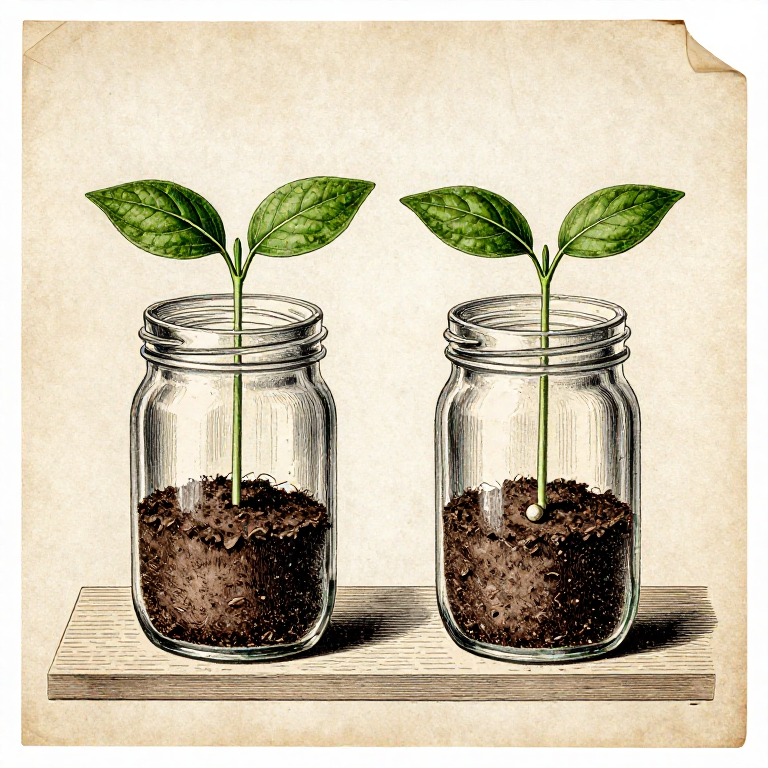


Change One Thing at a Time: Grow the Control, and the Confounded Jar Too
A control is not an extra jar you set up to be thorough. It is the only thing that turns a number into a result, because a measurement with nothing to compare it against cannot be wrong and therefore cannot be right either.
You will plant nine jars of beans in three groups: a CONTROL, a group with exactly ONE thing changed, and — on purpose — a group with TWO things changed at once. Ten days later you will measure them all.
The confounded group is the part that makes this stick. It usually grows the tallest, it produces the biggest number on the page, and it is the only one you will be unable to write a single honest sentence about. Reading that about confounding is easy to nod along to. Measuring it yourself, with your own beans, is not.
Начинающий
40 minutes to set up, then 5 minutes a day for 10 days
Инструкции
1
1
Set up nine jars that differ only where you intend them to
Set up nine jars that differ only where you intend them to
Label nine jars A1-A3, B1-B3 and C1-C3 with masking tape. Three groups of three, so each group has repeats — one jar per group would leave you unable to tell an effect from an unlucky bean.
WEIGH the soil into each jar rather than eyeballing it, and write the nine figures down. Aim for the same mass in every jar; record what you actually got, not what you were aiming for. Put the same number of beans in each, at the same depth, from the same packet.
Then set the three groups going:
- **A (control)** — a measured 20 mL of water on day 0 and every second day, on the windowsill.
- **B (one thing changed)** — a measured 40 mL on the same schedule, on the SAME windowsill. Water is the only difference between A and B.
- **C (two things changed)** — 40 mL on the same schedule, somewhere reliably warmer: an airing cupboard, or a shelf above a radiator.
Use the graduated cylinder for the water every time. 'A splash' is not a variable you can report, and the difference between A and B is exactly the thing you are trying to measure — it cannot be the thing you are sloppy about.
Write down everything you are HOLDING fixed, with its measured value: soil mass, bean count, planting depth, jar size, which window, watering days. That list, not the watering, is what makes the result traceable later.
Материалы для этого шага:
 Семена фасоли27 штук
 Грунт для горшечных растений2 литров
Необходимые инструменты:
 Банка Mason (для питья)
 Цифровые кухонные весы
 Мерный цилиндр
 Разметочный карандаш
 Малярная лента
2
2
Measure the same way, on the same schedule, for ten days
Measure the same way, on the same schedule, for ten days
Every second day: water each jar its measured dose, and write the date and time on the page. Once shoots appear, measure the height of each one with the steel rule and record every jar separately — never a group average. Averages can be computed later from individual figures; individual figures cannot be recovered from an average.
Measure from the same place every time. Soil surface to the tip of the tallest shoot is a fine convention; so is soil surface to the base of the first leaf pair. WHICH one you pick matters far less than picking one, writing it down, and never changing it mid-experiment.
Record the room temperature for A/B and for C on each visit. You asserted that C is warmer — that is a claim, and claims get measured. If it turns out C was only one degree warmer, you have learned something important about your own setup.
Record the failures in full: the jar that got knocked over, the bean that never came up, the day you forgot to water. A bean that fails to germinate is DATA, not an empty slot to be quietly dropped. Dropping the jars that behaved badly is the single most common way an honest experiment turns into a dishonest one, and it usually happens without anyone deciding to do it.
On day ten, measure everything one last time and stop.
Материалы для этого шага:
 Дистиллированная вода1 литр
Необходимые инструменты:
 ЛинейкаМерный цилиндр
 Термометр-гигрометр для камеры созреванияРазметочный карандаш
3
3
Work out what each comparison is allowed to say
Work out what each comparison is allowed to say
Загрузка блокнота Jupyter…
Необходимые инструменты:
 Калькулятор
4
4
What group C cost you, and why it is the tempting one
What group C cost you, and why it is the tempting one
Group C almost certainly grew best. It got more water and more warmth, and both help. It has the largest number on your page.
And there is no sentence you can write about it. 'Warmth helps' — you did not test warmth on its own. 'Water and warmth together help' — true, and it tells nobody how to spend their effort, because it does not say whether moving the jar was worth anything once the water had been increased. You cannot even rule out that the extra warmth was slightly HARMFUL and the extra water carried the whole gap.
This is why the instinct to change several things at once is so expensive. It feels efficient — three improvements tested in the time it takes to test one — and it produces a result that cannot be attributed, cannot be reported, and cannot be built on. Ten days of watering for a number nobody can use.
The fix is not cleverness, it is patience. One variable per group. If you must explore several, run them as several one-variable groups against the same control, which costs jars rather than interpretability.
The same trap turns up everywhere a maker works. A glaze that was fired hotter AND held longer. A weld run faster AND with a new rod. A dough with more water AND a different flour. In every case the run works better, and in every case nobody can say why, so the next batch starts from guesswork again.
5
5
Compendium: the awkward questions
Compendium: the awkward questions
**My B group was no better than A. Did the experiment fail?** No — it answered. 'More water made no measurable difference at this scale over ten days' is a finding, and a useful one. An experiment only fails when it cannot distinguish between the answers, which is what happened to group C.
**Why three jars per group and not one?** Because beans differ. With one jar per group you cannot tell a real effect from one vigorous seed, and you will have no scatter to compare the difference against. Three is the smallest number that gives you a spread at all; more is better, and more JARS is always a better spend than more groups.
**Is the control not just a wasted jar?** The control is the measurement. Without it you have 'the beans grew 112 mm', which is compatible with the water helping, doing nothing, or having held them back from 140 mm.
**Should the control be 'no water'?** No. A control is not an absence, it is the ORDINARY case — what you would have done anyway. A jar with no water tests whether beans need water, which you already know, and tells you nothing about whether doubling it helps.
**Does it matter that I know which jars are which while measuring?** Yes, more than most people expect. Knowing which jar 'should' be taller nudges where you decide the shoot tip is. If you can, have someone else re-label the jars so you measure without knowing, and compare the two sets of readings. The gap between them is your own bias, measured.
**Where this goes.** Repeats and spread come from the sibling rung on why one reading is not a measurement. The page that makes any of this traceable in six months comes from the notebook rung.
Необходимые инструменты:
ЛинейкаМатериалы
3- 27 штукЗаполнитель
- 2 литровЗаполнитель
- 1 литрЗаполнитель
Требуемые инструменты
8- Банка Mason (для питья)10% комиссияЗаполнитель
- Заполнитель
- Заполнитель
- Заполнитель
- Заполнитель
- Заполнитель
- Заполнитель
- Заполнитель
Связанные чертежи
Эти чертежи делятся знаниями — техники, материалы или принципы

CC0 Общественное достояние
Этот чертёж выпущен под лицензией CC0. Вы можете свободно копировать, изменять, распространять и использовать эту работу в любых целях без запроса разрешения.
Поддержите мейкера, покупая товары через его чертёж, где он получает Комиссию мейкера установленную продавцами, или создайте новую итерацию этого чертежа и включите его как связь в свой чертёж для распределения дохода.