ИСКУССТВО
КРАСОТА И ЗДОРОВЬЕ
РЕМЕСЛО
КУЛЬТУРА И ИСТОРИЯ
РАЗВЛЕЧЕНИЯ
ЭКОЛОГИЯ
ЕДА И НАПИТКИ
ОБРАТНАЯ ИНЖЕНЕРИЯ
НАУКИ
СПОРТ
ТЕХНОЛОГИИ
НОСИМЫЕ УСТРОЙСТВА
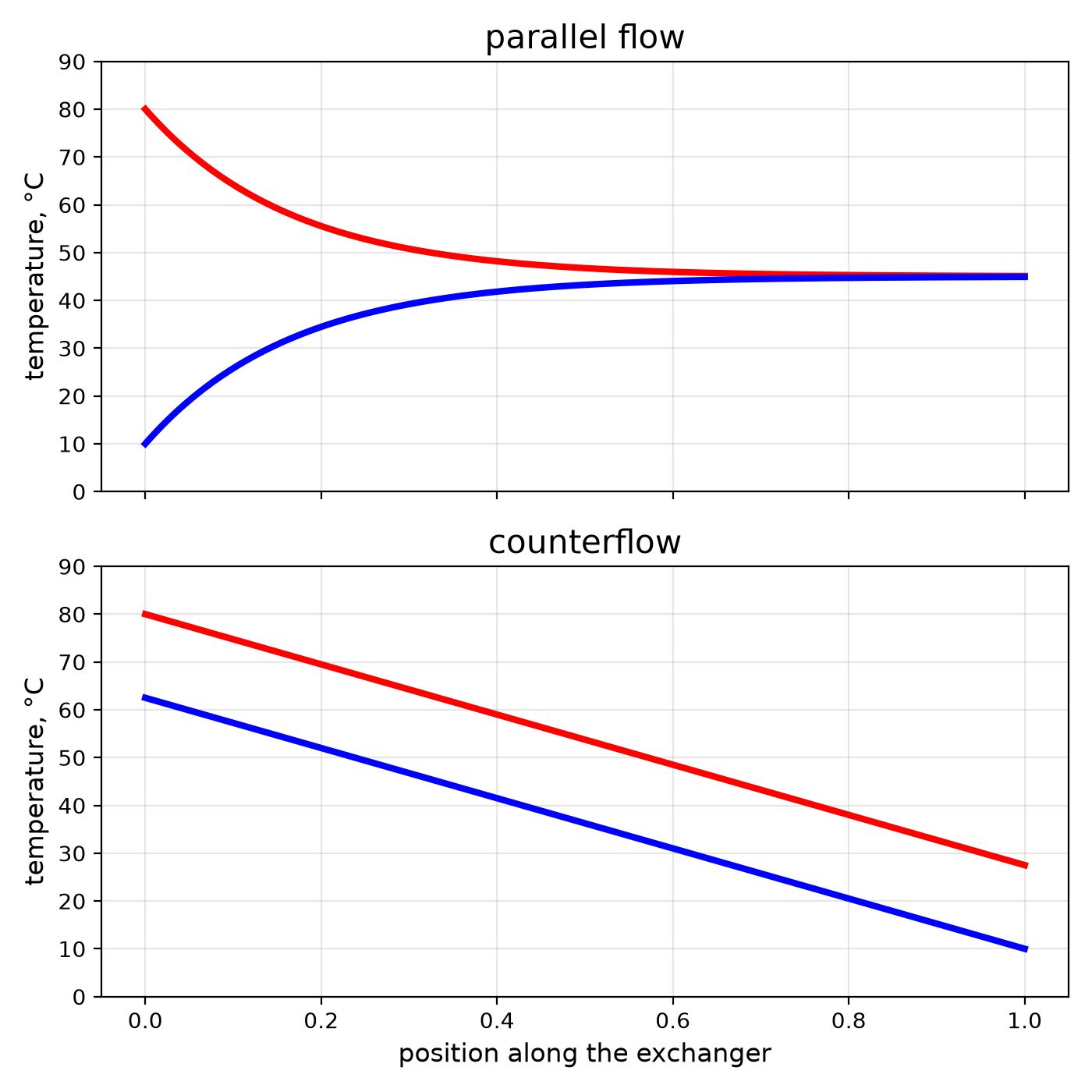
Youblob (generated from this blueprint's notebook) · CC0

Counterflow: The Same Area Does More When the Streams Run Opposite
Every heat exchanger in this batch — the economiser, the condenser, the plate exchanger — is built to one rule: make the hot and cold streams run in opposite directions. It is the single cheapest improvement in heat transfer, because it costs no extra metal.
Run the same way, two streams approach a common middle temperature and stop; the cold one can never leave hotter than the hot one does. Run opposite, the cold stream meets the hottest fluid just as it leaves, and can come out warmer than the hot stream exits.
This rung builds a tube-in-tube exchanger from a copper tube inside a hose, logs four temperatures with an Arduino, and runs it both ways to measure the difference.
Средний
About 5 hours
Инструкции
1
1
Parallel against counterflow, in numbers
Parallel against counterflow, in numbers
Загрузка блокнота Jupyter…
2
2
Build a tube-in-tube exchanger
Build a tube-in-tube exchanger
Take 2 m of 10 mm copper tube and slide it inside 2 m of clear vinyl tube with a bore comfortably larger — the annulus between them is the second channel. At each end fit a tee from the PVC fittings kit: the copper passes straight through the tee and is sealed where it exits with silicone; the tee's side branch is the jacket connection.
You now have two independent channels: inside the copper, and between copper and vinyl. Coil the whole thing loosely and insulate it with glass wool, leaving the four connections free. Push a waterproof temperature probe into each of the four connections through a hole sealed with silicone.
Материалы для этого шага:
 Медная труба2 метров
 Прозрачная виниловая трубка2.5 метров
 Набор фитингов для ПВХ-трубы1 набор
 Силиконовый герметик1 штука
 Утеплитель из стекловаты1 sqm
 Набор хомутов для шлангов1 набор
 Датчик температуры4 штук
Необходимые инструменты:
 Труборез
 Аккумуляторная дрель
 Набор свёрл
 Кожаные рабочие перчатки
3
3
The logger
The logger
Four DS18B20 probes on a single data wire, logging hot in, hot out, cold in and cold out every few seconds as comma-separated lines you can paste into the notebook or a spreadsheet.
hx_logger.inoarduino
Материалы для этого шага:
 Arduino Uno R31 штука
 Резистор 10 килоом2 штук
 Соединительные провода1 набор
Необходимые инструменты:
 Компьютер с Arduino IDE
4
4
Run it both ways
Run it both ways
Feed the copper with hot water from a bucket on a shelf — about 60 °C from a kettle topped up with cold — and the jacket with cold tap water. Set both flows to the same rate by timing each outlet into a measuring jug (aim for about 1 litre per minute).
**Parallel:** both streams enter at the same end. Let the logger settle for five minutes and note the four temperatures.
**Counterflow:** swap the jacket's hoses so the cold enters at the far end. Keep both flows the same. Settle and note.
Compare the cold outlet in the two runs. In counterflow it comes out noticeably warmer — often warmer than the hot outlet — with no change to the hardware except which way one hose points. Work out the heat each side carried; they should agree within a few per cent.
Материалы для этого шага:
 Вода40 литров
Необходимые инструменты:
 Электрочайник стеклянный
 Ведро
Ведро Мерный кувшин
 Секундомер
 Кухонный термометр
5
5
Context
Context
A practice rung: no patent anchors counterflow — it is physics that engineers learned and wrote into every exchanger. The effectiveness–NTU method used in the notebook was set out in the mid-twentieth century and is how exchangers are sized today.
Where it shows up in this catalogue: the economiser meets the coolest gas with the coldest water; the Stirling engine's regenerator and a rocket's regenerative cooling both depend on it; the Linde air liquefier works only because its counterflow exchanger lets the cold returning gas pre-cool the incoming gas.
**Honest limits.** Counterflow gains most when you want the streams to approach each other's temperatures; for a small temperature change on one side it matters less. And it cannot beat the laws: with equal flows even a perfect counterflow exchanger only approaches 100 % effectiveness as its area goes to infinity.
Материалы
11- 2 метровЗаполнитель
- 2.5 метровЗаполнитель
- 1 наборЗаполнитель
- 1 штукаЗаполнитель
- Заполнитель
- 1 наборЗаполнитель
- Заполнитель
- Заполнитель
- Заполнитель
- Заполнитель
- 40 литровЗаполнитель
Требуемые инструменты
10- Заполнитель
- 1 vendor sell this, none ship to you yetЗаполнитель
- Заполнитель
- Заполнитель
- Заполнитель
- Заполнитель
- Заполнитель
- Заполнитель
- Заполнитель
- Заполнитель
Связанные чертежи
Эти чертежи делятся знаниями — техники, материалы или принципы

The Economiser: The Heat Still Going Up the Chimney
от Martin
Механика
38
0
0
0
0
0
The Radiator: Mostly Convection, and Why Temperature Is Everything
от Emma
Механика
33
0
0
0
0
0
Stirling Engine
от Martin
ЭКОЛОГИЯ
57
0
0
0
0
0
The Cooling Tower
от Peter
Гидромеханика
44
0
0
0
1
0
Regenerative Cooling
от Emma
Космос
76
0
0
0
0
0
Ammonia Refrigeration Machine
от Emma
ТЕХНОЛОГИИ
42
0
0
0
2
0
CC0 Общественное достояние
Этот чертёж выпущен под лицензией CC0. Вы можете свободно копировать, изменять, распространять и использовать эту работу в любых целях без запроса разрешения.
Поддержите мейкера, покупая товары через его чертёж, где он получает Комиссию мейкера установленную продавцами, или создайте новую итерацию этого чертежа и включите его как связь в свой чертёж для распределения дохода.