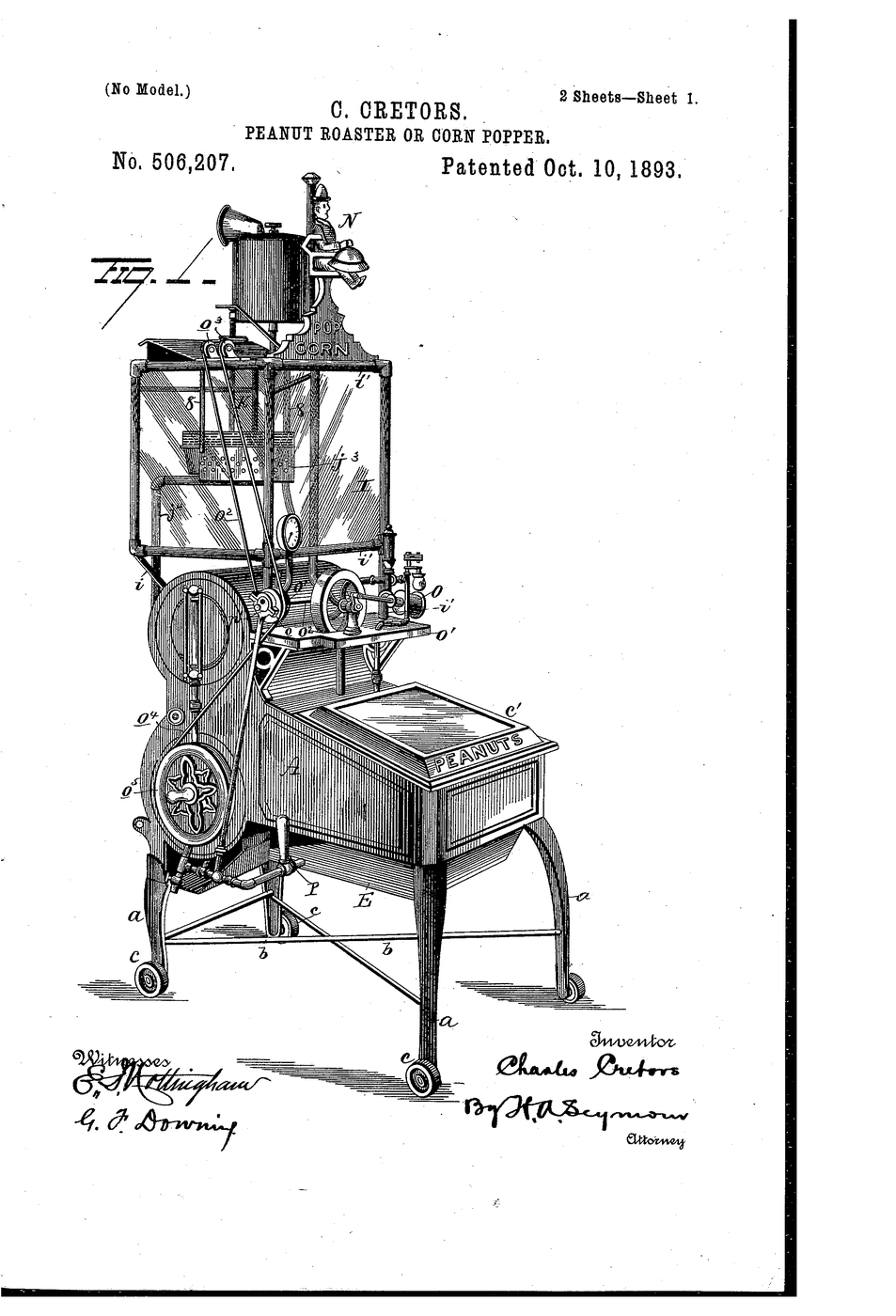


Popcorn Machine
Popping corn over a fire in a wire basket gives you dry popcorn and a lot of burnt kernels. The heat only reaches the bottom layer, nothing moves unless you shake it, and any fat or salt you add would simply burn on the basket — so seasoning happens afterwards, tossed over the top, where it sits on the outside and falls off.
Cretors pops the corn in its own seasonings. A closed heated pan with a powered stirrer keeps every kernel moving through hot fat, so nothing scorches and the flavour is in the corn rather than on it. The result is the same every time, which is what lets you sell it.
The machine is also a shop. It is engine-driven, mounted on a wagon, roasts peanuts in a second chamber, keeps them warm with exhaust steam, and works a little mechanical figure in the window whose stated purpose is "to attract the attention of people passing the device".
US Patent 506,207, "Peanut-roaster or corn-popper", filed 10 August 1891 and granted 10 October 1893 to Charles Cretors of Chicago.
Инструкции
Hot oil and a lid — treat both seriously
Hot oil and a lid — treat both seriously
Popping oil reaches around 200 °C and kernels leave the pan fast. Keep the lid on, keep the handle turned inward, and never add water to hot oil.
Read US 506,207 and count the chambers
Read US 506,207 and count the chambers
Cretors claims a rotating peanut cylinder AND a separate corn pan with a vertical stirrer shaft to prevent burning, both driven from one engine. Two products, one machine.
Pop a batch dry and unstirred
Pop a batch dry and unstirred
Heat kernels in a dry covered pan without moving them. Count the burnt ones and the unpopped ones when it stops. This is the baseline.
Материалы для этого шага:
 Зёрна кукурузы для попкорна200 г
Weigh the burnt and unpopped fractions
Weigh the burnt and unpopped fractions
Separate and weigh the three groups: good, burnt, unpopped. Percentages, not impressions — every later change gets measured against these.
Build a stirrer for the pan
Build a stirrer for the pan
Fit a vertical shaft through the lid with a low arm that sweeps just above the pan floor. It must clear the base by a millimetre or two, no more.
Материалы для этого шага:
 Деревянный шкант1 штука
Необходимые инструменты:
 Плоскогубцы
Add a crank and a belt drive
Add a crank and a belt drive
Drive the shaft with a crank and belt so it can be turned steadily from outside the hot zone. Cretors drives his from the engine; the point is that it turns continuously.
Pop a second batch dry but stirred
Pop a second batch dry but stirred
Same heat, same time, same quantity — but turn the stirrer throughout. Weigh the three fractions again and compare with step 4.
Add oil and pop a third batch
Add oil and pop a third batch
Put enough oil to coat the pan floor, then the kernels, then stir throughout. Note how much more evenly the heat arrives.
Work out why the oil matters
Work out why the oil matters
Dry kernels touch the metal at a point; oil wets the whole surface. The oil is a heat-transfer medium first and a flavour second — that is why it goes in before popping, not after.
Salt one batch during, one after
Salt one batch during, one after
Add fine salt to the oil before popping in one batch, and sprinkle it on afterwards in another. Taste both and note where the salt ends up.
Shake the after-salted batch and look at the bowl
Shake the after-salted batch and look at the bowl
Salt added afterwards falls to the bottom of the bowl. Salt in the oil is carried onto every surface as the corn expands — Cretors' "popped in its own seasonings".
Deliberately overheat a batch
Deliberately overheat a batch
Run the pan too hot with the stirrer going. It still burns. Stirring fixes uneven heat, not excessive heat — the two are different faults.
Compare all four batches side by side
Compare all four batches side by side
Lay out dry-unstirred, dry-stirred, oiled-stirred and overheated. Rank them on burnt percentage, unpopped percentage and taste. The winning combination is the patent.
History & Context — a machine that was also its own advertisement
History & Context — a machine that was also its own advertisement
The patent. US 506,207, "Peanut-roaster or corn-popper", filed 10 August 1891 and granted 10 October 1893 to Charles Cretors of Chicago. ⚠ Google Patents' metadata renders the name as "Charles Gretors" — an OCR error. The firm is C. Cretors & Co., and it still exists.
The invention is uniformity, not popcorn. Corn had been popped for millennia and sold on streets for decades before this. What Cretors built is the first machine that produces a predictable product: a stirred, oiled, enclosed pan removes the two variables that ruin a batch — cold spots and scorching — so the hundredth bag is like the first. That is the precondition for selling it as a branded commodity rather than as whatever came out of the fire today. Steps 4, 7 and 8 make the improvement a number instead of an opinion.
Popping in the seasoning is a genuine chemical difference. A kernel is a sealed capsule of starch and about 14 % water. Heated, the water flashes to steam at around 180 °C and bursts the hull, and the starch expands and sets in the instant that follows. Anything dissolved or suspended in the surrounding oil at that moment is carried onto the enormous new surface as it forms. Seasoning applied afterwards simply rests on the outside and, as step 11 shows, ends up in the bottom of the bowl.
The mechanical figure is not decoration, it is the business model. The patent explicitly claims an automated figure driven by the same mechanism, to attract passers-by. Cretors took the wagon to the 1893 World's Columbian Exposition in Chicago, where the machine was as much of the draw as the product. A mobile, self-powered, self-advertising food machine could follow crowds to fairs, circuses and parks rather than waiting for them — and popcorn's association with cinemas came later, when Depression-era theatre owners discovered that a cheap snack with enormous margins was more reliable than ticket sales.
The waste heat is reused, which is a nice piece of engineering. Exhaust steam from the engine heats a water tank that keeps roasted peanuts warm. Nothing about that is necessary to pop corn; it is the mark of a designer treating the whole wagon as one thermal system rather than as a set of separate appliances.
Материалы
2- Заполнитель
- 1 штукаЗаполнитель
Требуемые инструменты
1- Заполнитель
По этому чертежу делают

Связанные чертежи
Эти чертежи делятся знаниями — техники, материалы или принципы
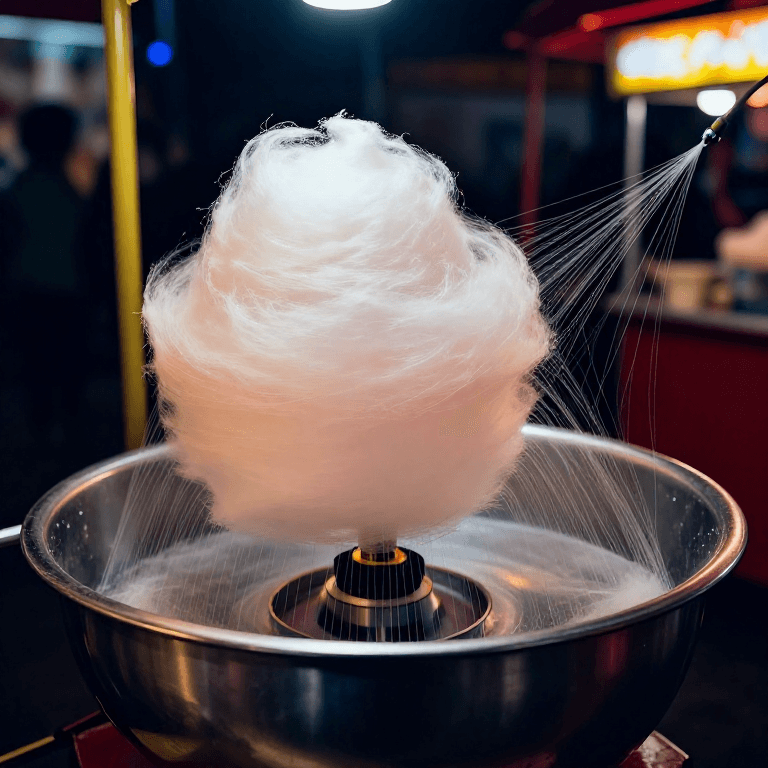
CC0 Общественное достояние
Этот чертёж выпущен под лицензией CC0. Вы можете свободно копировать, изменять, распространять и использовать эту работу в любых целях без запроса разрешения.
Поддержите мейкера, покупая товары через его чертёж, где он получает Комиссию мейкера установленную продавцами, или создайте новую итерацию этого чертежа и включите его как связь в свой чертёж для распределения дохода.