
Electric Flat-Iron
A sad-iron is a solid lump of cast iron heated on a stove. It is hot when you pick it up, cooling from the moment you do, and sooty on the face from the fire. Households kept several: one in use, two reheating. The work was scheduled around the stove.
An electric iron heats itself, continuously, from a wire. The heat is made inside the sole by a resistance carrying current, so the temperature does not fall as you work and nothing touches a fire. That is the whole idea, and in 1882 it was three decades ahead of the wiring needed to use it.
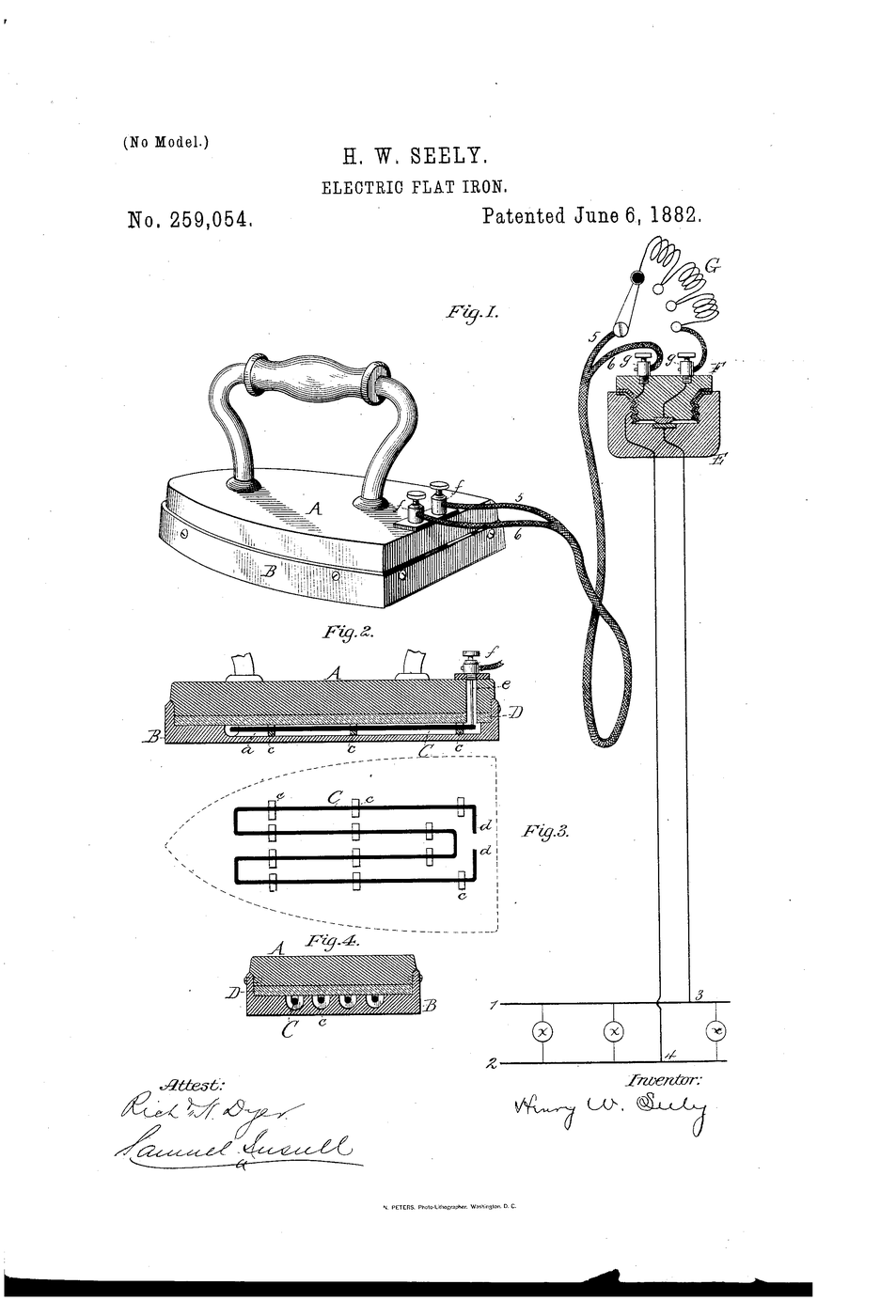
US Patent 259,054, "Electric flat-iron", filed 8 December 1881 and granted 6 June 1882 to Henry W. Seely of New York. The patent puts a carbon resistance in a groove in the base, close to the face, and connects it "in an electric circuit, preferably a multiple-arc circuit of an electric lighting system" — that is, into a lamp socket, because in 1882 lighting circuits were the only circuits a house had.
Инструкции
Build this on low voltage only — never on mains
Build this on low voltage only — never on mains
Use a bench supply at 12 V or less. A resistive heater is the one circuit where a beginner is tempted to reach for mains voltage, and it is the one place that is least survivable. No exceptions.
Read US 259,054 and note what heats it
Read US 259,054 and note what heats it
Seely specifies a carbon resistance, preferably molded in one continuous piece, seated in a groove in the base. Not a coil — a moulded carbon block.
Note the regulation clause too
Note the regulation clause too
The patent adds "an adjustable resistance, G ... in order that the heat of the latter may be properly regulated." It is manual regulation, not a thermostat — nothing measures the temperature.
Heat a solid iron block and time its fall
Heat a solid iron block and time its fall
Warm a steel block, then record its surface temperature every 30 seconds for 10 minutes with an infrared thermometer. This is the sad-iron the invention replaces.
Необходимые инструменты:
 Инфракрасный термометр
Plot the cooling curve
Plot the cooling curve
Sketch temperature against time. The useful ironing window is the part above about 120 °C — usually only a few minutes out of the ten.
Cut a groove in the sole plate
Cut a groove in the sole plate
File or mill a 3 mm channel across the upper face of a flat steel plate, following the patent's placement: in the base, close to the face, so heat reaches the cloth and not your hand.
Measure the nichrome before cutting it
Measure the nichrome before cutting it
Measure resistance per metre of 22-gauge nichrome with a multimeter. Calculate the length for about 10 W at 12 V — roughly 14 Ω.
Материалы для этого шага:
 Нихромовая проволока1 метр
Необходимые инструменты:
 Цифровой мультиметр — автовыбор предела, True RMS
Lay the element into the groove
Lay the element into the groove
Bed the measured nichrome in the channel. It must not touch the steel anywhere — the plate would short it out and carry current itself.
Insulate the element from the plate
Insulate the element from the plate
Pack the groove with plaster of Paris, exactly as the patent does, and let it set hard. Seely uses it to insulate electrically and to confine heat to the lower section.
Fit binding posts and flexible leads
Fit binding posts and flexible leads
Bring the two ends out to terminals, then to flexible wires "of sufficient length to allow the iron to be moved back and forth". The trailing flex is part of the design, not an afterthought.
Материалы для этого шага:
 Оцинкованная стальная проволока1 метр
Power up at 12 V and watch the current
Power up at 12 V and watch the current
Connect the bench supply and read the current. At 14 Ω and 12 V expect about 0.85 A. A reading far above that means a short in the element.
Необходимые инструменты:
 Лабораторный источник питания
Log the heating curve to steady state
Log the heating curve to steady state
Record sole temperature every 30 seconds until it stops rising. It settles where heat generated equals heat lost — that plateau is the iron's only temperature.
Compare the two curves
Compare the two curves
Put step 5 and step 12 side by side. The electric iron does not get hotter — it stays hot. That is the entire practical gain.
Add Seely's adjustable resistance
Add Seely's adjustable resistance
Put a rheostat in series and re-run the plateau at two settings. The plateau moves, proving regulation works — and drifts with room temperature, proving it is not control.
Iron a damp cotton scrap and judge it
Iron a damp cotton scrap and judge it
Press a creased damp cotton square for 20 seconds. Note whether the plateau is actually hot enough — at 10 W it will be marginal, which is the honest 1882 result.
History & Context — right idea, no grid to plug it into
History & Context — right idea, no grid to plug it into
The patent. US 259,054, "Electric flat-iron", filed 8 December 1881, granted 6 June 1882 to Henry W. Seely of New York City. It is routinely called the first electric iron patent, and that claim holds up.
Three things the popular account gets wrong, all checkable against the document. Secondary sources repeat that Seely's iron had "built-in coils", that it was "heated on a rack or stand", and that it had no way to regulate heat. The patent says otherwise on each count. The heating element is a carbon resistance, preferably moulded as one continuous piece, not a wire coil. There is no heating rack anywhere in the specification — the iron is designed to be used connected, with "flexible conducting-wires ... of sufficient length to allow the iron to be moved back and forth". And regulation is explicitly provided for, by an adjustable resistance in series. Later Seely-and-Dyer designs did use a stand, and that is very likely where the rack story comes from; it has been read backwards onto the 1882 patent. This blueprint follows the document.
Why it did not sell. Not because it worked badly, but because almost nobody could plug it in. The patent's own wording gives the game away: it connects to "a multiple-arc circuit of an electric lighting system", which in 1882 meant the handful of districts served by a central station — Edison's Pearl Street station began supplying customers in September 1882, three months after this grant. Domestic wiring was lighting only, ran during evening hours in many places, and offered no outlets in the modern sense. An iron is a daytime tool. The invention was correct and the infrastructure did not exist for another thirty years; electric irons only became ordinary household objects in the 1910s and 1920s, once daytime domestic supply and general-purpose outlets were normal.
Regulation is not control, and the difference is the next invention. Seely's series resistance lets you pick a heat setting; nothing in the iron measures whether the sole is actually at that heat. The plateau you find in step 12 depends on room temperature, on airflow, and on whether the sole is resting on cloth or in free air. Real control needed a feedback element — a bimetallic strip that opens the circuit when the sole gets too hot — and that arrived on irons in the 1920s. It is worth noticing that the indicate-versus-regulate distinction drawn in Warren Johnson's tele-thermoscope is the same gap showing up in a different appliance: sensing, regulating and controlling are three separate problems, and the nineteenth century solved them in that order.
On carbon versus nichrome. This build uses nichrome because it is safe, cheap and available; Seely used carbon because in 1881 nichrome did not exist. Albert Marsh's chromium-nickel resistance alloy was not patented until 1906, and it is what made every practical electric heating appliance possible — carbon oxidises and changes resistance as it ages, nichrome forms a protective oxide skin and holds its value. The substitution is honest but it is a substitution, and it quietly removes the hardest engineering problem Seely actually faced.
Материалы
2- 1 метрЗаполнитель
- Заполнитель
Требуемые инструменты
3- Заполнитель
- Заполнитель
Материалы из связанных чертежей
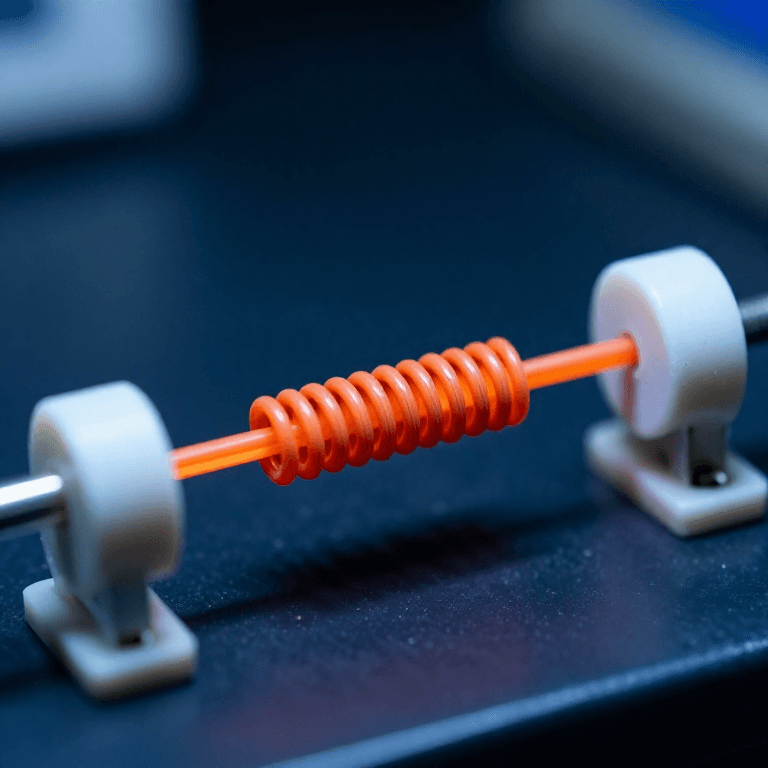
Связанные чертежи
Эти чертежи делятся знаниями — техники, материалы или принципы

CC0 Общественное достояние
Этот чертёж выпущен под лицензией CC0. Вы можете свободно копировать, изменять, распространять и использовать эту работу в любых целях без запроса разрешения.
Поддержите мейкера, покупая товары через его чертёж, где он получает Комиссию мейкера установленную продавцами, или создайте новую итерацию этого чертежа и включите его как связь в свой чертёж для распределения дохода.