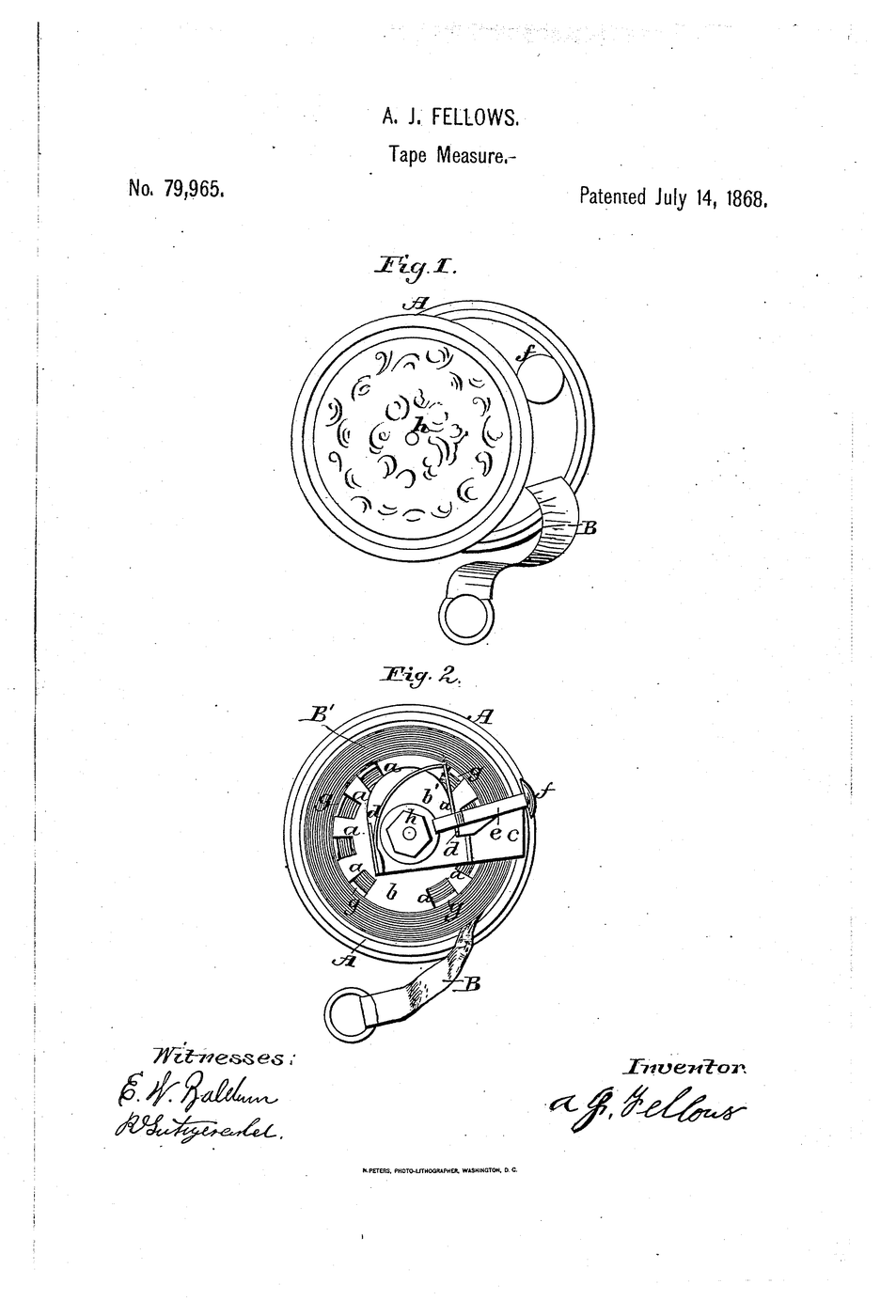


Spring Tape Measure
A folding rule measures a straight line on a bench. A coiled steel tape measures a room, a roof and a curve — and then disappears into a pocket.
US 79,965, Alvin J. Fellows of New Haven, Connecticut, granted 14 July 1868. Fellows did not invent the measuring tape; he solved the thing that made it usable. His claim is a spring click lock that holds the extended tape still while you read it, and releases it to recoil when you are done. Without the lock, a spring-loaded tape is a tool that fights you.
The case is doing three jobs at once: it stores the coil, it houses the spring, and its own known length becomes part of the measurement whenever you measure an internal corner.
Инструкции
Read the claim before you build
Read the claim before you build
Fellows claims the lock, not the tape. Write down what a spring tape does wrong without one.
Examine a real tape's hook
Examine a real tape's hook
Look at the end hook on the workshop tape. Push and pull it — it slides by about its own thickness. That is deliberate.
Необходимые инструменты:
 Рулетка
Measure outside, then inside
Measure outside, then inside
Measure the board's length with the hook pulled against the end. Then measure an internal gap with the hook pushed. Both read true because of that slide.
Материалы для этого шага:
 Плоская деревянная доска1 штука
Необходимые инструменты:
РулеткаProve the hook slide is the reason
Prove the hook slide is the reason
Hold the hook rigid with a finger and repeat the inside measurement. It now reads long by the hook thickness. A loose rivet that looks like a defect is the calibration.
Необходимые инструменты:
РулеткаMake a paper tape
Make a paper tape
Cut a paper strip 25 mm wide and 600 mm long. Graduate it in 10 mm steps against the steel ruler.
Материалы для этого шага:
 Миллиметровая бумага2 листов
Необходимые инструменты:
 Ножницы
 Линейка
 Перманентный маркер
Coil it and let it go
Coil it and let it go
Roll the strip tightly, hold it, release it. It uncoils limply. Paper stores no energy — note what is missing.
Build a spring from steel wire
Build a spring from steel wire
Wind 300 mm of steel wire tightly around the brass rod and slide it off. This coil stores energy; the paper did not.
Материалы для этого шага:
 Оцинкованная стальная проволока0.3 метр
Необходимые инструменты:
 Латунный пруток
Feel the energy return
Feel the energy return
Stretch the wire coil and release it. Steel returns to shape; that elastic return is what pulls a tape home.
Материалы для этого шага:
Оцинкованная стальная проволока0.3 метрBuild a friction lock
Build a friction lock
Cut a small card lever, glue it to the board so it pinches the paper tape when pressed. This is Fellows's claim in cardboard.
Материалы для этого шага:
Миллиметровая бумага1 лист Столярный клей3 мл
Необходимые инструменты:
НожницыTest lock and release
Test lock and release
Extend the paper tape, press the lever, let go. It should hold. Release and it should run free.
Measure a curve
Measure a curve
Measure around a curved edge with the steel tape, then try with the rigid ruler. The flexible tape does what a rule cannot.
Необходимые инструменты:
РулеткаЛинейкаCheck the tape against the ruler
Check the tape against the ruler
Lay the first 300 mm of the tape alongside the steel ruler. Look for drift. Cheap tapes disagree with rules, and one of them is wrong.
Необходимые инструменты:
РулеткаЛинейкаMeasure the same span ten times
Measure the same span ten times
Measure one span ten times, recording each. The spread is your repeatability — and it is larger than you expect.
Материалы для этого шага:
Миллиметровая бумага1 листНеобходимые инструменты:
РулеткаHistory & Context
History & Context
US 79,965, Alvin J. Fellows, New Haven, Connecticut, granted 14 July 1868.
Not that Fellows. Alvin J. Fellows of the tape measure is unrelated to Edwin R. Fellows of the gear shaper, a separate blueprint in this library. Same surname, different men, different trades.
What Fellows did and did not do. Measuring tapes existed well before 1868 — James Chesterman of Sheffield was manufacturing steel tapes from 1829. Fellows improved the spring click that holds the tape open. That is a smaller claim than ‘invented the tape measure’, which is how he is often described, and it is the accurate one.
The concave cross-section came much later and is worth knowing about: curving the blade across its width lets a modern tape stand out unsupported for a couple of metres. That is a twentieth-century refinement, not part of this patent.
Where it sits in this batch. The tape is the only instrument here built for the building site rather than the bench, and it is the one most people own. It carries a workshop standard out into the world — which is exactly what a standard is for. Its accuracy is coarse next to a micrometer, and that is correct: precision should match the job, and a roof does not need a thousandth.
Материалы
4- 1 штукаЗаполнитель
- 4 листовЗаполнитель
- 0.3 метрЗаполнитель
- 3 млЗаполнитель
Материалы из связанных чертежей
Связанные чертежи
Эти чертежи делятся знаниями — техники, материалы или принципы
CC0 Общественное достояние
Этот чертёж выпущен под лицензией CC0. Вы можете свободно копировать, изменять, распространять и использовать эту работу в любых целях без запроса разрешения.
Поддержите мейкера, покупая товары через его чертёж, где он получает Комиссию мейкера установленную продавцами, или создайте новую итерацию этого чертежа и включите его как связь в свой чертёж для распределения дохода.