
Feuerstein Sammeln und Bestimmen — Rohmaterial für Steinwerkzeuge
Инструкции
Was ist Feuerstein?
Was ist Feuerstein?
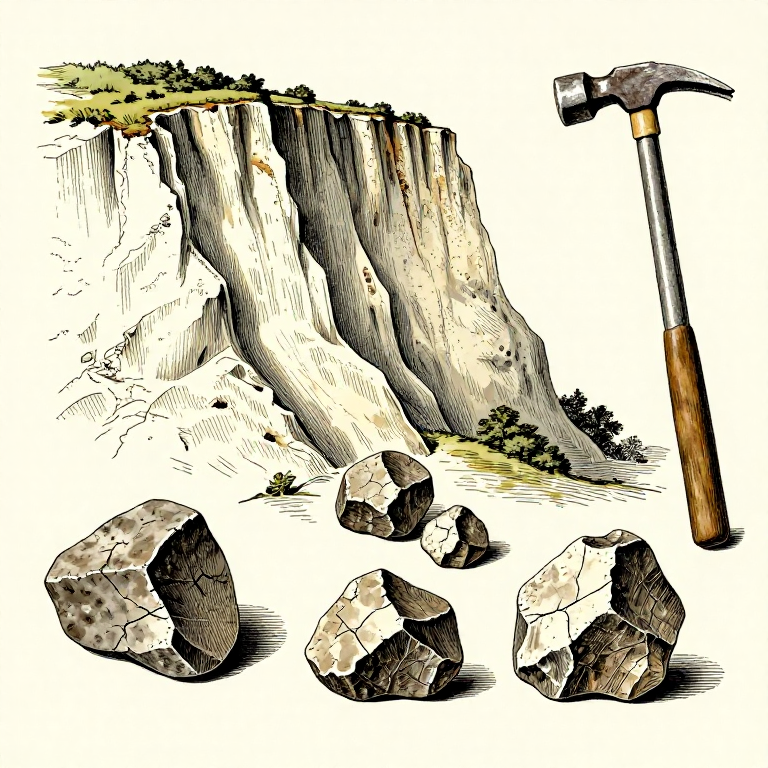
Feuerstein (auch Flint genannt) ist mikrokristalliner Quarz (SiO₂) mit einer Mohshärte von 7. Er entsteht in Kreide- und Kalksteinformationen aus gelöster Kieselsäure, die sich um organische Kerne ablagert. Feuerstein bricht muschelförmig (konchoidal) und erzeugt dabei scharfe Kanten — die Grundlage der Steinwerkzeugherstellung seit über 2,5 Millionen Jahren.
Fundorte in Norddeutschland kennenlernen
Fundorte in Norddeutschland kennenlernen
Die besten Fundstellen liegen in der Kreide-Zone: Rügen (Jasmund-Kreidefelsen), Helgoland, Schleswig-Holsteins Ostseestrände und die Moränenlandschaften Mecklenburg-Vorpommerns. Feuerstein wird durch Gletschererosion aus Kreideformationen gelöst und findet sich in Kiesgruben, an Stränden und auf frisch gepflügten Äckern.
Feuerstein an der Farbe erkennen
Feuerstein an der Farbe erkennen
Feuerstein hat eine weiße Kruste (Cortex) aus Kreide, die den dunklen Kern umgibt. Der Kern ist grau, schwarz, braun oder honigfarben — je nach Fundort. Rügener Feuerstein ist meist dunkelgrau bis schwarz. Baltischer Strandfeuerstein zeigt oft eine glatte, abgeriebene Oberfläche.
Muschelbruch überprüfen
Muschelbruch überprüfen
Der entscheidende Test: Feuerstein bricht mit glattem, muschelförmigem Bruch (konchoidaler Bruch). Wenn Sie einen Stein anschlagen und die Bruchfläche glatt, leicht gewölbt und glasig aussieht, ist es sehr wahrscheinlich Feuerstein. Körniger oder matter Bruch deutet auf anderen Stein hin.
Необходимые инструменты:
 Геологический молоток
Funkentest durchführen
Funkentest durchführen
Schlagen Sie den Stein mit einem Stück Kohlenstoffstahl (nicht Edelstahl). Feuerstein erzeugt helle, heiße Funken — daher sein Name. Dieser Test funktioniert nur mit Kohlenstoffstahl, nicht mit Edelstahl oder einem anderen Feuerstein.
Необходимые инструменты:
 Кресало из углеродистой стали
Ritztest zur Härtebestimmung
Ritztest zur Härtebestimmung
Feuerstein (Härte 7) ritzt Glas (Härte 5,5) mühelos. Halten Sie den Stein in festem Winkel gegen eine Glasscherbe und ziehen Sie ihn darüber. Wenn er eine sichtbare Rille hinterlässt, bestätigt das die Feuersteinidentifikation. Tragen Sie dabei Schutzhandschuhe.
Необходимые инструменты:
 Кожаные рабочие перчатки
 Осколок стекла
Qualität beurteilen — Körnung
Qualität beurteilen — Körnung
Guter Feuerstein hat eine extrem feine Körnung — die Bruchfläche fühlt sich glatt wie Glas an. Grober Feuerstein mit sichtbarem Korn oder eingeschlossenen Fossilien bricht ungleichmäßig und eignet sich schlecht für feine Werkzeuge. Homogene, feinkörnige Stücke sind am wertvollsten.
Необходимые инструменты:
 Ручная лупа 10x
Auf Risse und Frostschäden prüfen
Auf Risse und Frostschäden prüfen
Klopfen Sie leicht auf den Feuerstein und hören Sie auf den Klang. Ein heller, klingender Ton zeigt intaktes Material an. Ein dumpfer, matter Ton deutet auf innere Risse hin — oft durch Frost verursacht. Rissiger Feuerstein bricht unkontrolliert und ist für Werkzeuge unbrauchbar.
Passende Größe auswählen
Passende Größe auswählen
Für Werkzeugherstellung sammeln Sie Knollen von mindestens Faustgröße (8-15 cm Durchmesser). Kleinere Stücke reichen für Pfeilspitzen und Schaber. Für große Klingen und Beile brauchen Sie Stücke von 15-25 cm. Transportieren Sie nicht mehr als 5-8 kg pro Ausflug — Feuerstein ist schwer.
Материалы для этого шага:
 Кремнёвая конкреция5 kilogram
Sicher einsammeln
Sicher einsammeln
Tragen Sie feste Schuhe und Handschuhe. Frisch gebrochener Feuerstein hat rasiermesserscharfe Kanten. Wickeln Sie jeden Stein einzeln in Zeitungspapier oder Stoff, bevor Sie ihn in den Rucksack legen. Steine, die direkt aneinanderschlagen, können splittern.
Материалы для этого шага:
 Обёрточная бумага10 штук
Необходимые инструменты:
 Прочный рюкзакКожаные рабочие перчатки
Kreidekruste entfernen (optional)
Kreidekruste entfernen (optional)
Die weiße Kreidekruste (Cortex) kann belassen oder entfernt werden. Zum Entfernen weichen Sie den Stein 24 Stunden in Wasser ein und bürsten die weiche Kreide ab. Für die Werkzeugherstellung muss die Kruste nicht vorher entfernt werden — sie wird beim Bearbeiten ohnehin abgeschlagen.
Материалы для этого шага:
 Вода5 литров
Необходимые инструменты:
 Щётка с жёсткой щетиной
Fundstücke waschen und trocknen
Fundstücke waschen und trocknen
Waschen Sie gesammelten Feuerstein unter fließendem Wasser, um Erde und Sand zu entfernen. Lassen Sie die Steine an der Luft trocknen — nicht in der prallen Sonne, da schnelle Temperaturänderungen Risse verursachen können. Feuerstein trocknet in 2-3 Stunden vollständig.
Feuerstein beschriften und lagern
Feuerstein beschriften und lagern
Beschriften Sie jeden Stein mit einem Bleistift oder Wachsmarker auf der Cortex-Seite: Fundort und Datum. Lagern Sie Feuerstein trocken und frostfrei — Feuchtigkeit, die in Risse eindringt und gefriert, zerstört den Stein. Ein Regal in der Werkstatt ist ideal.
Необходимые инструменты:
 Разметочный карандаш
Fundort dokumentieren
Fundort dokumentieren
Notieren Sie GPS-Koordinaten, Gesteinsart der Umgebung (Kreide, Moräne, Strand), Qualität und Menge des gefundenen Feuersteins. Gute Fundstellen liefern über Jahre hinweg Material. Beachten Sie lokale Sammelvorschriften — in Naturschutzgebieten ist das Sammeln oft verboten.
Необходимые инструменты:
 Полевой блокнот
Fundort aufräumen
Fundort aufräumen
Füllen Sie ausgehobene Löcher wieder auf, nehmen Sie allen Müll mit und hinterlassen Sie den Fundort so, wie Sie ihn vorgefunden haben. Verantwortungsvolles Sammeln sichert den Zugang für andere und erhält die Natur.
Материалы
3- 5 kilogramЗаполнитель
- 10 штукЗаполнитель
- 5 литровЗаполнитель
Требуемые инструменты
9- Заполнитель
- Заполнитель
- Заполнитель
- Заполнитель
- Заполнитель
- Заполнитель
- Заполнитель
- Заполнитель
- Заполнитель
По этому чертежу делают

CC0 Общественное достояние
Этот чертёж выпущен под лицензией CC0. Вы можете свободно копировать, изменять, распространять и использовать эту работу в любых целях без запроса разрешения.
Поддержите мейкера, покупая товары через его чертёж, где он получает Комиссию мейкера установленную продавцами, или создайте новую итерацию этого чертежа и включите его как связь в свой чертёж для распределения дохода.