
Freewheel and Coaster Brake
On a fixed-wheel bicycle the pedals are locked to the rear wheel. Roll downhill and the cranks turn whether you want them to or not, at whatever speed the wheel dictates. You cannot stop pedalling, you cannot coast, and at speed the pedals throw your feet off.
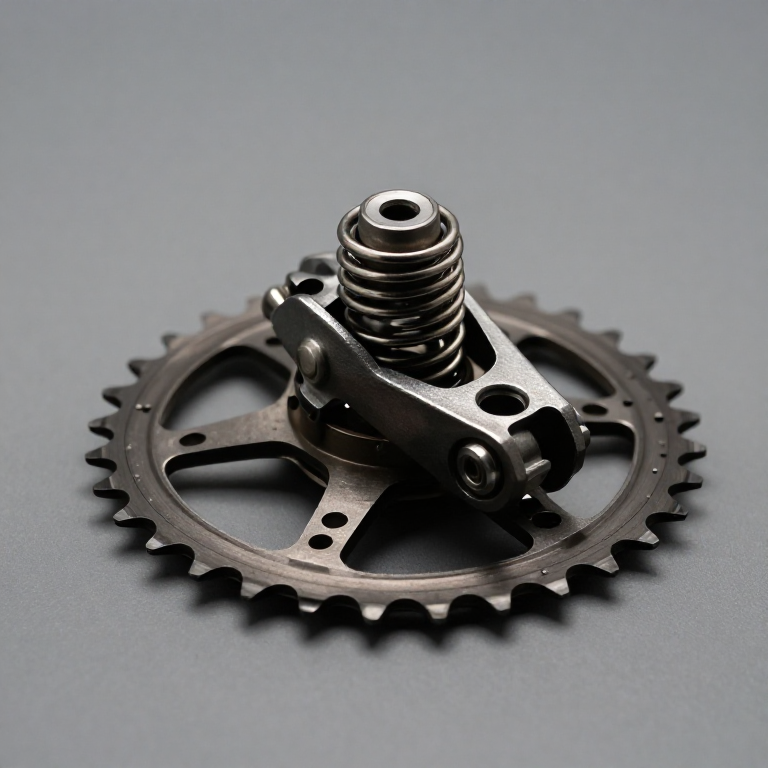
A freewheel is a one-way clutch: it transmits torque in the driving direction and disengages in the other. The classic mechanism is spring-loaded pawls on the hub body dropping into a ratchet ring. Pedal forwards and a pawl catches a tooth and drives. Coast, and the ratchet runs faster than the pawls, which are pushed down by the tooth ramps and skip over — producing the clicking every cyclist knows.
The engagement is quantised, and that number matters: with 24 ratchet teeth the crank may need up to 15° of rotation before a pawl catches. That dead movement is why an expensive hub with 54 or 72 points of engagement feels immediate and a cheap one feels vague — you are feeling 360°/n.
The coaster brake adds a third state to the same hub. Pedal forwards: drive. Coast: freewheel. Pedal backwards: a helical thread drives a brake cone or shoes outward against the hub shell and stops the wheel. One hub, three behaviours, selected entirely by which way you turn the cranks and no cable at all.
Инструкции
Listen before you open anything
Listen before you open anything
Lift the rear wheel and spin it backwards. Count the clicks in one full wheel revolution.
That count is the number of engagement points. Compute 360° / n — the maximum crank movement before drive picks up.
Expect 18–24 points on a basic hub (15–20° of dead movement) and 54–120 on a good one (3–7°).
Open a freewheel and find the pawls
Open a freewheel and find the pawls
Dismantle a freewheel or cassette body over a tray — there will be small springs and loose bearings.
Identify the pawls, their springs, and the ratchet ring.
Look closely at a ratchet tooth: it is asymmetric — a steep face on one side, a shallow ramp on the other. That asymmetry is the entire one-way behaviour. The steep face catches; the ramp lifts the pawl and lets it skip.
Необходимые инструменты:
 Слесарные тиски
 Трещотка велосипедная (односкоростная)
Test load sharing
Test load sharing
Turn the body slowly by hand and watch how many pawls are actually carrying at any moment.
Expect not all of them. Pawls are often deliberately spaced or shaped so they engage at slightly different moments — that is how a hub gets more engagement points without more teeth, and the cost is that one or two pawls carry the load at a time.
This is why a hub can be advertised with many engagement points and still shear pawls under a hard sprint.
Find the third state in a coaster hub
Find the third state in a coaster hub
In a coaster brake hub, find the helically threaded driver and the brake cone or shoe expander.
Rotate the driver backwards by hand and watch: the thread converts backward rotation into axial movement, and that movement pushes the brake outward against the hub shell.
Note what is absent: any cable, lever or adjuster. The braking command is the direction of pedalling.
Feel the limitation the hub cannot escape
Feel the limitation the hub cannot escape
With the wheel in a stand, apply the coaster brake and hold it. Then try to reposition the pedals for a standing start.
You cannot — backing the cranks brakes, so the pedals cannot be set where you want them.
And the braking surface is inside a sealed hub. All the heat goes into the hub shell and the grease. On a long descent that heat has nowhere to go, which is why coaster brakes are for flat towns and why every mountainous country kept rim brakes.
History & Context
History & Context
Older than the safety bicycle's success. Freewheel mechanisms appear on bicycles from the 1860s–70s and the ratchet-and-pawl principle is far older still — windlasses and clocks used it for centuries. The bicycle did not invent the one-way clutch; it made it a mass-produced precision component.
The coaster brake belongs to a place. It became standard in the United States, Germany and the Netherlands and never took hold in Britain or the Alps. That is not fashion — it is topography plus the heat problem in step 5, and it is a clean example of the same technology being correct in one market and wrong in another.
Why fixed-wheel survives anyway. Track racing bans freewheels, because a rider who can drive the pedals in both directions has control a freewheel cannot give, and because there is nothing to fail. Fixed-wheel riding on the road persists for the same reason plus directness of feel. The freewheel is not simply better; it trades control for comfort.
Where else you meet it. Every ratchet spanner, every starter motor's Bendix drive, every helicopter's autorotation clutch, the sprag clutch in an automatic gearbox. The bicycle version is just the one most people can hear.
Modern rethinking. The pawl has competition: ratchet-ring hubs use two opposed toothed discs pushed together by springs, so every tooth engages at once. That gives high engagement counts and shares load across all teeth rather than one or two — which addresses step 3's weakness directly, at the cost of more drag while coasting.
Требуемые инструменты
2- Заполнитель
- Заполнитель
Материалы из связанных чертежей
Связанные чертежи
Эти чертежи делятся знаниями — техники, материалы или принципы
CC0 Общественное достояние
Этот чертёж выпущен под лицензией CC0. Вы можете свободно копировать, изменять, распространять и использовать эту работу в любых целях без запроса разрешения.
Поддержите мейкера, покупая товары через его чертёж, где он получает Комиссию мейкера установленную продавцами, или создайте новую итерацию этого чертежа и включите его как связь в свой чертёж для распределения дохода.