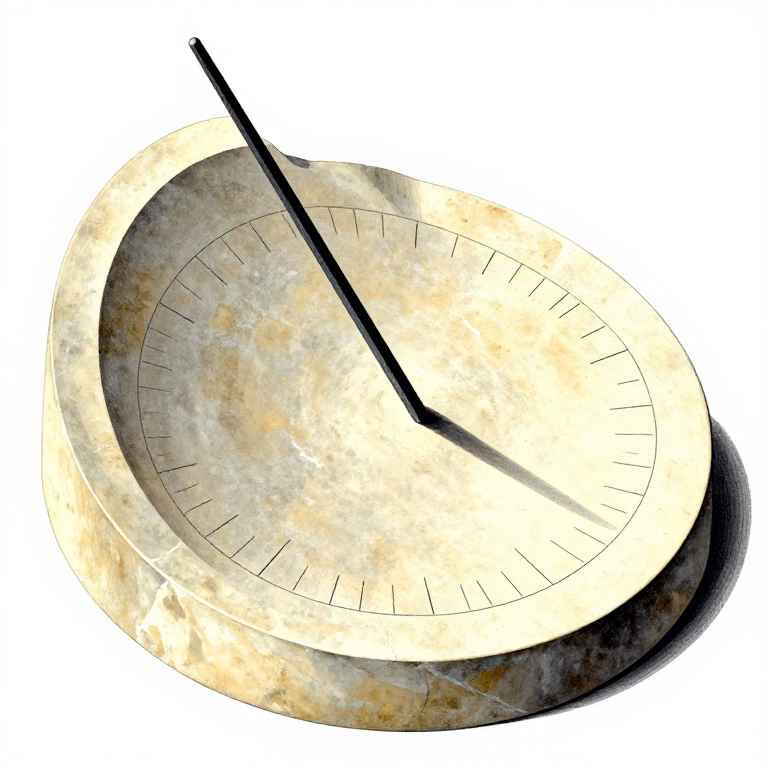


Greek Sundial — Carving a Hemispherical Sundial
Инструкции
Carve the Hemispherical Bowl
Carve the Hemispherical Bowl
Mark a circle approximately 25-30 cm in diameter on the top face of the stone block. Using stone-carving chisels and mallet, hollow out a hemispherical concavity to a depth equal to the bowl's radius (half the diameter). Work in progressive stages: rough out with a point chisel, refine with a claw chisel, and smooth with a flat chisel followed by abrasive stones. The interior surface must be smoothly curved — a true hemisphere — because the geometric accuracy of the hour lines depends on the bowl's shape. Check the curvature by rotating a template (a half-circle cut from thin wood) inside the bowl; it should contact the surface evenly at all angles. The exterior can be left rough or carved into a decorative form.
Материалы для этого шага:
 Каменный блок1 block штука
 Металлический стержень1 rod, 5-8 cm long см
 Свинецsmall amount штука
Необходимые инструменты:
 Железное зубило
 Деревянная киянка
 Компас
 Песчаник (абразивный)
 Секундомер
 Закрытые защитные очки
Install the Gnomon
Install the Gnomon
Drill a small hole at the exact geometric center of the bowl rim (the highest point on the north side for a sundial in the Northern Hemisphere). Insert a straight metal rod (the gnomon) into the hole so it points directly toward the bowl center, projecting horizontally inward from the rim. Fix it in place with lead or strong adhesive. The tip of the gnomon casts a small shadow point onto the interior of the bowl as the sun moves across the sky. The shadow point traces a curved path across the bowl surface each day, with the path changing seasonally. The gnomon length should be approximately equal to the bowl radius so its shadow can reach all parts of the interior surface throughout the year.
Mark the Hour Lines by Observation
Mark the Hour Lines by Observation
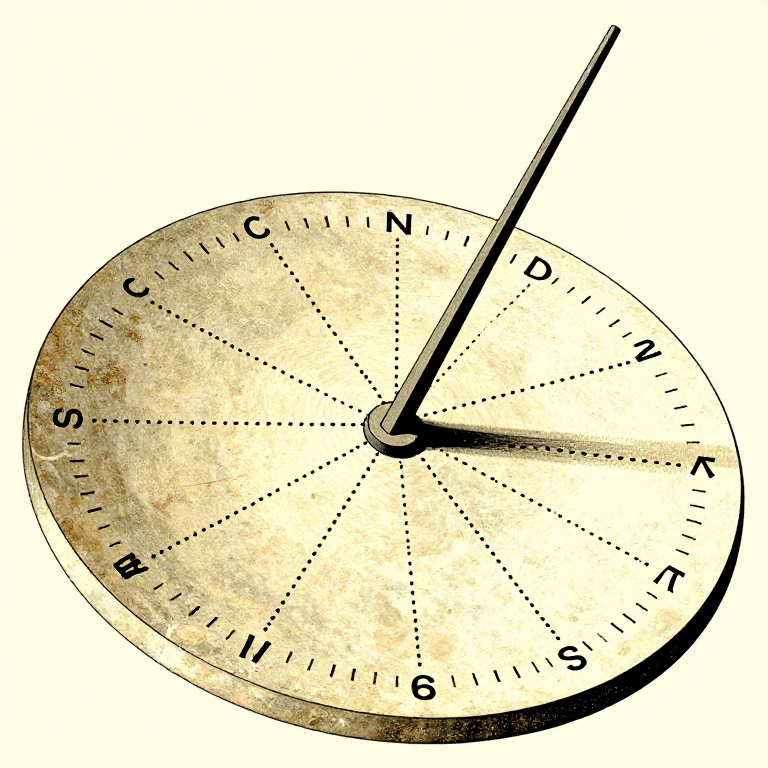
Position the sundial on a level surface in direct sunlight, oriented with the gnomon pointing due south (in the Northern Hemisphere). Using a reference clock, mark the position of the gnomon's shadow tip on the bowl interior at each hour of the day. Connect these hourly marks with curved lines incised into the stone — these are the hour lines. For the Greek seasonal hour system, the day and night were each divided into 12 equal parts, meaning hour lengths changed with the seasons. To mark seasonal hour lines, repeat the observation process on the summer solstice, equinoxes, and winter solstice. The shadow tip follows a different curved path on each date. The solstice and equinox paths create three day-curves (the tropics of Cancer and Capricorn and the equator projected onto the bowl interior).
Incise the Lines and Labels
Incise the Lines and Labels
Using a fine chisel and mallet, permanently incise the calibrated hour lines and seasonal day-curves into the bowl interior. The hour lines radiate from the gnomon position and are labeled with the hour number. The three seasonal curves (summer solstice, equinox, winter solstice) cross the hour lines at right angles, creating a grid that indicates both the time of day and the approximate date. Label the seasonal curves with their corresponding zodiac signs, as was traditional on Greek sundials. The intersection of an hour line with a day-curve gives the time for that particular date. For a mathematically calculated dial (rather than empirically observed), the hour line positions can be computed using spherical trigonometry, which the Greeks developed by the 2nd century BCE.
Position and Use the Sundial
Position and Use the Sundial
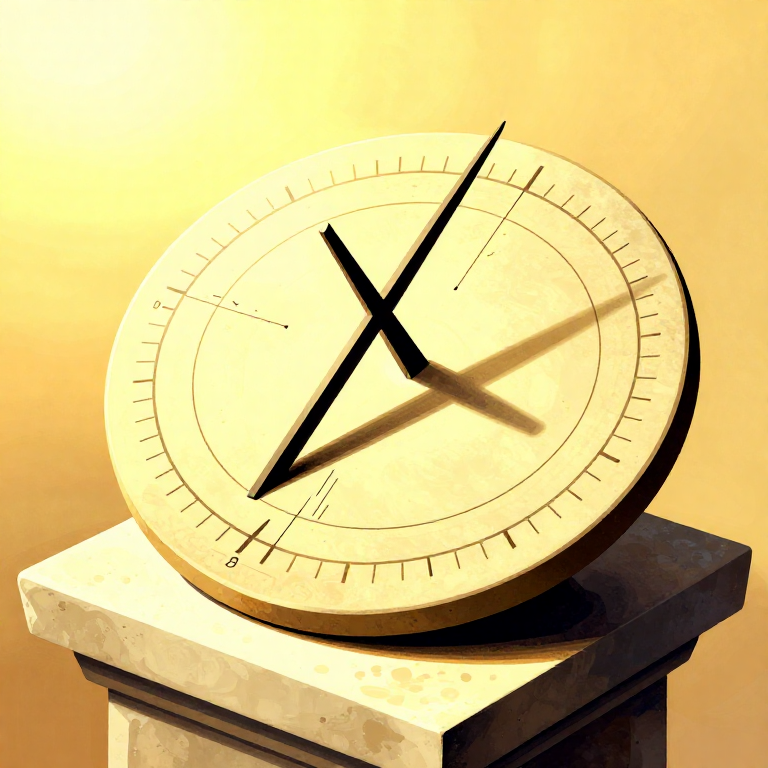
Install the sundial permanently on a flat stone pedestal in an open location with unobstructed sunlight from sunrise to sunset. Level it precisely using a plumb bob and spirit level. Orient the gnomon due south by aligning it with the shadow at solar noon (when the shadow is shortest). Once correctly positioned, the sundial will display the time of day as the shadow point moves across the hour lines, accurate to within approximately 10-15 minutes. Numerous Greek sundials survive in museum collections and at archaeological sites — the Tower of the Winds in Athens (1st century BCE) featured multiple sundial types on its exterior walls. The hemispherical sundial was the most accurate fixed sundial type available in the ancient world, and versions of it remained in use through the Roman period and into the medieval Islamic world, where sundial mathematics reached its highest development.
Материалы
4- 1 block штукаЗаполнитель
- small amount штукаЗаполнитель
- 1 rod, 5-8 cm long штукаЗаполнитель
- 1 штукаЗаполнитель
Требуемые инструменты
10- Заполнитель
- Заполнитель
- Заполнитель
- Заполнитель
- Заполнитель
- Заполнитель
- Заполнитель
- Заполнитель
- Заполнитель
- Заполнитель
CC0 Общественное достояние
Этот чертёж выпущен под лицензией CC0. Вы можете свободно копировать, изменять, распространять и использовать эту работу в любых целях без запроса разрешения.
Поддержите мейкера, покупая товары через его чертёж, где он получает Комиссию мейкера установленную продавцами, или создайте новую итерацию этого чертежа и включите его как связь в свой чертёж для распределения дохода.