

Pogo Stick
Jump on the spot and every landing throws away the energy you put into the jump — it thuds into the ground and is gone, so each hop starts from nothing. What if the landing could store that energy and hand it straight back to launch the next hop?
That is exactly what a pogo stick does. It is a pole you stand on with a strong spring at its foot. When you come down, your weight compresses the spring, storing the energy of the fall; an instant later the spring pushes back and flings you up again. Foot-rests carry your feet, a handle steadies you, and a rubber tip grips the ground.
Because the spring returns most of the energy of each landing, you only have to add a small push at the bottom of each bounce to keep going — the spring recycles the rest, so a rider can hop steadily for as long as they like.
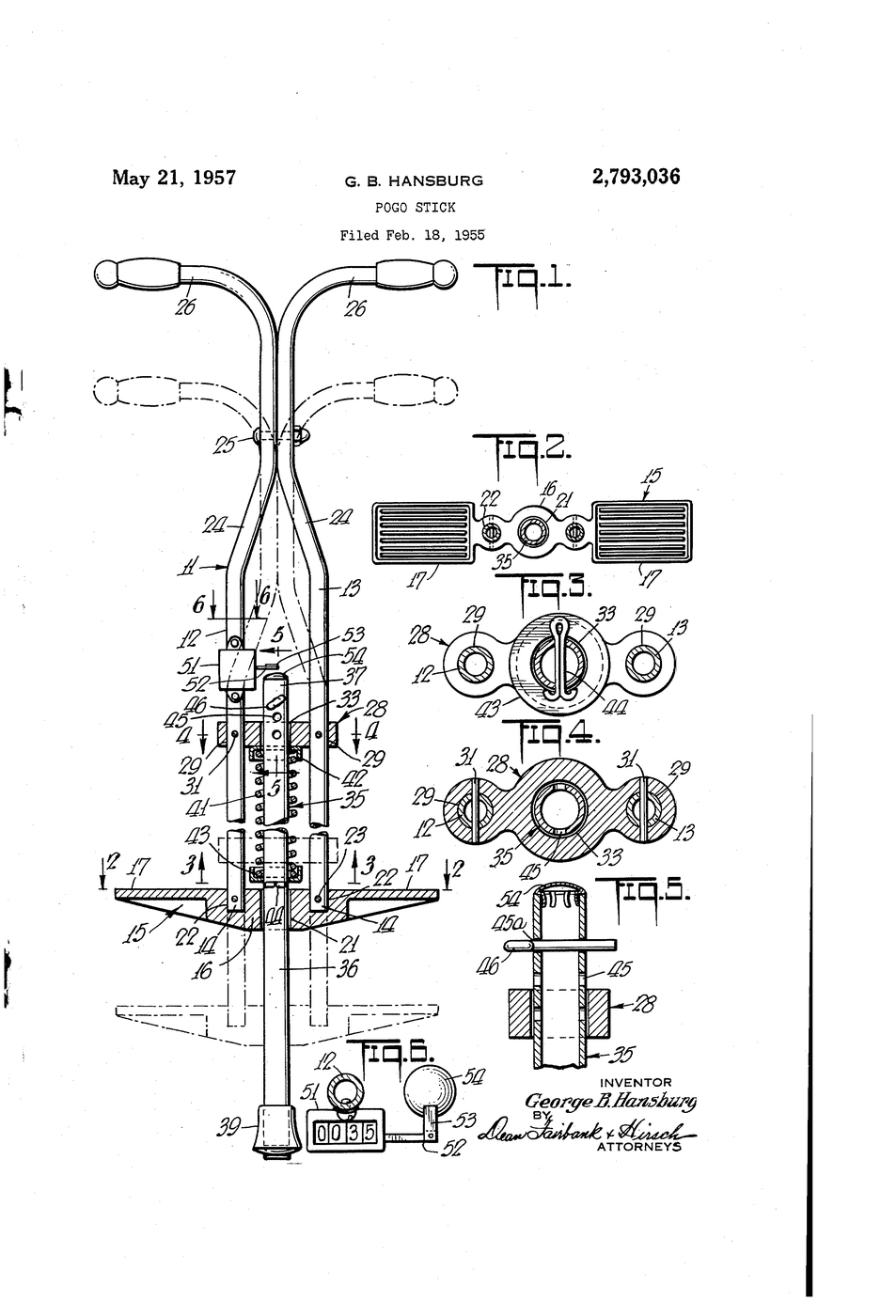
US Patent 2,793,036, "Pogo Stick", granted 21 May 1957 to George B. Hansburg, whose earlier design made the pogo stick a craze in the 1920s.
Инструкции
Read the claim: a spring that stores the landing
Read the claim: a spring that stores the landing
Hansburg claims a pole with foot-rests and a compression spring at the foot that stores the energy of each landing and returns it to launch the next hop. Note: store, then give back.
Feel a spring store and return energy
Feel a spring store and return energy
Press a stout compression spring down on the table and release it: it leaps up. The push you put in came back out — a spring is an energy store.
Материалы для этого шага:
 Набор пружин сжатия1 набор
Measure the spring's strength
Measure the spring's strength
With a force meter, push the spring down a measured distance and read the force. Twice the squeeze, twice the force — the energy stored grows with how hard you compress it.
Необходимые инструменты:
 Динамометр (пружинные весы)
Build the pole and spring foot
Build the pole and spring foot
Fix the spring to the bottom of a stout pole so it can compress up into (or against) the pole and spring back — a sprung foot. Cap the spring's bottom with a rubber tip.
Материалы для этого шага:
 Деревянный шкант1 штука
Add foot-rests and a handle
Add foot-rests and a handle
Fix two small foot-rests low on the pole and a grip near the top. (For a small demonstration model, keep it hand-sized.)
Материалы для этого шага:
 Лист фанеры1 лист
Необходимые инструменты:
 Лобзиковая пила
Press down and store the energy
Press down and store the energy
Push the pole straight down onto a hard floor. The spring compresses and stores the energy of your push — you can feel it fighting back.
Release and watch it bounce
Release and watch it bounce
Let go. The spring shoves the pole back up and it hops. The energy you stored on the way down came back to launch it up.
Measure bounce height vs push
Measure bounce height vs push
Press to different depths and mark how high the model hops each time. More compression stores more energy and bounces higher — a clean energy relationship.
Count the losses
Count the losses
Drop the model from a set height and see how high it bounces back. It returns most, but not all — some energy is lost to sound, heat and the ground. A good pogo spring returns as much as it can.
Try a stiffer spring
Try a stiffer spring
Swap in a stiffer spring. It bounces harder and higher for the same push but needs more force to compress — why a child's pogo has a softer spring than an adult's.
See why you must add a push each bounce
See why you must add a push each bounce
Because a little energy is lost every bounce (step 9), a free bounce dies away. To keep hopping, the rider pushes down at the bottom of each bounce, topping up what was lost. The spring recycles the rest.
Ride a real one — safely
Ride a real one — safely
On a full-size pogo stick, ride only with a helmet, flat ground and adult supervision. Feel the same cycle at body scale: land, store, launch, top-up. The physics is exactly your model's.
History & Context — the toy that recycles a jump
History & Context — the toy that recycles a jump
The patent. US 2,793,036, "Pogo Stick", granted 21 May 1957 to George B. Hansburg. Hansburg, a toy designer, had introduced an all-metal enclosed-spring pogo stick around 1919 that sparked a 1920s craze (Ziegfeld Follies dancers performed on them); this later patent covers a refined, safer version. Earlier spring hopping-sticks existed — George Herrington patented one in the US in 1881 — but Hansburg's is the design that made the pogo stick a lasting toy.
The physics is energy storage and return. An ordinary jump is wasteful: the energy of your fall smashes into the ground as sound and heat and is lost, so every hop must be powered from scratch by your muscles. A pogo stick puts a spring in the path: on landing, your weight and speed compress the spring, and that energy is stored as elastic strain rather than thrown away (step 6); a moment later the spring un-compresses and hands the energy back, launching you upward (step 7). Because a good steel spring returns most of what it stored — it is elastic, losing only a little to friction, sound and the ground each cycle (step 9) — the rider only has to supply that small lost fraction with a push at the bottom of each bounce (step 11), and the spring recycles the rest indefinitely.
Where it sits. This trick — a spring that catches and returns the energy of a landing — is everywhere once you see it: in the tendons of a running animal (a kangaroo's legs store and return energy exactly like a pogo spring), in the soles of running shoes, in trampolines, in the suspension of a car, and in the "extreme" pogo sticks that now launch riders three metres up. Your bouncing model teaches the whole principle: don't waste the landing — store it, and spring back.
Материалы
3- 1 наборЗаполнитель
- 1 штукаЗаполнитель
- 1 листЗаполнитель
Требуемые инструменты
2- Заполнитель
- Заполнитель
CC0 Общественное достояние
Этот чертёж выпущен под лицензией CC0. Вы можете свободно копировать, изменять, распространять и использовать эту работу в любых целях без запроса разрешения.
Поддержите мейкера, покупая товары через его чертёж, где он получает Комиссию мейкера установленную продавцами, или создайте новую итерацию этого чертежа и включите его как связь в свой чертёж для распределения дохода.